




Trade unions representing employees of South Sudan’s main oil operating companies on Friday called for the suspension of a government directive enforcing contributions to the National Social Insurance Fund (NSIF), saying key legal and administrative requirements have not been met.
In a statement extended to Radio Tamazuj, unions representing workers at Dar Petroleum Operating Company (DPOC), Greater Pioneer Operating Company (GPOC) and Sudd Petroleum Operating Company (SPOC) said they support the establishment of the social insurance fund and the provision of retirement, disability and survivor benefits for workers.
However, the unions said the implementation process did not comply with provisions of the National Social Insurance Fund Act 2023.
They said the law requires the establishment of a Board of Trustees before the appointment of a Managing Director, and questioned the legality of appointing the fund’s chief executive before the board had been constituted.
The unions also criticized a directive issued by a senior official at the Ministry of Labour ordering compliance with the fund, saying it was issued before the publication of contribution rates, remittance procedures, designated bank accounts, employer and employee registration processes, and individual worker accounts.
They said the move was inconsistent with provisions of the NSIF Act governing registration, record-keeping, deductions, collection and payment procedures.
The workers’ representatives called on the Ministry of Labour to suspend enforcement of the directive until the law is fully implemented and a phased rollout framework is established.
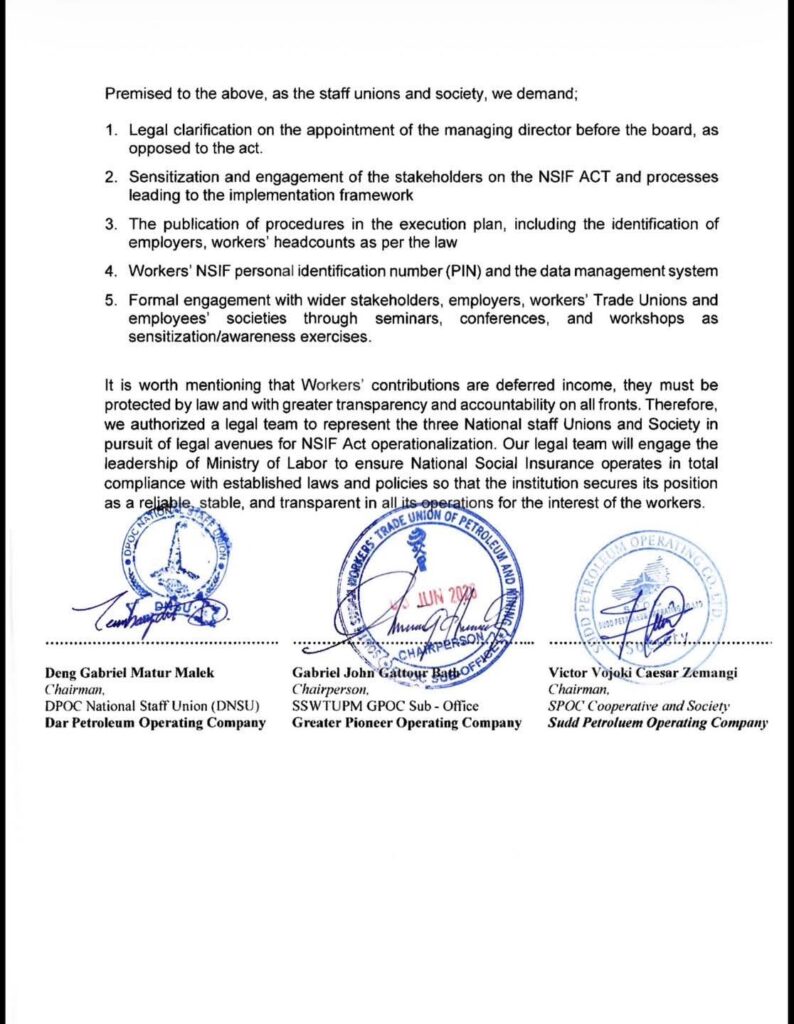
The unions also demanded clarification on the appointment of the Managing Director, publication of implementation procedures, issuance of workers’ personal identification numbers under the scheme, and wider consultations with employers, trade unions and employees through seminars, workshops and conferences.
The statement said the unions had appointed a legal team to pursue legal avenues to ensure the fund is implemented in compliance with the law and relevant regulations.
South Sudan passed the National Social Insurance Fund Act in 2023 as part of efforts to establish a national social security system for workers in both the public and private sectors.
The dispute follows a Ministry of Labour circular issued in April 2026 that revoked Circular No. 03/2010, which had allowed employers to retain and manage social insurance contributions.
The new directive ordered all employers, including private firms, NGOs, UN agencies and diplomatic missions, to deduct and remit both employer and employee contributions directly to the NSIF on a monthly basis.
The ministry said the measure was intended to operationalise the NSIF Act and strengthen social protection, while warning that compliance was mandatory. Employers were instructed to clear any outstanding contributions and await further guidance on contribution rates, designated accounts and registration procedures from the fund’s management.
However, the rollout has drawn scrutiny from legal experts and stakeholders who say key requirements, including employer and employee registration, issuance of social insurance numbers and establishment of enabling regulations, should precede full enforcement of deductions and remittances.
The National Ministry of Labour was not immediately available to comment on the oil workers’ statement.

 and then