



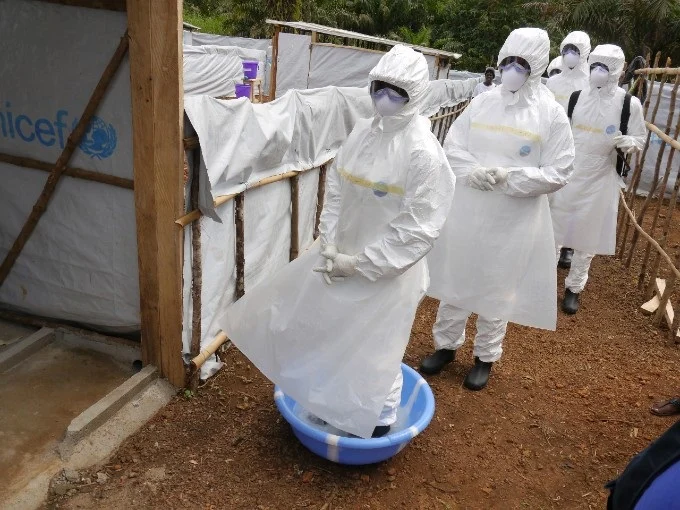
The health authorities in Central Equatoria State’s Morobo County said they have reinforced measures to deal with Ebola after a suspected case was registered in neighboring Democratic Republic of Congo’s (DRC) Ingbokolo area, just 20 kilometres away.
On Monday, a suspected Ebola patient died within 24 hours after developing symptoms consistent with the disease in Ingbokolo.
James Malish, the county’s health director, told Radio Tamazuj that they were alerted about the death of the suspected Ebola patient and that it puts residents at risk due to the proximity of the area and porous borders.
“On Monday, I received a call from Ingbokolo, DRC, where a suspect who came from Bunya through Ariwara to Ingbokolo died 24 hours after developing Ebola-like symptoms. This is very critical for us because we are just about 20 to 25 kilometres from Ingbokolo,” he said. “As you can see, the entry point [border] does not even have a barrier. Our people are at risk because we do not have the support to address this situation. We have three entry points here through which businesswomen from Juba cross to DRC, so we are at risk as a country.”
“I appeal to the government and non-governmental organizations to intervene and support us,” Malish added.
He said that despite forming a county Ebola task force, there has been a low response in supporting them with protective gear.
“We have done our assessment, formed our committee headed by the commissioner, and created a Rapid Response Team. We identified at least eight points of entry at which we are supposed to put people who can screen travellers to identify suspected cases,” he said. “We have shared our reports with the state and national health ministries. However, we lack finances for training and orienting the teams, and for operations.”
Meanwhile, Morobo County Commissioner Joseph Mawa appealed for support.
“Everyone is aware of the Ebola outbreak in DRC and also in Uganda. This is a deadly disease that is not to be tolerated. As the leadership of the county, we have taken measures to stop the spread, and with help from the WHO, we have an Ebola Task Force which is working, and they have set up screening points at entry points to DRC and Uganda,” he said. “We also have porous entry points like Kaka, Odotla, and Bazi, which IOM will soon cover. The staff is already prepared to set up the screening points.”
The commissioner urged travellers to move through authorized entry points so that they can be screened, saying this will check the spread of Ebola.
Ebola Virus Disease is a severe and often fatal illness caused by infection with the Ebola virus. The disease spreads through direct contact with the blood or bodily fluids of an infected person, as well as contaminated surfaces and materials. Symptoms can appear between two and 21 days after exposure and commonly include fever, fatigue, headache, vomiting, diarrhea, and, in severe cases, bleeding.
According to the World Health Organization, the current outbreak affecting the DRC and Uganda is caused by the rare Bundibugyo strain of the Ebola virus, for which there is currently no licensed vaccine or specific treatment. As of June 9 2026, the WHO reported 515 confirmed cases, including 91 deaths, in the DRC and 19 confirmed cases, including two deaths, in Uganda. All cases reported in Uganda have been linked to transmission originating from the DRC.
Although South Sudan has not recorded any Ebola cases linked to the current outbreak, health authorities classify the country as being at high risk due to its proximity to affected areas and the movement of people across borders.
Officials emphasize that misinformation and stigma can undermine response efforts. They urged communities to remain vigilant, seek information from trusted sources, and report any suspected symptoms immediately to the nearest health facility.

 and then