



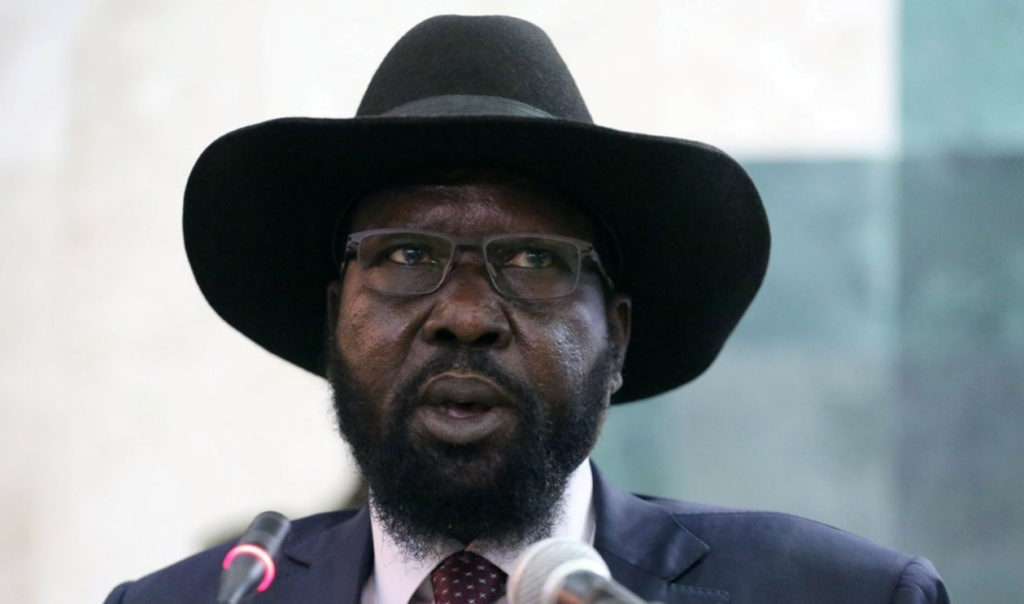
South Sudan President Salva Kiir Mayardit has dissolved the transitional unity government established under the 2018 peace agreement, including the national legislature and state governments, removed First Vice-President Riek Machar and all four Vice-Presidents from office, and appointed a caretaker administration ahead of elections scheduled for Dec. 22, 2026.
The changes were announced in a Republican Order issued by Kiir on Tuesday evening and read on state-owned South Sudan Broadcasting Corporation (SSBC).
Under the order, issued in accordance with the National Elections Act, 2012, as amended in 2026, Kiir will remain president throughout the electoral period until a newly elected president is sworn in. The First Vice-President and all Vice-Presidents have been relieved of their positions with immediate effect.
Presidential advisers and presidential envoys will continue to serve under the authority of the president, according to the order. Kiir also appointed former speaker of parliament Joseph Ngere Paciko as adviser on governance after he lost his position following the dissolution of parliament.
“All substantive National Ministers and Deputy Ministers are hereby relieved of their portfolio duties,” the order says, while directing ministries and other government institutions to continue operating under an interim or caretaker structure.
Kiir appointed caretaker ministers to oversee key ministries, including presidential affairs, cabinet affairs, foreign affairs, defence, interior, justice, national security, finance, petroleum, trade, information, East African Community affairs and peacebuilding.
The order also dissolves the Transitional National Legislative Assembly and the Council of States.
At the subnational level, the 10 state governments and state legislative assemblies have been dissolved. The administrations and legislative councils of the three administrative areas have also been dissolved.
Caretaker ministers
Kiir appointed the following caretaker ministers at the national level: Africano Monde Gedima, minister of presidential affairs; Martin Elia Lomuro, minister of cabinet affairs; Cecilia Adut Manyok, minister of foreign affairs; Ayor Akuoch Anok, minister of defence; Rizik Zakariah Hassan, minister of interior; Wek Mamer Kuol, minister of justice; Obuto Mamur Mete, minister of national security; Athian Diing Athian, minister of finance; Awou Daniel Chiang, minister of petroleum; Labanya Margret, minister of trade; Ateny Wek Ateny, minister of information and ICT; Michael Makuei Lueth, minister of East African Community Affairs; and Stephen Par Kuol, minister of peacebuilding.
Kiir also appointed three deputy ministers: Philip Jada Natana as deputy minister of foreign affairs; Marial Chanuong Yol as deputy minister of defence; and David Marial Gumke as deputy minister of interior.
Caretaker governors
Kiir separately appointed caretaker governors for the 10 states. The appointments include Agustino Wani Jadallah for Central Equatoria, Louis Lobong Lojore for Eastern Equatoria, Moses Majok Gatluak for Jonglei, Riny Tueny Mabor Deng for Lakes, Charles Madut Akol for Northern Bahr el Ghazal, Dr Joseph Nguen Monytuil for Unity, James Koang Chuol for Upper Nile State, Bol Wek Agoth for Warrap, Sherif Daniel Sherif for Western Bahr el Ghazal, and Daniel Badagbu Rembisa for Western Equatoria.
The president also appointed caretaker chief administrators for the three administrative areas. The appointed chief administrators are Charles Jok Abyei for the Abyei Administrative Area, Joseph Boboya Ngere for the Pibor Administrative Area, and Daniel Makuei Thiyier for the Ruweng Administrative Area.
At county level, the order relieves all county commissioners of their political and policy duties pending the appointment of interim commissioners. Outgoing commissioners may only perform functions necessary to maintain essential services, public order and administrative continuity.
The Republican Order says independent commissions, organised forces, the judiciary, civil service and other institutions whose continued operation is required by law will remain functional.
It also places restrictions on caretaker officials, including a prohibition on entering into long-term international agreements, incurring substantial public debt, entering strategic concession agreements or disposing of public assets without presidential authorisation and compliance with the law.
The order further requires officials serving during the caretaker period to remain politically neutral and not use public office, government resources or state institutions to promote or disadvantage political parties or candidates.
The caretaker arrangement is to remain in force until the elected president, national legislature and elected state, administrative-area and local authorities assume office, unless the order is amended or revoked.
The dissolution comes a day after Kiir signed amendments to the election law, removing legal obstacles that had previously linked the conduct of elections to the permanent constitution-making process and a national population census.

 and then