



The National Constitutional Review Commission (NCRC) has called on journalists to actively participate in its ongoing civic education and public consultation exercises, describing the media as a critical pillar in shaping the country’s permanent charter.
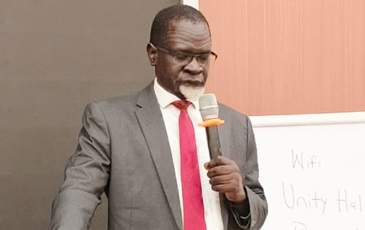
Speaking during a two-day workshop in Juba exclusively organized for the media fraternity on Friday, NCRC Secretary-General John Natana Abraham and Commission Chairperson Dr. Riang Yer Zuor emphasized that the media’s views are vital for establishing a durable legal framework that addresses the core socio-economic and political rights of South Sudanese citizens.
The Commission provided a comprehensive progress report on its nationwide deployment under the Constitution-Making Process Act and said it divided its operations into 13 distinct sectors—covering the ten states, three administrative areas, and national institutions. It said specialized subcommittees were deployed to each area and institution.
“At this stage, we can confidently say we have covered the entire country,” Dr. Zuor announced. “What we are doing today is part of our civic education and public consultations with national institutions.”
He challenged journalists to look beyond press freedom and media-specific policy, urging them to contribute broadly to national thematic areas.
“It is vital that your views as the media community are heard,” Dr. Zuor stressed. “Furthermore, as citizens of South Sudan, we want you to provide your perspectives on all issues important to our people—do not limit yourselves strictly to media-related topics.”
With the introductory protocols concluded on the opening day of the institutional phase, the chairperson noted that the workshop would bypass further formalities and proceed directly into technical presentations and data gathering. The views compiled from the media fraternity will be systematically processed and forwarded to the upcoming Constitution Drafting Committee.
Meanwhile, the NCRC Secretary-General John Natana Abraham framed the ongoing permanent constitution-making process as a monumental milestone in the country’s history, honoring generations of struggle.
“This is a historic moment—a moment you have been waiting for, and one our great-grandparents wished to see,” he said. “They sacrificed their lives many times during the 17-year war, and again during the 21-year war of liberation.”
He noted that the long journey toward independence—stretching from the 1972 Addis Ababa Peace Agreement to the 2005 Comprehensive Peace Agreement (CPA) and the subsequent 2011 referendum—was fought to secure fundamental rights.
“Now is the time for us to collectively entrench and enshrine those rights in our Constitution,” Abraham urged, reminding the media that the Constitution is a legally enforceable document that must be taken seriously. “As the media, you are the eyes of the people, and we expect a lot from you at this stage.”
Abraham further clarified that the consultations are part of a phased process, with a technical drafting committee, the National Constitutional Conference, and subsequent legislative stages still to come.

 and then