



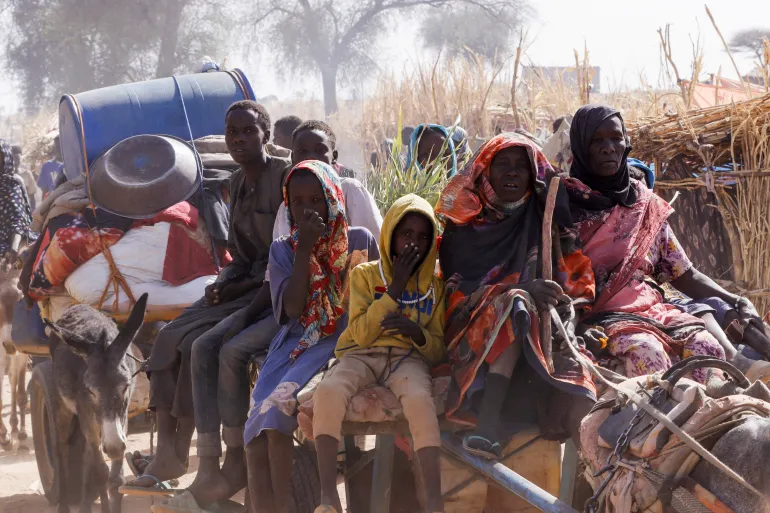
The town of Tawila in Sudan’s North Darfur State is witnessing a rapidly growing influx of families displaced by armed conflict, insecurity and drought, as humanitarian actors warn of a looming deterioration in living conditions amid acute shortages of essential assistance.
The General Coordination of Displaced Persons and Refugee Camps in Sudan said in a statement issued by its spokesperson, Adam Rijal, that between 23 and 27 September, the area received 275 families comprising 1,390 people from Dar El Salam, Dar Al- Simayat and Fawz Al-Naeem in North Darfur, as well as six families from Nyala in South Darfur.
The statement said the latest arrivals brought the cumulative number of displaced people who have reached Tawila since the beginning of September to 909 families, comprising a total of 4,797 people.
Mohamed Adam Mohamed Abdalla, who was displaced from Karkab village, said conditions in his area had become highly unstable due to insecurity and acute water shortages.
“We arrived in Tawila without necessities, hoping to receive humanitarian assistance and support,” he lamented. “Hunger also compelled us to flee.”
Hawa Ishaq, a displaced woman, said the war and the loss of lives, property, and husbands had forced them to flee.
“We travelled long distances on foot before a truck transported us from Mellit to Tawila for 70,000 Sudanese pounds per passenger. Families are now living in extremely difficult conditions and sharing the limited shelter available,” she said. “After our circumstances became extremely difficult, I heard that there was assistance for displaced people in Tawila, so we decided to come here. It is an area we had never visited before.”
Meanwhile, Hassan Mohamed Ahmed, also from Karkab, said hunger, the destruction of crops, insecurity, and water shortages were the immediate reasons for their displacement to Tawila. He said they are now without adequate shelter and are sleeping in the open under the rain.
“The famine-like conditions forced us to flee to Tawila after all means of earning a living in our area had disappeared,” he bemoaned. “We arrived in Tawila, and we have nowhere to stay.”
The newly arrived families are facing a complex set of humanitarian challenges, compounded by sharp increases in the prices of essential commodities and declining purchasing power, as well as major gaps in shelter, healthcare, sanitation and access to safe drinking water.
The General Coordination renewed its appeal to regional and international humanitarian organizations and donors to intervene urgently to strengthen the humanitarian response and bridge the widening gap between growing needs and available resources, ensuring the delivery of life-saving assistance and averting further deterioration in Darfur and other regions of Sudan affected by the war.

 and then