



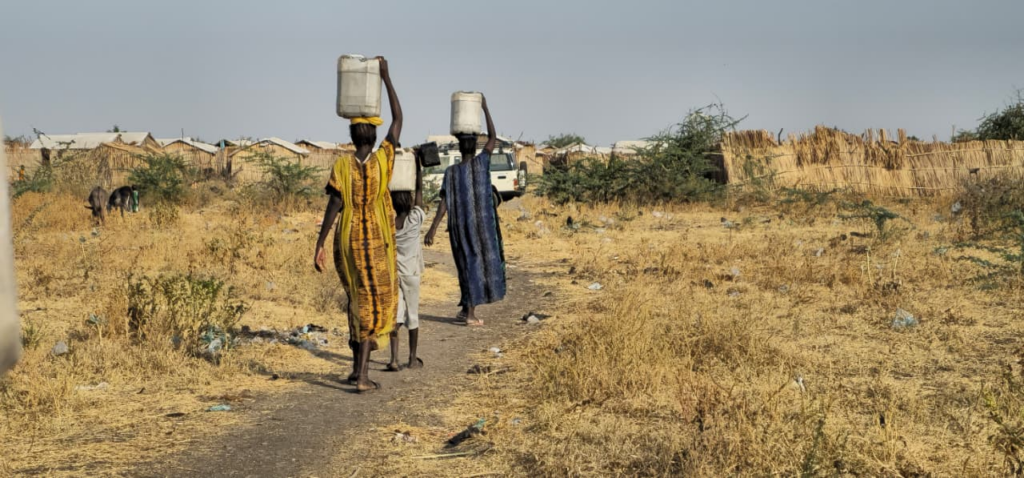
For women in Rijong Payam, getting water can mean walking for three hours.
The wells they depend on are often far from their homes, and finding a suitable place to dig a new one is itself a challenge.
Sarah Teresio Wala, who represents women in Rijong Payam in Terekeka County, said access to water is one of the biggest problems facing the community.
“We do not have water in our payam. Our land is dry,” Wala said. “It is only good during the rainy season, but when it is dry season there is no water.”
The problem is particularly difficult for women during pregnancy and after childbirth.
Some women move closer to wells or other water sources when they are preparing to give birth, Wala said. But doing so can leave them far from their homes and food supplies.
“Due to lack of water and also distance, we women have to move close to the wells and the water body for those who are going to give birth,” she said.
“We end up facing the challenge of moving long distances to get food to the area.”
For women who remain at home, the lack of water can also make basic hygiene after childbirth difficult.
Wala said some women rely on traditional methods of cleaning themselves because there is not enough water.
“Most of the women who give birth now use the traditional way of cleaning themselves,” she said.
Wala attributed illness and deaths among some women after childbirth to poor hygiene and a lack of water, although she did not provide figures to support the claim.
“Many women die due to poor hygiene because after giving birth, the women don’t bathe due to lack of water and they end up getting sick and they die,” she said.
Rijong Payam also has no hospital, Wala said.
“I request the NGO for support on the issues of the lack of water in our community. And the other difficult thing is access to health. We don’t have a hospital in our payam,” she said.
Even when women receive medical assistance, the lack of water remains a problem, she said.
“Even if the doctor helps the women, still without water it is difficult,” Wala said.
Water Scarcity
The community relies largely on groundwater wells for drinking water.
But the water is not always close to home.
“We normally dig groundwater wells and that is how we get water for drinking,” Wala said. “But that is also a big challenge because we have to look for a better place to dig the groundwater well and in most cases the areas are very far from our homes.”
The distance means women can spend hours traveling to collect water.
“We have to move or walk for three hours in order to reach the groundwater wells to get water,” she said.
Wala said the problem receives little attention.
“Nobody speaks up about these issues to the government or even the NGOs,” she said.
She also said government officials face limitations in responding to the community’s needs.
But water is only part of the problem.
The changing conditions are also being felt in the fields.
Dry Fields
During the rainy season, farmers in Terekeka depend on the land for food and income.
But Wala said rainfall is often insufficient, while intense heat dries out crops.
“Sometimes even during the rainy seasons there is no flooding here, but the biggest challenge now is that crops don’t grow because of little or no rain,” she said.
“There is no flooding because the sun is much and when there is a lot of sun, the crops dry up during that time.”
“The area is very dry, so crops don’t grow.”
Farmers, she said, are increasingly producing only enough for their own families.
“Farmers are now struggling because they can only farm for home use and they don’t sell the crops,” she said.
For a community that depends on farming, a poor harvest can mean less income and fewer options when food becomes scarce.
Peter Ladu Paul, acting coordinator of the Relief and Rehabilitation Commission in Terekeka County, said food security is already a concern.
He said rainfall has become difficult to predict and families are struggling to produce enough food.
“The truth is climate shocks are making humanitarian needs bigger every year,” Ladu said.
He said the response should focus on preparing communities before a crisis rather than waiting for one to happen.
“This workshop of inception is timely because it shifts us from responding to crisis to prepare before crisis,” he said.
Ladu said early warning systems are particularly important.
“As we start this program, I ask all of us to focus on early warning system,” he said.
He also stressed that both the government and communities have roles to play.
“Government must lead,” Ladu said. “Community must be also in the centre.”
Nile Basic
Terekeka’s water challenges are part of a broader regional context.
South Sudan is part of the Nile Basin, where water resources cross national borders and support farming, livestock, fishing and other livelihoods.
Yet being part of the basin does not necessarily mean that water is easily accessible to people in every community.
In Rijong, women can still walk for hours to reach a groundwater well.
The community also faces increasingly difficult conditions for farming, according to local residents.
Wani Steven of the African Democracy and Resilient Network, or ADRNET, said those pressures were among the reasons Terekeka was selected for a new climate adaptation project.
The project aims to strengthen the capacity of government and communities to adapt to climate change.
Wani said Terekeka was selected because of its vulnerability to climate-related shocks.
“This project is strengthening the capacity of government and communities in South Sudan to adapt to climate change in Terekeka County,” he said.
“The overall objective of the project is to reduce vulnerability of the community to climate change in South Sudan, and its goal is to scale adaptation to promote, sustain peace and community or economic growth,” he said.
The project will work with different groups in the county, including traditional leaders, youth, women, churches and government officials.
“We are going to talk to the chief, we are going to talk to the youth, we are going to talk to the women group, we are going to talk to the leaders, we are going to talk to the church,” Wani said.
“Climate change affects everyone.”
But Wani also stressed that the project is intended to belong to the people it serves.
“This project is yours,” he told community members.
Climate Action
The project will establish water committees and work with women and farmers on climate adaptation.
“We are going to form water committees,” Wani said. “We are going to work with the women group, particularly the farmers.”
It also includes plans to protect community forests and restore degraded land.
“We are going to protect our community forests,” he said.
Project organizers say they intend to restore 200 hectares of land in Terekeka and establish two nursery sites to raise seedlings for community planting.
They are targeting about 12,000 people, with 3,000 seedlings planned for planting in the first year.
The nurseries are expected to continue operating during the project before being handed over to the county.
Wani said the project is also intended to help communities withstand drought, flooding and food insecurity.
But he said communities must also take responsibility for protecting the environment.
“If there is no rain, because we are contributing,” he said.
“If it is hot, we are contributing to that.”
He pointed to poor waste management, a lack of toilets and tree cutting as some of the practices contributing to environmental problems.
“Because at times we cut the trees every time,” he said.
“So the community forest is our responsibility with you to see that every tree in Terekeka is protected.”
Tree Planting
Asunda Paul Laku, chairperson of the women’s association in Terekeka County, said the training had changed how she viewed the environment.
She said she had learned more about climate change and the role communities play in protecting their surroundings.
“I realized that we humans are the ones causing it,” Laku said.
One of the biggest lessons, she said, was the importance of trees.
“We cut the trees yet it is the same trees that save us,” she said.
People cut trees for charcoal, she said, without fully understanding their value.
“We didn’t even know the value of trees.”
Now she wants that to change.
“But now we have learnt that the trees are very important,” Laku said. “We should not be cutting the trees anyhow because the trees produce for us rain, shade.”
She wants climate training extended across all 10 payams of Terekeka.
“We want the NGOs to continue training all the 10 payams in Terekeka so that people can stop destroying the forest,” she said.
She said awareness is one part of the solution, but the community still needs practical support.
For women in Rijong, water remains the most immediate concern.

 and then