



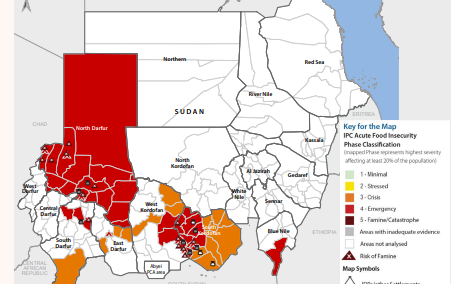
Sudan faces a growing risk of famine in parts of Greater Darfur and Greater Kordofan as conflict, displacement and severe drought worsen food insecurity and malnutrition, the Integrated Food Security Phase Classification (IPC) said on Monday.
New evidence points to deteriorating nutrition conditions in several localities, including areas previously identified as at risk of famine in a worst-case scenario for October 2026 to January 2027, the IPC said in an alert.
The warning comes as humanitarian operations face severe funding shortages, insecurity and restrictions on aid access, particularly in Greater Kordofan, limiting efforts to reach people in need.
In Greater Darfur, 13 of 17 nutrition surveys conducted since January recorded critical levels of global acute malnutrition, while six found prevalence above 20%, according to the report.
A survey conducted in August and September in four camps for internally displaced people in Eastern Jebel Marra, South Darfur, found global acute malnutrition among children aged six to 59 months at 38% in one camp and 30.8% in another.
Nearly a quarter of households surveyed reported severe hunger, while about two-thirds had poor food consumption scores. Death rates were at emergency levels, the report said.
In Nyala, the proportion of children accessing nutrition services who were admitted for severe acute malnutrition rose from 5.2% in January to 11.4% in August. In Kas locality, the proportion increased from 4% to 17.4% between January and June.
Admissions for severe acute malnutrition in Um Baru, North Darfur, remained nearly twice the levels recorded in 2025. In Al Malha, admissions increased more than eleven-fold, while At Tina and Kernoi also reported high numbers, the IPC said.
North Darfur continues to face severe food insecurity, with delayed rains damaging crops and forcing displaced farmers to rely on markets for food. Food stocks are critically low, and high prices reflect increasing scarcity.
Tawila, which hosts more than 650,000 internally displaced people, could receive further arrivals as people flee neighbouring areas in search of food, water and basic services, the report said.
Conflict threatens harvests
More than 300,000 people have been displaced across Greater Kordofan since October 2025, disrupting agricultural activities and limiting access to livelihoods, according to the IPC.
Fighting in North Kordofan has driven farming communities towards El Obeid, where damaged infrastructure, strained services and restricted humanitarian access have increased pressure on residents and displaced people.
In South Kordofan, fighting in Heiban locality and attacks on Kauda and surrounding villages have displaced thousands during the planting season, forcing people into remote areas of the Nuba Mountains where poor rainfall is further undermining agricultural production.
The IPC cautioned that lower numbers of malnutrition admissions reported in North and South Kordofan did not necessarily indicate improved conditions, citing limited access to health services and gaps in reporting.
Severe drought associated with El Niño is compounding the effects of the conflict. Poor vegetation growth was recorded across 64% of croplands in North Darfur and about half of croplands in South Darfur, West Kordofan and South Kordofan, the report said.
Severe water deficits affected all or nearly all croplands in the four states, leaving limited prospects for agricultural recovery. Failed rains and poor crop growth are expected to reduce harvests, push cereal prices higher and cut household incomes from farming and livestock.

 and then