



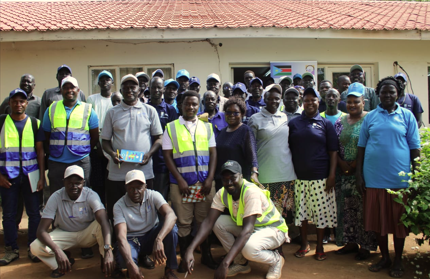
The National Ministry of Water Resources and Irrigation, with funding from the World Bank, concluded a three-day training on gender-based violence (GBV) in Rumbek on Friday, attended by 45 participants from government institutions, the community, and project stakeholders across Lakes State.
The training, which targeted members of the Grievance Redress Mechanism (GRM) and State Project Coordination Committee (SPCC), is part of the implementation of the Regional Climate Resilience Program for Eastern and Southern Africa (RCRP) to strengthen climate resilience, particularly in flood-prone areas.
Climate-related shocks such as flooding have increased social vulnerabilities, including risks of Gender-based Violence (GBV) and Sexual Exploitation and Abuse (SEA), especially among women, girls, and displaced populations.
The training focused on understanding GBV and SEA; prevention strategies and codes of conduct; survivor-centered response approaches; reporting mechanisms and referral pathways; and the roles of SPCC and GRM committees in prevention and response.
Sawsan Omer Kmail, the acting director for Gender in the Ministry of Gender, Child and Social Welfare, who is a member of the National Technical Working Group, told Radio Tamazuj on Friday that she appreciated the discussions by the participants and urged them to encourage the community to report gender-based violence.
“We are actually also learning from you (participants) because learning is two-way. We learned from the Rumbek Community. I hope you go with this knowledge and share it. You now have skills that you can use to convince the survivors to go and report,” she said. “Finally, I would like you to continue with this spirit by loving your community despite the challenges that we know the government is going through. Civil servants have not been paid a salary for two years, and we do not know until when, but I am encouraging you to continue with the same spirit, so that we can support our community with issues of development.”
“You have to use the knowledge you got here, and you monitor sexual exploitation and abuse through the processes that you learned,” Omer added.
For his part, Mager Anyuon Thuc, the Director General in the Lakes State Ministry of Land, Housing, and Public Utilities, said the training was to create awareness about the project and appreciated the facilitators from Juba.
“This training is about what we are going to do in this phase at the project site,” he said. “We need to implement the project as instructed by the World Bank.”
Nikoneria Makuer Nyinde, the Director General in the State Ministry of Local Government, said addressing gender-based violence was a project requirement.
“There was a hot argument on the topic GBV, with some arguing that human beings are not perfect. However, it is human beings making all kinds of crimes. We have been discussing the issues of sexual exploitation,” he said. “We have no mandate to see into it that these acts are stopped somewhere, but we are talking about GBV in implementing a World Bank project, and the World Bank project is telling you that when I am in South Sudan, then human dignity must be respected, and this is the message. It is you who are going to implement the project, and you are being told to implement human dignity.”
“So, you need to be careful and accept the rule of law, which is very important in creating a good life in the world,” Makuer added.
Meanwhile, Tabitha Abiel Maktab, a woman leader who represented Wulu County, said she was happy with the training and acquired a lot of knowledge about gender-based violence.
“Rape is not good, and the rapist might also be infected with diseases, or the victim might get pregnant,” she said. “We need to respect everyone in the community. We need love and understanding at home if we want to be happy.”
On his part, Chief Kumbai Marial Kumbai said that he learned how to handle rape cases between unmarried men and girls and between husbands and wives.
“We have also been trained to extend awareness about rape and gender-based violence in the community,” he stated. “Rape traumatizes females in the community, and this is not good because it leads to deadly community conflicts across Lakes State, which claim many lives.”

 and then