



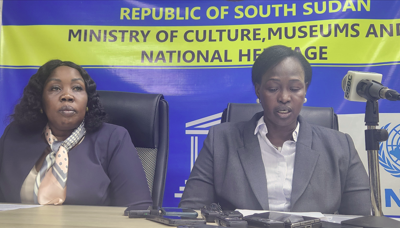
South Sudan’s Ministry of Culture, Museums, and National Heritage on Friday announced that there will be no government budget for this year’s Martyrs’ Day commemorations, citing economic constraints and preparations for the country’s upcoming elections.
Martyrs’ Day, observed annually on 30 July, honors the men and women who died during South Sudan’s long struggle for independence. The ministry urged citizens across the country to mark the occasion by candlelight vigils and prayers.
Addressing journalists in Juba, Culture Minister Sarah Nyanath said the absence of a dedicated budget should not diminish the significance of the national day, stressing that remembrance of those who sacrificed their lives for the country’s freedom should transcend financial limitations.
“As I previously stated during the observance of Liberation Day and Independence Day, our national commemorative days must never be measured by the availability of financial resources,” she said. “Their significance is defined not by expenditure but by the depth of our national gratitude, collective memory and enduring patriotism.”
She acknowledged that no specific allocation had been made for state-sponsored remembrance activities this year, attributing the decision to prevailing economic challenges, competing national priorities, and preparations for the forthcoming national elections.
Despite the funding shortfall, the minister called on state governments, the three administrative areas, county, payam, and boma authorities, religious institutions, schools, youth and women’s groups, cultural organisations, and communities across South Sudan to organise local observances.
She encouraged South Sudanese to commemorate the day through candlelight vigils, prayers, moments of silence, and community reflections in homes, churches, mosques, schools, and public institutions.
“May every candle lit become a beacon of hope, peace, reconciliation and national unity, reminding us that the sacrifice of our martyrs continues to illuminate the path toward a stronger, more united South Sudan,” Minister Nyanath stated. “As we honour those who paid the ultimate price, let us renew our commitment to peace, reconciliation, nation-building, constitutional order and service to our people.”
For her part, Victoria Julia Amon, the ministry’s undersecretary, said the media has a crucial role in ensuring that the message of remembrance reaches citizens throughout the country.
“Our presence today reflects our shared commitment to preserving our national memory, promoting unity and honoring the extraordinary sacrifices of the men and women whose courage secured the freedom and sovereignty of our country,” she said.
She urged journalists to continue reporting professionally on the planned commemorations, saying the ministry’s objective is to encourage South Sudanese to observe the day with “dignity, peace and patriotism.”
Responding to questions from journalists, Minister Nyanath rejected suggestions that those who fought for South Sudan’s independence had sacrificed their lives in vain.
“The sacrifice was not in vain. Today, we have a nation recognised among the nations of the world,” she said. “We have our own flag, constitution, national anthem and passport.”
She argued that while the country continues to face political and economic challenges, it is the responsibility of the current generation to fulfil the aspirations of those who died during the liberation struggle.
“It is up to us now to fulfil our vow that we are going to protect this nation; the responsibility now rests with the living,” she said.
The minister also revealed that the government intends to establish a national museum dedicated to preserving the country’s liberation history and honouring its heroes, although she acknowledged the project remains in the planning stages due to resource constraints.
“We are in the process. It is part of the things that are in the pipeline,” Nyanath disclosed, adding that preserving South Sudan’s history remains one of the ministry’s priorities.

 and then