



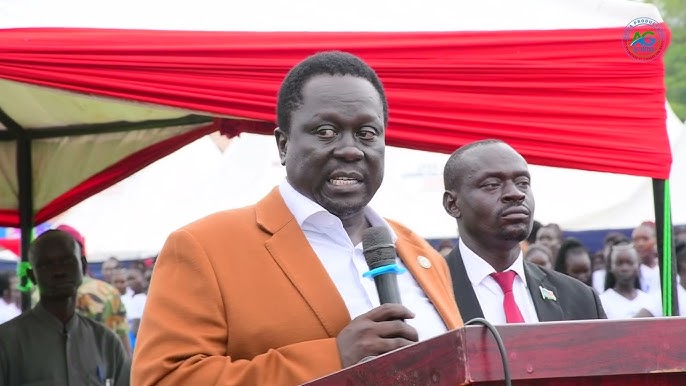
South Sudanese leaders on Friday called for a more inclusive labour system and stronger worker protections, while unveiling plans to establish a specialised Labour Court to expedite employment-related disputes in a country where legal redress for workers is often slow or inaccessible.
Speaking during International Workers’ Day celebrations at Juba National Stadium, Vice President for the Service Cluster Hussein Abdelbagi Akol said the country needed a system that “respects effort, rewards productivity and protects the dignity of every worker,” warning that failure to do so risked leaving many behind.
“We must ensure that no worker is left behind in the development of our nation,” Akol said.
Speaker of the Transitional National Legislative Assembly Joseph Ngere Paciko said parliament would step up oversight of employers and enforce labour laws more strictly, signalling increased scrutiny of workplace violations.
“Parliament will not hesitate to act against any employer who undermines the Labour Act,” Paciko said, adding that lawmakers were committed to holding both public and private sector employers accountable.
Labour Minister Anthony Lino Makana said the government was intensifying efforts to address youth unemployment through skills training programmes supported by international technical partners.
However, Makana’s main announcement centred on the creation of a specialised Labour Court, which he said was designed to address long-standing complaints of unfair dismissal, non-payment of benefits, workplace injuries and discrimination.
“For years, workers have been dismissed unfairly, mothers denied maternity leave, and employees injured at workplaces without anywhere to seek justice,” Makana said. “This situation must change.”
He said a memorandum establishing the court had already been approved and endorsed by President Salva Kiir Mayardit.
According to Makana, the proposed court will be mandated to resolve unfair dismissal cases within 60 days and enforce provisions of the Labour Act covering wages, working hours, occupational safety and social security.
The minister also said the court would prioritise cases involving vulnerable workers, particularly women facing harassment and discrimination, and would introduce legal aid for those unable to afford representation.
“The Labour Court will not only enforce the law but will also protect vulnerable workers and ensure access to justice through legal aid services,” he said.
Makana said the Chief Justice was expected to appoint judges for the new court next week, paving the way for it to begin operations.
Legal experts and labour observers have long criticised the existing judicial system for delays in handling employment disputes, arguing that weak enforcement has contributed to widespread labour rights violations and limited accountability for employers.
Central Equatoria State Governor Emmanuel Adil Anthony said Workers’ Day was an opportunity to recognise the contribution of labour to national development, while calling for improved working conditions and respect for labour rights.
“International Workers’ Day reminds us of the value of every worker in building our society,” he said.
The event brought together government officials, workers’ representatives and development partners, who underscored the need for stronger labour protections and inclusive economic growth.
International Workers’ Day, also known as Labour Day or May Day, is observed annually on May 1 to celebrate workers and the labour movement.
The celebrations come amid mounting challenges facing workers in South Sudan, including high unemployment, low wages, delayed salary payments in the public sector and a large informal economy with limited legal protections.

 and then