



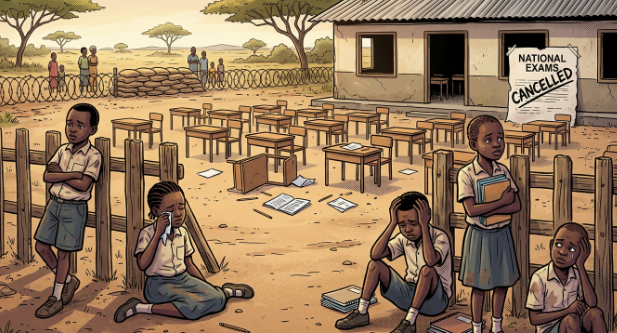
The peaceful demonstration staged by primary school students in Akobo County in Jonglei State on 14 November 2026 over uncertainty surrounding their participation in the Certificate of Primary Education examinations has sparked public debate. The incident has raised important questions about the responsibilities of the national government, the Jonglei State Government, and the Sudan People’s Liberation Movement-in-Opposition (SPLM-IO) authorities administering areas outside government control.
According to a report published by Radio Tamazuj on 14 November, the demonstration took place only two days before Primary 8 examinations scheduled to begin on 16 November, while Senior 4 examinations are due to start on 23 November. The Akobo Education Authority warned that hundreds of candidates could miss the examinations because the necessary access and coordination arrangements had not been finalized. Its education director, Peter Buom Reat, reportedly expressed concern that delays among the relevant authorities were threatening the students’ academic prospects.
While some people attribute the situation entirely to the government, others blame the SPLM-IO for failing to facilitate the participation of students living in areas under its control. There are also those who believe that both the Jonglei State Government and the SPLM-IO authorities in Akobo County share responsibility for neglecting the educational needs of these children.
In my view, responsibility should be shared by all the relevant authorities, although the precise causes of the failure must be established through a transparent examination of the decisions and communications made by each party. The national Ministry of General Education and Instruction, the Jonglei State Government, and the SPLM-IO leadership should have anticipated the challenge and established arrangements well before the commencement of the examinations. The exclusion of students should not become an unavoidable consequence of political and administrative divisions.
The Ministry of General Education and Instruction, working in coordination with the Ministry of Humanitarian Affairs and Disaster Management, relevant state authorities, UNICEF, UNMISS and other development partners, could have developed special arrangements to enable these children to sit for their examinations.
Such arrangements could have included transporting students to examination centres in neighbouring counties under government control, providing temporary accommodation, ensuring their safety and facilitating their return after the examinations. Any such plan would require agreement among the relevant authorities, parental consent, secure transportation, proper supervision and clear arrangements for the custody and distribution of examination materials.
There is a precedent for special arrangements
This is not the first time South Sudan has faced the challenge of conducting national examinations in areas outside direct government control. UNICEF’s South Sudan Humanitarian Situation Report of 30 November 2018 documented that UNICEF and its partners assisted with transporting Primary Leaving Examination papers to examination centres in SPLA-IO-controlled areas, including Akobo, Lankien, Walgak, Jiech and Fangak. This experience demonstrates that cooperation between education authorities and humanitarian partners can help overcome access challenges, even in politically sensitive areas.
A similar situation occurred in 2021, when Primary Eight candidates in Akobo missed the national examinations amid security concerns raised by the national Ministry of General Education. At the time, local teachers disputed the existence of security threats in the area, while civil society representatives called for alternative arrangements. UNMISS also offered support to facilitate access. Radio Tamazuj reported that the Ministry subsequently announced an alternative examination sitting beginning on 15 February 2021. This precedent reinforces the argument that students who miss scheduled examinations because of exceptional circumstances should be considered for an officially approved alternative sitting.
The current challenge also appears to extend beyond Akobo. Radio Tamazuj reported on 15 November 2026 that students in Panyijiar County, Unity State, had also protested over uncertainty surrounding access to national examinations. The report cited 599 registered candidates in the county: 393 Primary Eight pupils and 206 Senior Four students. It also described disagreement and security concerns surrounding a proposed arrangement to transport Primary Eight candidates to neighbouring Leer County. These developments underline the need for a coordinated national solution for students in all affected areas, rather than isolated responses to individual protests.
It is therefore unfortunate that innocent children have found themselves caught between political and administrative disagreements. Education should never be used as a political bargaining tool or sacrificed because of differences between competing authorities. These students are not responsible for the political and military circumstances prevailing in their areas. They are simply children seeking an opportunity to complete an important stage of their education and progress academically like their fellow South Sudanese.
A call for urgent intervention
I therefore appeal to UNICEF, the Ministry of General Education and Instruction, the Ministry of Humanitarian Affairs and Disaster Management, UNMISS, and other development partners to urgently engage the relevant authorities and explore practical solutions for the affected students.
One possible option would be to organize special examinations for candidates who are unable to participate in the scheduled examinations, subject to approval by the competent national examination authorities. Alternatively, additional examination centres could be established in accessible and secure locations. Such arrangements must preserve examination integrity, ensure equal treatment of candidates, and provide clear information to students, parents and schools.
The relevant authorities should also establish a standing coordination mechanism for future examinations in conflict-affected and opposition-administered areas. This should include advance registration of candidates, timely decisions on examination centres, agreed procedures for the safe transportation and custody of examination papers, contingency plans and clear lines of responsibility among national, state and local authorities.
Ultimately, the question should not be which political authority wins the blame game, but how these children can be given a fair opportunity to sit for their examinations. The government and the SPLM-IO may have different political positions, but they share a moral and national obligation to protect the interests of South Sudanese children. At the same time, any assessment of responsibility should be based on evidence about which arrangements were proposed, which were accepted or rejected, and what prevented their implementation.
These children represent the future leadership of our country. Denying them access to national examinations because of circumstances beyond their control is not only an educational setback but also a failure of collective responsibility.
The future of South Sudan must not be held hostage to the political divisions of the present.
The writer is a South Sudanese author, journalist, and university lecturer at Starford International University, Juba. He specializes in Security Studies, International Development, and Development Studies, with professional experience in public administration, anti-corruption, and governance. His writings focus on politics, peace, security, and national development. He can be reached via williamtor2011@gmail.com /+211 922 402 262.
The views expressed in ‘opinion’ articles published by Radio Tamazuj are solely those of the writer. The veracity of any claims made is the responsibility of the author, not Radio Tamazuj.

 and then