



With little capital but a determination to succeed, a young South Sudanese trader turned a small quantity of cooking oil and beans into the beginning of a business journey. Today, he is encouraging other young people to create jobs rather than wait for employment.
Before John Kennedy Clement had a business center bearing his name, before customers began recognizing his shop, and before he started dreaming of a music production studio and a bookshop, his business was little more than a modest table under a tree.
There was no sophisticated shop, no elaborate business plan, and no guarantee that customers would come. There was cooking oil, a small quantity of beans, and a young man determined to make something of himself.
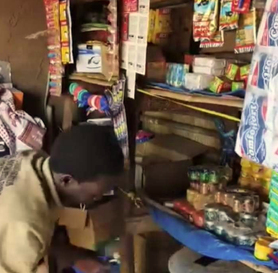
For Clement, the journey began in 2014, while he was still a secondary school student. Today, he runs John K. Business Center in Ikotos Town in Eastern Equatoria State, where he sells essential household goods and hopes to expand into new services.
His story is not simply about selling products; it is about recognizing an opportunity, starting with what is available, surviving difficult economic conditions, and refusing to allow limited resources to determine his future.
“I decided to start operating the business,” Clement recalls, explaining how a vision that his classmates had noticed in him gradually became a reality.
Even while studying, he says, his classmates recognized his ability to manage his belongings and handle money. Their observations helped him begin to see entrepreneurship as something he could pursue.
While studying during the day, Clement was invited by his brother, Tom Lususa, to look after a hotel at night while the latter travelled to Kenya. The arrangement allowed him to continue his education while taking responsibility for the hotel after dark.
Yet, in the quiet hours of the night, his thoughts were turning towards something of his own. He wanted to start a business, but he had little capital. Clement says he prayed to God for an opportunity and began thinking about placing a few items outside the hotel to start selling.
The following morning, a telephone call from his brother in Dubai brought unexpected encouragement. His brother offered to send him some money. Clement was excited. He had not spoken with his brother for quite some time, and the offer opened a door he had been hoping to find.
Rather than spend all the money on himself, he decided to put part of it towards his business ambitions. He also had a small quantity of beans that relatives had sent from his village. Instead of consuming them, he saw another possibility: they could become part of his starting stock.
He combined the money with the beans and sent them to Torit, where he obtained 20 liters of cooking oil. That was the beginning. He placed the goods under a tree and started selling, measuring out the beans and oil for customers.
For Clement, the significance of that first stock was not how much he possessed. It was that he had finally begun. He says he has learned that closing the shop out of discouragement only makes the situation harder.
“When you close, that means there will be no money coming in,” he says.
His response to difficult circumstances is straightforward: keep the business operating, even when the available stock is limited, and continue working towards something better.
He acknowledges that the economic situation can be discouraging. Yet he believes that remaining active creates the possibility of recovery and progress.
“Even if I have little,” he says, recalling the advice that helped him persevere, “you go up, continue, continue, continue.”
For Clement, persistence is not merely a personal virtue. It is part of his responsibility to the customers and community that depend on his services.
Inside John K. Business Center, the products are chosen with the everyday needs of customers in mind. Asked what he would keep if every item in the shop disappeared except one, Clement chooses cooking oil.
His reasoning is practical. Cooking oil, he explains, is an important household commodity used in daily life. He says he also welcomes customers who have very little money to spend. If someone arrives with only a small amount, he may recommend buying a sweet, one of the cheapest items available.
Clement promotes his business through Facebook, WhatsApp and word of mouth. He says its location opposite County Freedom Square also helps customers find it. He plans to install a signpost to make the business easier to identify.
He says he encourages customers and other young people to study how businesses operate, so that they too can become sellers rather than remaining only consumers. He believes that people should share knowledge and encourage others to pursue their own ideas.
“We are not selfish,” he says, explaining that he wants customers to learn from what he is doing and develop businesses according to their own visions.
His message is particularly directed at young people who may believe that the only route to success is securing employment with the government or a non-governmental organization.
Clement does not dismiss the importance of education or employment. Instead, he argues that education can also provide the knowledge needed to create a business and provide opportunities for others.
He says he has pursued business administration training through the Whittaker Peace and Development Initiative (WPDI) in Ikotos and expresses gratitude to a mentor he identified as Dudu Judith for helping guide his development. For him, the lesson is that practical experience should be strengthened by knowledge.
“Because when you do the business without knowledge you will not prosper,” he says.
His advice reflects a wider challenge facing young South Sudanese: how to turn education, skills and limited financial resources into sustainable livelihoods in a country where opportunities can be difficult to find.
Clement believes young people should learn to identify local needs, develop useful services and begin with the resources available to them. He also encourages those who earn small amounts of money to consider their future responsibilities before spending everything they receive.
Rather than immediately using their income for entertainment or other personal expenses, he urges young people to identify priorities, save where possible, and invest in activities that may support them and their families in the future. He wants them to understand that starting small is not something to be ashamed of.
Although John K. Business Center began with cooking oil and beans, Clement says he does not want it to remain limited to selling household goods. His ambitions include establishing a music production studio and a bookshop within the next five years.
He says he has also established another structure intended to accommodate a computer center, which he hopes to transfer there as the business develops. These plans remain ambitions rather than completed achievements, but they reveal the direction in which he wants to take his enterprise.
For Clement, expansion means exploring different services instead of depending entirely on one product or source of income. The idea is to build a business that can serve different needs while creating opportunities for further growth.
He also hopes that some of the services he develops in town could eventually reach people in villages, where access to business and other services may be more limited.
He says he has completed his studies and is also pursuing further education through distance learning. Yet he has chosen to continue building his business rather than treating formal employment as the only measure of success.
He believes creativity and innovation can help young people build independent livelihoods and employ others. He also warns against allowing access to political office or a government appointment to become the sole foundation of a person’s future.
In his view, people need skills and alternative livelihoods that enable them to continue contributing to society when circumstances change. He argues that when individuals depend entirely on a particular position, losing it can leave them without a clear direction.
For him, developing businesses and creating employment opportunities are among the ways people can build more secure futures.
The challenges confronting the country cannot be solved by small businesses alone. But Clement believes that a culture of creativity, investment, and self-reliance can help communities build livelihoods and reduce dependence on a limited number of employment opportunities.

 and then