



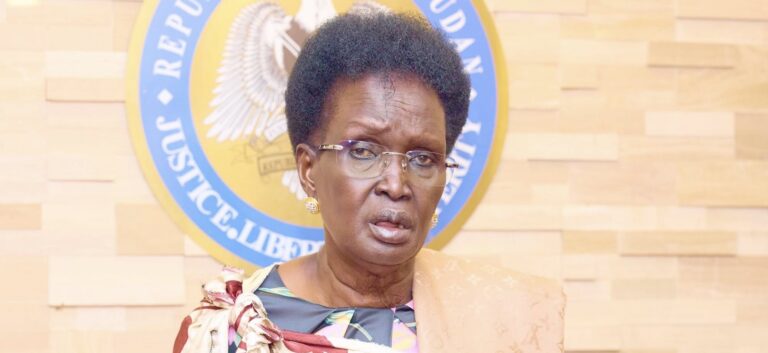
South Sudan’s Former Political Detainees (FDs) have distanced themselves from Vice President Rebecca Nyandeng’s criticism of President Salva Kiir, condemning her remarks and reaffirming their support for Kiir and the ruling SPLM.
The FDs, who are represented in the transitional government, said they were not involved in remarks made by Vice President Nyandeng during a funeral for veteran politician Kosti Manibe last month in which she questioned who was advising and overseeing Kiir.
Isaiah Hakim Garang, the FDs’ parliamentary whip and representative on the committee overseeing implementation of the 2018 peace agreement, said on Monday that the group condemns Nyandeng’s remarks and rejects any call for confrontation with the government.
“We came out as former political detainees to condemn the statement made by Mama Rebecca Nyandeng during the funeral prayers of late Honorable Kosti Manibe,” Garang told reporters in Juba.
Garang said political leaders are entitled to express their views but should not encourage citizens to act against the government.
“We know, as leaders, you have the right to express your right, but it’s not also good to incite people to go out against our government,” he said.
Nyandeng, one of five vice presidents in the transitional government and widow of late SPLM leader Dr. John Garang, questioned the country’s political direction during a requiem Mass for Manibe at All Saints Cathedral in Juba.
“When Dr. John Garang was there, those of Deng Alor, Elijah Malok, those of Kosti Manibe, all those people were there, watching. Who’s watching over President Salva Kiir now?” she said.
She also said she could sometimes go as long as two years without meeting Kiir and urged young South Sudanese to speak out against wrongdoing.
The presidency has defended Kiir’s role in the liberation struggle and said the struggle was a collective undertaking.
FDs reaffirm support for Kiir
Garang said the FDs remain committed to the SPLM and would support Kiir as the party’s candidate in the planned December 2026 presidential election.
“As former political detainees, our position is very clear. We are standing with our president Salva Kiir Mayardit and flag bearer of the SPLM,” he said.
The FDs is one of the parties to the 2018 peace agreement, which brought together the government and opposition groups in a power-sharing arrangement aimed at ending years of civil war.
The group later rejoined the SPLM, the party led by Kiir, under an agreement to reunify the party’s factions. Its members subsequently took up positions within the the SPLM, including Vice President Nyandeng and FDs leader Deng Alor Kuol.
Garang said the FDs had fully returned to the SPLM and remained committed to its leadership.
“The doctrine of our party, SPLM, cannot allow us to attack our chairman of the SPLM, or to say things against our party,” he said.
He also called on young people to reject violence and support implementation of the peace agreement.
“Don’t listen to the leaders who are encouraging you to go out or to take arms. We are here to implement the peace agreement,” Garang said.
Garang said the FDs were not responsible for anything that happened during Manibe’s funeral.
“Whatever happened, we are not part of it,” he said.
Alor recovering in Nairobi
Garang also said FDs leader Deng Alor Kuol is recovering at his home in Nairobi after being discharged from hospital following treatment for an illness.
Alor collapsed in Juba last month and was evacuated to Nairobi for medical treatment. He underwent an operation and was subsequently discharged.
“Deng was taken to Nairobi Hospital, and the operation was done by the doctors, and now Alor is in a better health condition,” Garang said.
Garang thanked Kiir for facilitating Alor’s medical evacuation and for supporting the return of Manibe’s remains to South Sudan for burial in Lui, Western Equatoria state.
The FDs’ declaration comes as South Sudan’s political leadership faces renewed tensions ahead of elections planned for December 2026.
South Sudan gained independence in 2011 but was plunged into civil war in 2013. The 2018 peace agreement formally ended the conflict, but implementation has repeatedly been delayed. Elections are currently scheduled for December 2026.

 and then