



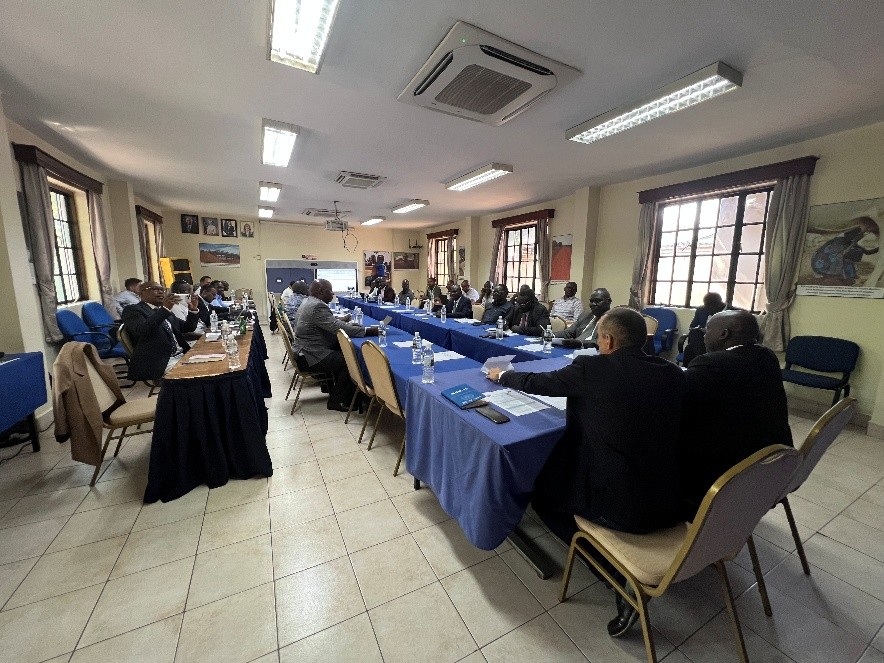
The Ministry of Agriculture and Food Security, represented by Undersecretary Dr. Michael Roberto Kenyi Legge, and the European Union (EU) convened the third Steering Committee meeting of the Green and Resilient Economy Team Europe Initiative (GRE TEI) on Monday.
The meeting brought together the relevant line ministries, co-funding donors (Germany, the Netherlands and the Swiss Agency for Development and Cooperation – SDC), as well as implementing partners. It provided a platform for coordination, oversight, and strategic guidance.
“Today’s Steering Committee confirmed the value of working together across institutions and partners to support agriculture, rural livelihoods and food security in South Sudan,” said Massimo Scalorbi, Head of Cooperation of the European Union Delegation to South Sudan. “Through the Green and Resilient Economy Team Europe Initiative, the European Union and its partners are helping to connect local production, inclusive value chains and sustainable management of natural resources for the benefit of communities across the country.”
Dr. Kenyi affirmed the Ministry’s position, saying “The Ministry is committed to accelerating the development and implementation of key policies and legal frameworks, which will provide the foundation for long-term agricultural transformation and sustainable food systems”.
The GRE TEI aims to support agriculture and rural development, while strengthening food and nutrition security and rural livelihoods, particularly in marginalised regions and among vulnerable groups, including internally displaced persons (IDPs), refugees and returnees. The initiative also seeks to create employment opportunities, especially for women and young people, and to promote climate-smart business development by improving market connectivity and fostering inclusive value chain development. All interventions are grounded in the sustainable management of natural resources, including water, land and forests.
The GRE TEI consists of six projects implemented by different partners: The Green and Resilient Agriculture and Climate Economy (GRACE) project is implemented by the Food and Agriculture Organization (FAO), the International Trade Centre (ITC) and the World Food Programme (WFP) across Central and Western Equatoria, Lakes and Northern Bahr el Ghazal States.
The Community-Driven Rural Development (CDRD) project is implemented by GIZ and SNV in Western Equatoria, Central Equatoria, Eastern Equatoria and Western Bahr el Ghazal State, and is co-funded by the EU, Germany and the Netherlands.
The Sustainable Markets and Agribusiness Competitiveness Plus (SMAC+) project is implemented by CARITAS in Central and Eastern Equatoria and is co-funded by the EU and the Swiss Agency for Development and Cooperation (SDC).
The Strengthening Pathways towards a Green and Resilient Rural Economy in South Sudan project is implemented by ACTED, FFI, ERP and CMD in the greater Bahr el Ghazal region and Western Equatoria, including in the Southern National Park.
The Supporting Sustainable Livelihoods and Conservation in the Great Nile Migration Landscape project (GNML), is implemented by African Parks Network in the Great Nile Migration Landscape, covering Boma and Badingilo National Parks and the Jonglei sector.
Finally, International Fertilizer Development Center (IFDC) implements the Green and Resilient Economy Business Incubator (GREBI) project, to stimulate entrepreneurship, value addition and the growth of micro, small and medium-sized enterprises (MSMEs) within agricultural value chains and geographical hotspots supported by the GRE partners.
With a total resource envelope of €115.6 million, this comprehensive package supports sustainable and climate-resilient economic development in South Sudan. Running until the end of 2029, the programme will contribute to improved food security, job creation, natural resource protection and stronger community resilience.
The half-day Steering Committee was structured around three thematic sessions: agricultural production and productivity, value chain development, and natural resource management and protection. During the sessions, partners presented their strategic approaches and interventions under these three pillars, while also discussing common challenges. The meeting concluded with a set of recommendations and action points to guide the next six months of GRE implementation.

 and then