



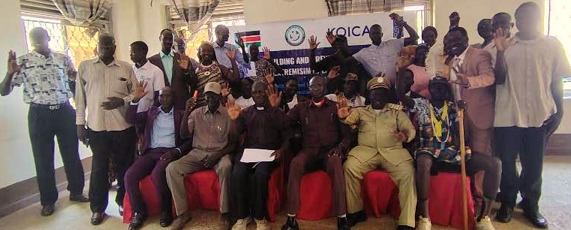
In a rapidly changing digital world where a single social media post can unite communities or fuel violence, the Korea International Cooperation Agency (KOICA) has made it possible for traditional and religious leaders in Eastern Equatoria State, who have been challenged to embrace technology and become frontline defenders of peace, to develop skills to utilize social media digital platforms as instruments of promoting peace.
The call was made during a two-day workshop in Torit that brought together faith-based leaders, traditional chiefs, government officials, civil society representatives, and media practitioners to explore how digital platforms can be used to combat hate speech, misinformation, and disinformation.
The initiative, supported by KOICA through the United Nations Development Programme (UNDP), aims to equip influential community leaders with practical digital skills to promote peace and social cohesion at a time when South Sudan is preparing for elections and is facing growing online misinformation.
Opening the workshop, Olivia Victoria Davies, Reintegration Specialist at UNDP South Sudan, emphasized that influential leaders can no longer rely solely on face-to-face communication if they are to remain relevant in shaping public opinion.
“A single message shared on your smartphone can reach hundreds or even thousands of people,” she said. “Instead of allowing hate and misinformation to dominate online spaces, religious and traditional leaders have the responsibility to share messages of peace, morality, and unity that positively influence society.”
Victoria noted that while technology has transformed how people communicate, it has also created opportunities for the rapid spread of hate speech, particularly among young people who rely heavily on social media for information.
She stressed that the workshop was designed not only to introduce participants to digital platforms but also to build their confidence in using smartphones and social media to counter harmful content with positive, verified information.
Dut Atem Kuir, the acting director for liaison at the national peacebuilding ministry, described hate speech as one of the invisible drivers of violence in South Sudan.
“Most of the conflicts and violence are caused by hate speech. People may speak or write something without realizing the damage it can cause,” he told participants.
Meanwhile, Lopeyok Sammy Aperengole, the acting peacebuilding minister in the state, acknowledged that while digital technology has revolutionized communication, it has also weakened traditional values of respect and social cohesion.
He expressed concern over the increasing misuse of social media, recalling how some individuals celebrated the killing of a local commissioner online instead of promoting peace and solidarity.
The minister also highlighted the digital divide affecting many remote areas of Eastern Equatoria, where limited mobile network coverage continues to restrict access to information and peace messaging.
He appealed to development partners to expand communication infrastructure and extend similar awareness campaigns beyond Torit to remote counties, including Kapoeta, Budi, Ikotos, Lafon, Kauto, and Lopit areas, so that rural communities are not left behind.
For his part, Eastern Equatoria State Information Minister Elia John Ahaji described misinformation, disinformation, and hate speech as some of the greatest threats to peaceful coexistence in South Sudan.
“We must communicate accurate information to our people. Community leaders, journalists, and media houses must learn to distinguish between truthful information and content created out of hatred,” he stated. “There is no way you can effectively lead people today without understanding technology.”
He stressed that leaders must engage with digital platforms so they can correct misinformation before it escalates into conflict.
Participants received practical training on using smartphones and social media platforms to verify information, develop peace messages, and respond responsibly to harmful online content.
Organizers believe that empowering trusted local leaders with digital skills will help create a network of credible voices capable of promoting reconciliation, preventing violence, and strengthening community resilience against misinformation.
As internet access continues to expand across South Sudan, the workshop underscored a simple but powerful message: technology itself is neither the problem nor the solution—it depends on how it is used.
For Eastern Equatoria’s faith leaders, traditional authorities, and community influencers, the challenge now is to transform social media from a platform that can spread division into a powerful tool for peace, dialogue, and national unity.

 and then