



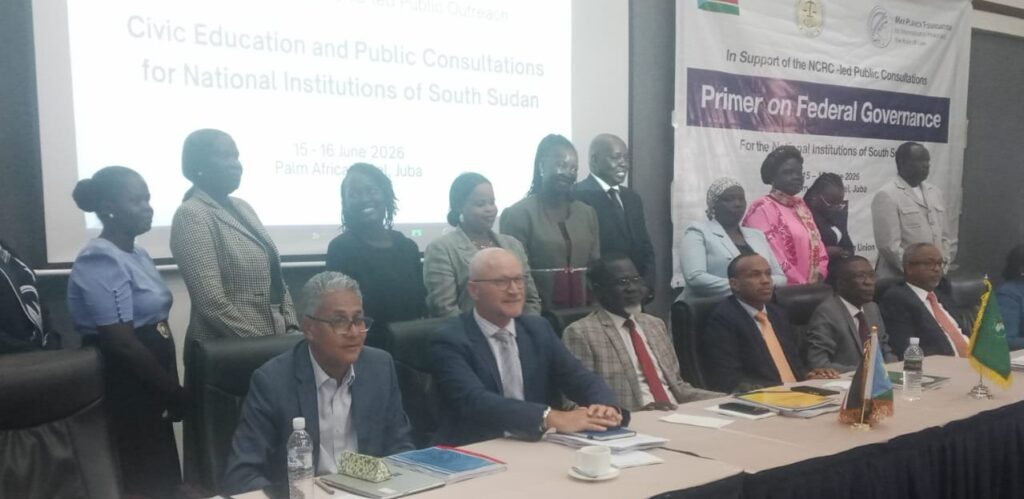
South Sudan’s constitution-making process entered a new phase on Monday after the National Constitution Review Commission (NCRC) launched a two-day civic education and public consultation workshop for national institutions in the capital, Juba.
The workshop, held at Palm Africa Hotel, brought together representatives from the judiciary, legal bodies, academia and civil society to discuss constitutional issues and provide input for the drafting of a permanent constitution.
NCRC Chairperson Riang Yer Zuor said the process was designed to be inclusive and participatory.
“This workshop is very important because the current constitution-making process … has been designed in such a manner that it is inclusive in terms of all sectors of our society,” he said, referring to the Revitalised Agreement on the Resolution of the Conflict in South Sudan and the Constitution Making Process Act, 2022.
He said the process must be owned and led by South Sudanese citizens, with no group excluded from participation.
Riang contrasted what he described as elite-driven constitution-making with a participatory approach.
“The first one is the elite constitution-making process in which elites sit, draft and adopt a constitutional text for everyone else. Then the second category is a democratic constitution-making process,” he said.
“The latter is participatory in which the public … are involved through civic education and public consultation exercises.”
He said drafting cannot begin before nationwide consultations are completed.
“What this means is that no drafting can take place before consulting the people on the relevant constitutional issues,” he said.
Riang said preparations for the exercise followed the commission’s reconstitution in November 2023 and included internal procedures, staff training, and establishment of civic education committees nationwide.
He said consultations had already been completed in all 10 states and three administrative areas, adding that engagement with national institutions was the final stage before drafting.
The workshop will gather views from institutions including the judiciary, Ministry of Justice and Constitutional Affairs, bar associations, legal aid groups and academic institutions.
IGAD Special Envoy to South Sudan Musa Dejamal Ali said constitution-making was a nation-building exercise.
“Constitution-making is much more than a legal exercise. It is fundamentally a nation-building process,” he said.
He said a permanent constitution serves as a social contract.
“For a young nation such as South Sudan, the importance of a permanent constitution cannot be overstated. It is the social contract through which the country’s parties, communities and people express their shared commitment to live together in peace, dignity and mutual respect,” he said.
He added that legitimacy depends on process as well as content.
“The process determines its legitimacy, credibility and public ownership,” he said.
“This is why civic education and public participation are indispensable. Citizens must understand the process, contribute their views and see their aspirations reflected in the final outcomes.”
Ali urged stakeholders to engage constructively and reaffirmed IGAD’s support for the constitution-making process and implementation of the 2018 peace agreement.

 and then