



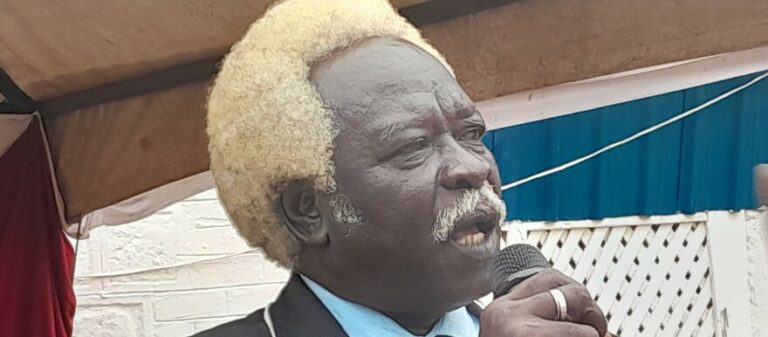
Kornelio Kon Ngon, a presidential aspirant and former third deputy speaker of parliament, has given the National Elections Commission (NEC) 72 hours to revert to the legally prescribed date for the country’s elections, warning that he will go to court if the commission fails to withdraw its decision to postpone the polls to February 11, 2027.
Speaking at a press conference in Juba on Wednesday, Kon said the revised electoral timetable, which moves the election date from December 22, 2026, to February 11, 2027, violates the constitution and the Elections Act 2012, as amended in 2026.
“As the Alliance, we give the commission 72 hours to cancel the timetable and revert to the original date. After 72 hours, we will go to court if they don’t cancel it,” he said.
The NEC issued the revised electoral timetable on November 14, moving the elections by 51 days beyond the previously scheduled December 22 date. The commission had announced the December polling date in June but later revised the calendar, citing the need for more time to complete outstanding electoral preparations.
The commission said the original timeframe was insufficient to complete pending activities, including candidate nominations, submission of candidates’ lists and the printing of ballot papers.
NEC spokesperson Josephine Achiro Fortelo said the commission had invoked Article 57(1)(c) of the National Elections Act 2012, as amended, which she said empowered it to adjust the electoral timetable.
The revised timetable was published on the same day voter registration was scheduled to begin. The exercise is set to run from November 14 to 28 at 3,161 centres across the country’s 10 states and three administrative areas.
Kon, a candidate of a faction of the National Alliance of Political Parties (NAPP), said the constitution and electoral law set December 22 as the election date and require the president to dissolve the transitional government three months before the polls.
He said the mandate of the president and the caretaker government was limited to three months and cannot be extended without further amendments to the constitution and electoral law.
“Amendment No. 13 to the constitution gives the president the authority to form a caretaker government for only three months, and the transitional period must end with elections, which should be conducted two months before the end of the transitional period,” he said.
“September 22, 2026, marked the end of the transitional government. That is why the president dissolved all organs of the transitional government, including the executive and parliament. The constitution gives the caretaker government only three months to administer the country temporarily, with limited powers, because parliament is not there,” he added.
Kon said the NEC’s decision was not based on consultations or approval from political parties and other relevant stakeholders. He said the commission had not communicated any plans to revise the timetable during a consultative meeting held in Juba on Thursday, November 12.
He said the meeting ended with a dinner for political parties, without any discussion of a revised election timetable, describing the commission’s subsequent announcement as a blatant violation of the constitution and electoral law.
Kon said the Elections Act allows the commission to exercise its powers within a limited period and that any extension beyond the three-month timeframe would require further constitutional amendments.
“The country needs another Amendment No. 14 to the Transitional Constitution if we are going to change the election date to February 11. So what happened is a violation of the constitution,” he said.
He said the decision to change the election date had been announced through a revised timetable without citing a clear legal provision authorising the move. He added that political parties had been waiting for an official and legally grounded decision explaining the change from December 22, 2026, to February 11, 2027.
Kon said the NEC’s powers under Article 60 of the Elections Act 2012, as amended in 2026, are limited to dealing with election-related disruptions, including insecurity or a state of emergency declared by the president in a particular area during an election.
He said the provision allows the commission to address such circumstances and determine how voting could be rescheduled in affected areas, but doesn’t give it authority to postpone general elections that had not yet taken place.
He argued that the NEC had no legal authority to invoke Article 60 before the elections, adding that the constitution is the country’s supreme law and clearly stipulates when elections should be held. He said even the president had no authority to change the election date.
“We want the Elections Commission to cancel its decision and change its decision and go back to December 22, 2026,” he said.
Kon said that if there are challenges to holding the elections on December 22, the commission should consult the presidency to find a lawful solution involving political parties and other stakeholders.
He emphasised that the tenure of the president and the current transitional government would end on February 22 and cannot be extended.
Kon’s party is the second political party, after the United Sudan African Party (USAP), to challenge the legality of the NEC’s decision to move the elections from December 22, 2026, to February 11, 2027.

 and then