



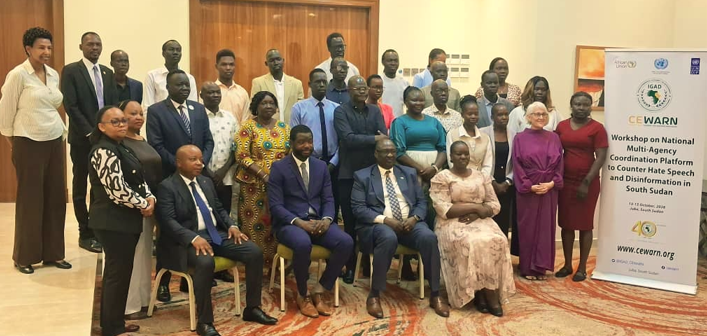
As the December elections approach, the United Nations and the Intergovernmental Authority on Development (IGAD) have called on South Sudan to strengthen coordination and early response mechanisms to counter hate speech and disinformation, warning that harmful narratives could threaten peace, social cohesion and preparations for elections.
The call was made on Tuesday during the launch of a three-day workshop to establish a national multi-agency coordination platform to address hate speech and disinformation in the country.
Beleteze Foretia, representative of the United Nations Office of the Special Envoy of the Secretary-General for the Horn of Africa, said inflammatory rhetoric, rumors and deliberately misleading information could undermine trust between communities and contribute to political and security instability.
“Countering hate speech and disinformation is, therefore, not simply about regulating information, but it is fundamentally about preventing conflict, protecting civilians, strengthening social cohesion and sustainable peace,” he said. “Political uncertainty, limited access to credible information and declining public trust can create conditions in which harmful narratives flourish, potentially undermining confidence in political and electoral processes.”
“At the same time, efforts to counter hate speech and disinformation must safeguard freedom of expression, independent journalism and legitimate political participation,” Foretia added.
He called for stronger cooperation among government institutions, independent media, civil society organizations, faith-based groups, traditional leaders, women, youth and academic institutions to address the problem.
He said the proposed platform should prioritize early identification of harmful narratives, coordinated preventive action and stronger links with existing early warning and response mechanisms.
Foretia added that cooperation with regional bodies, particularly the African Union and IGAD, would help improve information sharing, coordinated analysis and timely responses to emerging threats.
Meanwhile, Victoria Anib Majur, IGAD Head of Mission for South Sudan and Social Development, said the changing information environment required stronger cooperation among national, regional and continental institutions.
She said digital platforms had created new opportunities for communication and civic participation but had also increased the speed at which misinformation, disinformation and harmful narratives spread.
“Their purpose is not to replace existing mandates, but to strengthen cooperation, information sharing and coordinated responses to emerging challenges,” Anib said, referring to the proposed national multi-agency coordination platform.
She added that the initiative was part of IGAD’s broader commitment to conflict prevention and peacebuilding through effective early warning and early response mechanisms.
Anib urged participants to use the three-day workshop to develop a shared understanding of the challenges, clarify responsibilities among stakeholders, strengthen the link between early warning and preventive action, and ensure national ownership and sustainability of the platform.
The IGAD official said the initiative was timely as South Sudan advances its peace process, prepares for elections and pursues constitution-making and other peacebuilding efforts.
The workshop is expected to examine South Sudan’s hate speech and disinformation landscape, review proposed governance arrangements for the platform and identify measures to strengthen coordination.
Foretia said the success of the initiative would ultimately depend on its contribution to preventing violence, strengthening public trust and promoting a peaceful and cohesive society.
Organized by the African Union and the United Nations Development Programme (UNDP), the training brought together participants from various institutions, including representatives from the president’s office, foreign ministry, media, civil society and members of the faith-based groups, among others.
 and then