



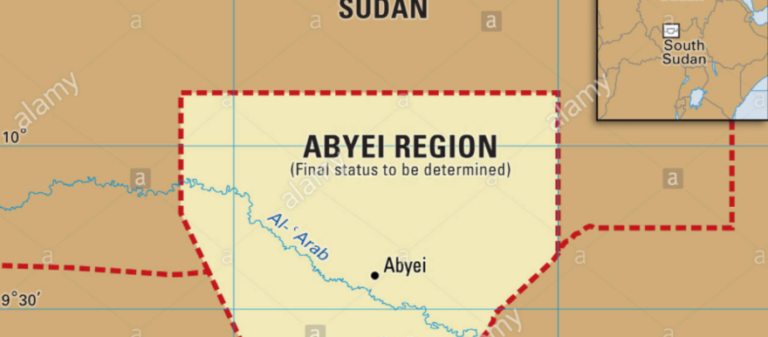
The Comprehensive Peace Agreement (CPA) 2005 was brokered to end Africa’s longest and deadliest civil war in the Sudan. As the war engulfed the whole country with different dynamics, the CPA addressed each region with a separate conflict resolution mechanism (Nuba Mountains, Southern Blue Nile, Abyei and Southern Sudan respectively). For the Southern region, the people of South Sudan were given the right to self-determination at the end of a six-year interim period, with the options to confirm the unity of the Sudan or vote for secession. The Interim Constitution of Southern Sudan 2005 incorporated the right to self-determination into its constitutional principles of declaration.
On the disputed and claimed areas, the SPLM and NCP established the Technical Border Committee (TBC) with the mandate to define and physically demarcate the borderline between Sudan and South Sudan. While the TBC mapped out the vast majority of the borders on paper, a number of specific border zones, including Kafia Kingi, remained highly contested and required separate political and legal resolution. The CPA mechanisms for resolving the Kafia Kingi dispute were much easier than those for other disputed areas.
For example, under the terms of the CPA, Kafia Kingi was meant to be returned to South Sudan during the interim period since the area was transferred in 1960, four years after the demarcation of the border between South Sudan and Northern Sudan in January 1956. Unfortunately, the Government of South Sudan did not follow it up with the Government of Sudan and instead focused only on the Abyei Protocol throughout the interim period and even fifteen years after the independence of South Sudan.
The Fertit, who are traditional inhabitants of the lands, are now part of South Darfur in Sudan. The silence of the Government of South Sudan on Kafia Kingi, Mile 14, Magenis, just to mention but a few, is a great disservice to the people of South Sudan, particularly the natives of those areas. The lands and communities living along these areas are equally important as the Ngok of Abyei.
On the separate Abyei conflict, the CPA includes a protocol known as the Abyei Protocol. Article 1.1.2 of the Abyei Protocol defines Abyei as the area of the nine Ngok Dinka chiefdoms transferred from Bahr el Ghazal to Kordofan in 1905. The Abyei Protocol also confirms that the Misseriya and other nomadic people should keep their traditional rights for grazing cattle. Article 1.2.1 of the Abyei Protocol gave full inalienable rights to both the Ngok Dinka and the Misseriya as citizens of both Western Kordofan and Bahr el Ghazal, with representation in the legislatures of both states. This is further clarified under Article 6.1 on the eligibility of Abyei residents to vote in the Abyei Referendum; that it will be members of the Ngok community and other Sudanese residing in the area.
In the implementation of the Abyei Protocol, the peace agreement provides that at the end of the six-year interim period, simultaneously with the referendum for Southern Sudan, the residents of Abyei will cast a separate ballot on whether Abyei retains its special administrative status in the north, or Abyei becomes part of Bahr el Ghazal.
In January 2011, the referendum for Southern Sudan took place in accordance with the terms and conditions of the peace agreement and was internationally observed with precision. The overwhelming results of 98.83% favored secession, and an independent South Sudan joined the community of nations. Unfortunately, the Abyei Referendum Commission was not established, and members of the Ngok ethnic community and other Abyei residents were never able to hold their referendum in accordance with the conditions outlined in the CPA 2005.
Emerging issues in the Abyei conflict
The territorial conflict over Abyei Area has been something the people of South Sudan have fought alongside the Abyei Ngok Dinka community since the first and second Sudanese civil wars against successive regimes in Khartoum. There was a wider belief that the Government of Sudan or Misseriya wanted to take the land of the Ngok Dinka, continuing their support of the transfer of the Abyei Area to Kordofan in 1905. However, no one had ever asked where, or what the exact size of, the lands of both the Ngok Dinka and Misseriya were until the negotiations in the early 2000s between the Government of Sudan and the SPLM, when the Abyei Protocol was signed. Subsequently, the Abyei Protocol provides for the establishment of the Abyei Boundary Commission with memberships from the Government of Sudan, the SPLM and the international community.
The ABC mandate was to determine the boundary of the lands of the Nine Ngok Dinka Chiefdoms transferred to Kordofan in 1905, in order to help the parties establish Abyei special administration during the interim period and thereafter be the jurisdictional area where the referendum exercise will be conducted at the end of the interim period.
With this legal mandate, the Ngok Dinka members in the ABC and representatives of the Ngok Dinka community who were consulted in the absence of the representatives of other neighboring communities took advantage of such an opportunity and included many areas in the east, west, north and south of the Bahr el Arab (Kiir River) which were never part of Ngok lands so transferred to Kordofan in 1905. The work of the ABC, greatly influenced by members of the Ngok in the SPLM representation, has indeed contributed to the slow implementation of the Abyei Protocol and, by extension, contributed to the ongoing inter-communal violence, as their technical work in the demarcation and delimitation of the internal boundaries of Abyei and other areas emboldened the Ngok community to believe such areas annexed to their lands are truly part of the Abyei area.
Therefore, the parties, including the international community through their representatives in ABC, had directly or indirectly taken part in the annexation of the land of other communities and must therefore be made aware of their moral and legal responsibility in correcting the mistakes committed through their representatives.
Boundaries between Abyei and other areas
On the northern boundary, the conflict between the Ngok Dinka and the Misseriya stems from the (ABC) report, where the Ngok Dinka were accused by Misseriya of having included areas far north of the Kiir River which, according to Misseriya, were never part of the nine Ngok chiefdoms transferred to Kordofan in 1905.
This has led to the rejection of the ABC report by the Government of Sudan on the grounds that the ABC had exceeded its mandate because it was tasked with defining the area of the nine Dinka Ngok chiefdoms transferred to Kordofan in 1905, only to be included in the special administrative status during the interim period.
This has been the same case on the eastern boundary, where the Ngok Dinka added some parts of Aliny and Abiemnhom counties as part of the nine Ngok chiefdoms transferred to Kordofan in 1905. However, this unfounded claim was later corrected by the Arbitral Award during the arbitration proceedings at the Permanent Court of Arbitration (PCA), which confirmed that the ABC had once again exceeded its mandate, and a new demarcation and delimitation of the areas on the eastern border were drawn.
Finally, on the western boundary, the Ngok Dinka have included Gok Machar and some areas in Aweil East County into boundary and administrative disputes involving sections of the Ngok Dinka and communities within Northern Bahr el Ghazal State.
This finally brought us to the conclusion that the parties—the Government of Sudan and the SPLM—have failed to implement the Abyei Protocol as they disagreed on establishing the exact areas of the nine Ngok Dinka chiefdoms transferred to Kordofan in 1905. As a result, both parties could not also agree to establish the Abyei Local Administration and subsequently could not establish the Abyei Referendum Commission to organize the referendum.
Regional effort on the Abyei conflict
The failure of the parties to implement the Abyei Protocol led to the intervention of the African Union Commission, which appointed the African Union High-level Implementation Panel on Sudan and South Sudan, chaired by former South African President Thabo Mbeki. The AUHLIP conducted its findings and presented a proposal to the parties on 21st Sept 2012 with immediate, medium and long-term implementation strategies on Abyei special administrative status, soft border, pastoralist rights, revenue sharing and economic development, Abyei Joint Oversight Committee, and finally to the conduct of a referendum. Yet, the parties, including the meeting of the two Presidents, Omar Hassan al-Bashir and Salva Kiir Mayardit, which was expected to bless the proposal, failed to agree, and nothing has been implemented to date.
At the bilateral level, following the failure of the parties to agree on the AUHLIP proposal, the Government of South Sudan unilaterally established Abyei Area Administration without participation of Misseriya vide Republican Order number 03/2015. Subsequently, the President formed a high-level committee on the final status of Abyei, whose core mandate is to engage with the Government of Sudan and report directly to the President on the progress made in addressing the longstanding issue surrounding the final status of Abyei. Equally, the High-level Committee is to also follow up on the findings, recommendations, and implementation of the AUHLIP proposal, and the arbitral award to resolve the final status of Abyei.
Despite several attempts by the High-level Committee, which also suffers unilateral formation as viewed by the Government of Sudan and international community since its formation to engage with the Government of Sudan and international community, nothing tangible has ever been achieved between Juba and Khartoum and between Misseriya and the Ngok Dinka. Instead, the same demarcation of the areas has led to tensions between the Ngok Dinka and other South Sudanese communities whose lands were added to be part of Abyei Area.
Now that the two parties have failed to implement the Abyei Protocol, and considering the emergence of the new territorial dispute or claims, the question is whether the High-Level Committee on the final status of Abyei under Hon. Adut Salva Salva Kiir has the mandate or mechanism to resolve conflict between the Ngok and the South Sudanese communities, with regards to the new emerging claims or disputes, and whether the Abyei Protocol remains the right mechanism to resolve the new conflict that came as a direct result of the demarcation and delimitation work of the ABC.
And finally, whether the Government of South Sudan and other stakeholders should adopt a new conflict resolution mechanism to address the new emerging realities of the conflict between the Ngok Dinka and the surrounding South Sudanese communities, since the issue of Abyei has now changed from being a conflict between Ngok and Misseriya to being a conflict between Ngok and other South Sudanese.
Conclusion
After careful analysis of the complex situation in Abyei conflict, it is to be noted before going into the proposed conflict resolution mechanism that there are two major challenges facing the search for the final status of Abyei: first, the Ngok Dinka themselves are sharply divided over the final status of Abyei as some of them want to be part of South Sudan, others want an autonomous state between the two countries, while others want to continue as Sudanese and part of Sudan.
Both factions of the Ngok with opposing views on their national identity and final status of Abyei have spoken clearly on record. Furthermore, these divisions did not start today or yesterday, but right from the beginning of the negotiations between the Government of Sudan and the SPLM in 2002, when the Ngok members were on both sides of the political divide at the negotiating table and had directly opposed each other. Such disagreement over a common course of action as the Ngok community have had to some extent affected the implementation of the Abyei Protocol in the Comprehensive Peace Agreement.
Another challenge is the conflict between the Ngok and Misseriya tribes, both of whom are residents of Abyei, over the final status of Abyei as both claim some territorial borderlines, and such lack of unity of an internal front for a unified cause of action is greatly affecting the final status of Abyei. So it’s premature for the Government of South Sudan and Sudan in the first place to agree on something called the final status of Abyei when the very people with whom their common cause is being addressed are divided amongst themselves, both as the Ngok community into three groups on one side and Ngok with Misseriya on the other.
The policy recommendations shall come out in part two of this article.
The writer, Hakim Chol Ayii, is a researcher on politics and governance. He can be reached at akimchol@gmail.com.
The views expressed in ‘opinion’ articles published by Radio Tamazuj are solely those of the writer. The veracity of any claims made is the responsibility of the author, not Radio Tamazuj.
 and then