



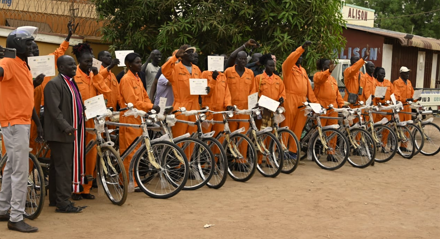
Women’s Empowerment Solution Initiative (WESI), a national organization, with support from Water is Basic-USA, on Thursday distributed brand new bicycles and awarded certificates to 20 trainees who participated in a 14-day training on water pump mechanics, hygiene promotion, business, and trauma healing in Rumbek, Lakes State.
Simon Buud Gai, the WESI executive director, said trainees, 10 women and 10 men, now known as water warriors, were drawn from all the state’s counties apart from Rumbek North County, which was inaccessible due to insecurity.
“It is my privilege to tell you that we are bringing the WESI project to Lakes State in 2026. In 2020, it was a reality in Warrap State and in 2021, in Northern Bahr el Ghazal State and in 2025, Western Bahr el Ghazal State,” he said. “What we are doing is water, sanitation, and hygiene (WASH). We integrate trauma healing programs in this training because a traumatized person cannot work. The gap we are closing is water crisis, women’s empowerment, ownership, and sustainability.”
“Water crisis is a big problem, and if you don’t have water, you die in a day, yet if you don’t have food, you die in seven days,” Buud added.
For his part, Stephen Roese, the president and founder of Water is Basic-USA, said they have been working to provide safe water in South Sudan for the last 20 years and work with WESI.
“In 2020, we decided the best way to make sure water is available to everyone in South Sudan is to train women to repair water wells and teach them how to do business. We began to train as a pilot, and the women were amazing,” he said. “Last year, they repaired 1,066 wells in Warrap and Northern Bahr el Ghazal states. Now, we have extended to Lakes State. Water is the basic path for the training in the tools, and the women do not work for us, and the power mechanics do not work for WESI.”
“They are independent businesses, and they answer the call from the community when the water is not working, and they go, and the community pays the fees and money for spare parts,” Roese explained.
He revealed that they have spare parts stuck at the Kenyan port of Mombasa because they have failed to get tax exemptions from the national government in Juba. He added that they have, over time, distributed mechanic tool kits to the beneficiaries.
“It is the simple message, the most important resource in the village community is water, and you own it together, and if you work together to maintain it, we have provided the mechanic with tools and spare parts to maintain the well,” Roese stated.
Meanwhile, Monica Abeny Marial, a beneficiary of the WESI training in Rumbek, told Radio Tamazuj that they are excited to be certified pump mechanics.
“We are trained on how to repair hand pumps and in business and hygiene promotion. This is an opportunity for women to work as hand pump technicians in rural areas, and we are very grateful to the WESI organization,” she said. “We have received bicycles and tool boxes, and we were awarded certificates in trauma healing, pump mechanics, and hygiene promotion.”
On his part, Mager Anyuon Thuc, the Director General at the State Ministry of Lands, Housing and Public Utilities, said that the trainees are now empowered with skills, tools, and spare parts to start a business.
“As a ministry, we are going to see that you reach the far ends of the counties so that your people benefit. Make sure you rehabilitate the boreholes that have broken down to ensure people do not suffer,” he said. “I would like to extend a message to donors that we have areas which are very far, like Rumbek North, Yirol West, Yirol East, and parts of Amongpiny, and you need to give them enough spare parts.”

 and then