



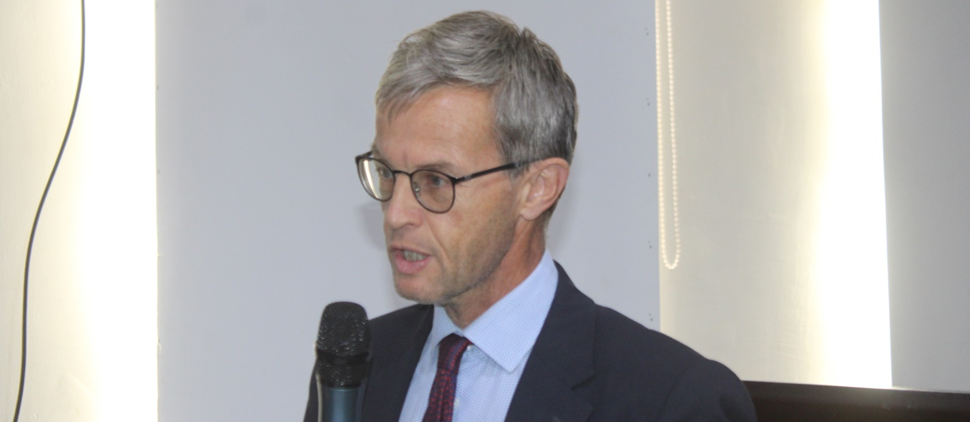
A senior European Union official marked International Women’s Day in South Sudan on Friday by condemning the use of sexual violence as a “method of warfare” and calling for urgent action to turn promises of equality into reality.
Lothar Jaschke, deputy head of the EU Delegation, spoke at Nyakuron Cultural Centre in Juba, emphasizing the continuing relevance of March 8. “Some argue that we do not need March 8 anymore, not necessarily because equality has been achieved, but because there is no point in highlighting issues for one day and then putting them aside for the rest of the year,” he said. “Tragically, we also need International Women’s Day to highlight that gender-based violence is almost exclusively committed against women.”
Jaschke expressed concern over the disproportionate impact of armed conflict on women and girls in South Sudan. While citing limited data on casualties in Northern Jonglei and Upper Nile, he said sexual violence remains a persistent feature of the conflict. “It became a method of warfare and a mechanism for exercising power,” he said.
He noted that sexual violence is often unreported, particularly when perpetrators are linked to armed groups or state authorities, which contributes to its normalization. Jaschke urged the government to accelerate work on a long-promised bill to combat gender-based violence, saying it could help address impunity.
The EU official also criticized underfunded public services, which he said threaten women’s access to health care and education. He cited a national budget allocation of just 0.4% for health as “very, very low and far away from international standards,” adding that the current donor-dependent model is “not sustainable.”
His remarks come as South Sudan faces rising ceasefire violations and attacks. “The hate speech we see from leaders and on social media is endangering the social climate, emboldening individuals and groups to commit horrible crimes, often with impunity,” he said, condemning recent massacres in Ayod and Abiemnom and calling for accountability.
Jaschke noted some progress through EU-funded programs, including ResPEct, which has provided psychosocial support to 11,000 people and trained hundreds of local authorities and professionals in responding to sexual and gender-based violence.
He concluded by calling for renewed political will to implement the stalled peace agreement through dialogue. “I am fully convinced that South Sudan needs many more empowered women in politics, in the private sector, in the security forces,” he said. “I am convinced that our world would look much better and more peaceful if there were more women in leading positions.”
The EU co-chairs the Women, Peace, and Security Working Group in South Sudan with the United Kingdom and supports the domestication of international treaties such as the Maputo Protocol, which guarantees women’s rights.

 and then