



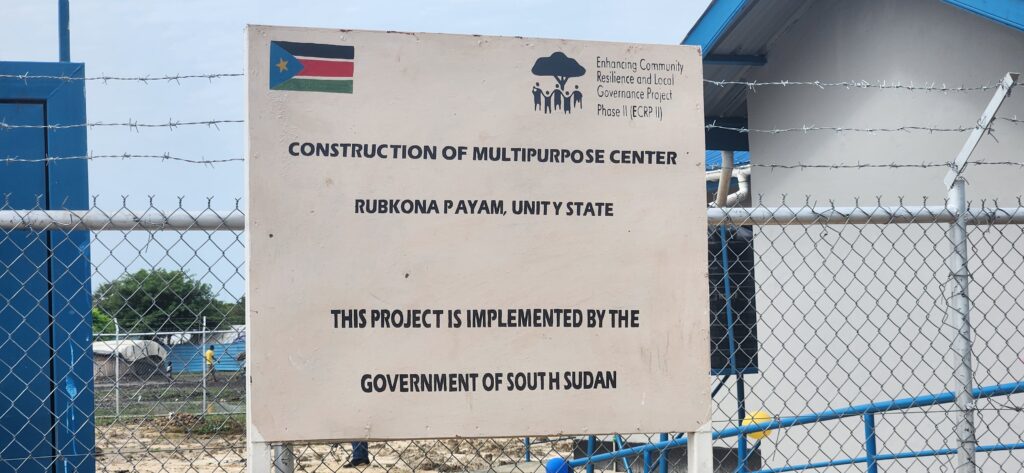
Authorities in Unity State on Wednesday inaugurated a new community centre in Rubkona County built under the World Bank-funded Enhancing Community Resilience and Local Governance Project (ECRP II), while local officials urged further investment to reclaim land lost to years of flooding.
The multi-purpose facility, funded by the World Bank through the government of South Sudan and implemented by the International Organization for Migration (IOM), includes a meeting hall, kitchen, toilets and a water supply.
Speaking at the handover ceremony, IOM Monitoring and Evaluation Officer Motuma Daba said the project was implementing 99 community infrastructure projects across Rubkona County based on priorities identified by residents.
“We are currently working in 12 counties, and Rubkona is one of them,” Daba said. “Based on the needs identified by the community, we plan to construct 99 infrastructure projects in Rubkona alone, including schools, toilets, water points, health centres and multi-purpose community facilities.”
He said the projects are expected to be completed by December.
Beyond public infrastructure, Daba said the project is also investing in flood mitigation, including the construction of more than nine kilometres (5.6 miles) of roads and over 40 kilometres (25 miles) of dykes to help protect communities from recurrent flooding.
“We have to work hand in hand to keep these infrastructures functioning,” he said. “If we build and nothing is used, it will be a waste of resources. Schools should have teachers, health facilities should have nurses and doctors, and the community should maintain these facilities.”
Rubkona County Commissioner Salam Maluit welcomed the completion of the centre, saying it reflected efforts to improve access to community services.
“We are very happy for this achievement,” he said. “This is a very nice place built for the people.”
However, he appealed to the national government and development partners to support land reclamation in areas submerged by prolonged flooding, saying additional habitable land was needed to ease overcrowding.
“The people are crowded because of flooding,” Maluit said. “If these areas are reclaimed, people living in displacement sites and those crowded in Rubkona town will have enough space.”
He said authorities were not seeking to permanently relocate residents but expected displaced families to return to their original homes once floodwaters receded.
“It is not relocation,” he said. “If the water goes down, people should return to their previous places. Those are our ancestral lands.”
Nyebula Both Chiengjock, chairperson of the Rubkona Payam Development Committee, said the new centre would provide a permanent meeting space for women, youth and other community groups that previously gathered under trees or in temporary grass-thatched shelters.
“The women will come together, discuss their issues and support one another,” she said. “Due to flooding, conflict and other challenges, many women have become widows or struggle to provide for their families. This space will help them find ways to cope.”
She said the community had also benefited from other ECRP II investments, including dykes, schools and health facilities.
“Our community has suffered a lot and lacks basic infrastructure,” she said. “These projects mean a great deal to us.”
The International Organization for Migration says the ECRP II programme is designed to strengthen community resilience, improve local governance and expand access to essential services in some of South Sudan’s most vulnerable counties.
Large parts of Unity State have been inundated by seasonal flooding for several consecutive years, displacing hundreds of thousands of people, damaging infrastructure and limiting access to farmland, health services and schools. Humanitarian agencies have invested in dykes, raised roads and other flood protection measures to help communities adapt while supporting recovery and basic service delivery.

 and then