



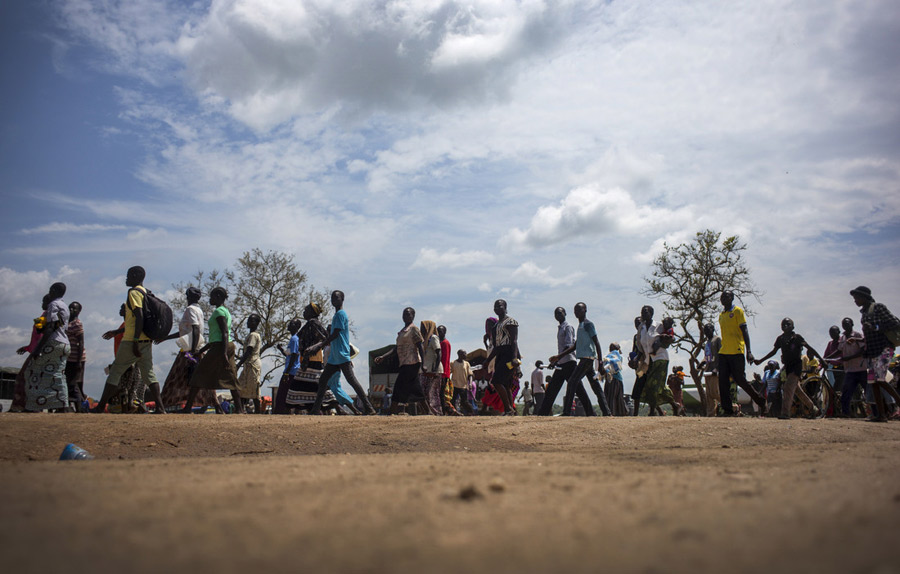
Recently, the Ugandan Minister for Relief, Disaster Preparedness and Refugees, Hon. Sam Engola, urged refugees hosted by the Republic of Uganda, including those from the Republic of South Sudan, to consider voluntarily returning to their countries of origin as humanitarian funding continues to decline. The appeal comes at a time when Uganda’s refugee response is facing serious financial pressure, with reduced international assistance affecting the services available to refugees and the communities that host them.
First and foremost, we would like to express our deepest gratitude and appreciation to the Ugandan government and its people, through the Minister for Relief, Disaster Preparedness and Refugees, Hon. Sam Engola, for their generous hospitality towards us throughout this period as refugees from South Sudan, displaced by war in search of peace, security and human dignity. You have been, and continue to be, our brothers and sisters in good times and bad. This is an undeniable historical fact.
We, the refugees from South Sudan, acknowledge that you embraced us with your boundless generosity and hospitality during our most difficult times. Whenever we sought hope, security, peace, and human dignity, we found you – the people and the government – by our side. This is a humanitarian and diplomatic legacy that we cherish deeply. It remains unchanged by shifting circumstances here and there, and even by our own changing circumstances. We will build upon it, generation after generation, for the benefit of the people of both nations.
Honestly, we have suffered greatly as humanitarian assistance has declined and funding for programmes supporting South Sudanese refugees has become increasingly insufficient. Food assistance, healthcare, education and other essential services have all come under pressure. That is only half the story. The other half is that the situation continues to deteriorate. However, this pales in comparison to the situation in South Sudan, where restoring stability through good governance, peace and security is the true incentive for voluntary return, especially now that donor support has dwindled to such low levels.
While the Ugandan government’s concerns about a sharp decline in international funding are understandable, its appeal to refugees to consider voluntary return raises an important question: Can refugees safely return to South Sudan while the political, security and humanitarian conditions that led to their displacement remain unresolved?
By raising this question, we do not aim to belittle the Ugandan government, especially since it is one of the governments in the region that is fully aware of what is happening in South Sudan. Rather, we seek to draw modest attention to the dangers of returning under the current circumstances, where political instability, armed conflict, displacement and insecurity continue to affect communities across the country.
Uganda has long played a vital role in protecting South Sudanese refugees. However, declining donor support is placing increasing pressure on the country’s refugee-hosting system and the communities that welcome them. The funding crisis is real and requires urgent international attention. However, a lack of funding should not determine whether a refugee still needs protection. A refugee does not become safe to return simply because the resources available to support them have decreased.
Voluntary repatriation is a legitimate and lasting solution when refugees freely choose to return to a safe and stable environment. However, “voluntary” must mean more than simply the absence of physical force. If refugees are deprived of food, healthcare, education, and other basic services to the point where remaining in Uganda becomes unbearable, their decision to leave may no longer be truly voluntary. This is why the humanitarian funding crisis must not be allowed to turn economic hardship in a country of asylum into an indirect pressure to return to an unsafe country of origin.
The security and political situation in South Sudan remains a major concern. The country continues to face conflict and political instability, while displacement, food insecurity, and weak public services affect large parts of the population. The peace process has also not delivered the level of political and security stability necessary to guarantee the safe and sustainable return of millions of displaced South Sudanese. Therefore, returning refugees need much more than transportation across borders. They need security, shelter, land, food, healthcare, education, livelihoods, freedom of movement, and protection from political persecution and renewed violence. Without these conditions, external displacement could simply become internal displacement.
The Government of South Sudan bears a special responsibility. If it wants its citizens to return, it must create the conditions for a safe and sustainable return. This requires strengthening the protection of civilians, implementing the country’s peace commitments, resolving land and property disputes, restoring basic services, creating economic opportunities, and ensuring that returnees live without discrimination or political persecution.
At the same time, Uganda should not be left to bear the burden of refugees alone. The international community must provide sustainable, long-term funding for both refugees and host communities. Donors should support schools, healthcare, water, roads, livelihoods, and other infrastructure in refugee-hosting areas. Protecting refugees must remain a shared international responsibility rather than becoming a burden carried primarily by Uganda and the communities that host refugees.
The solution should not be reduced to a choice between remaining in Uganda and returning to South Sudan. A multi-pronged approach is more appropriate: continuing to protect refugees who cannot return safely; expanding opportunities for self-reliance for refugees and host communities; facilitating safe and dignified returns for those who genuinely wish to return to their areas of origin; and expanding resettlement in third countries and other legal pathways for the most vulnerable refugees.
Before embarking on large-scale returns, independent assessments should be conducted to determine whether individual return areas meet minimum standards regarding security, protection of civilians, land rights, housing, food, healthcare, education, livelihoods and freedom of movement. These assessments should be site-specific, as conditions can vary considerably across South Sudan. What may be relatively safe in one area cannot automatically be assumed to be safe in another.
Voluntary return should not be based solely on top-down decisions. Refugees themselves – women, youth, community leaders, and vulnerable groups – must have a voice and participate effectively in decisions concerning their return. They should receive accurate and independent information about conditions in their areas of origin and be allowed to make informed decisions without pressure.
Ultimately, the question is not simply when refugees will return, but what needs to change in South Sudan for them to return safely and remain there.
The refugee burden in Uganda is real. The donor funding crisis is real. And the need for sustainable solutions is real. But none of these realities should justify premature or indirect forced returns. Refugees should return because their homeland is safe, not because exile has become unbearable.
In conclusion, the necessity of voluntary return is not determined by the number of refugees willing to return to their countries of origin, nor is its success measured by the number of refugees transported across borders. Rather, it is measured by the ability of those who return to live in safety, rebuild their livelihoods, regain their dignity, and remain in their homes without being displaced again.
For South Sudanese refugees, this means that the conditions that forced them into exile must first be addressed. Until there is genuine political stability, security, equal protection, and an end to the systems of political and tribal exclusion that place communities at risk, large-scale return cannot be considered a truly sustainable solution. This remains impossible under the current regime of tribal segregation in South Sudan.
The writer, Sokiri Lo Poni, is a concerned South Sudanese. He can be reached via Sokiril8@gmail.com.
The views expressed in ‘opinion’ articles published by Radio Tamazuj are solely those of the writer. The veracity of any claims made is the responsibility of the author, not Radio Tamazuj.
 and then