



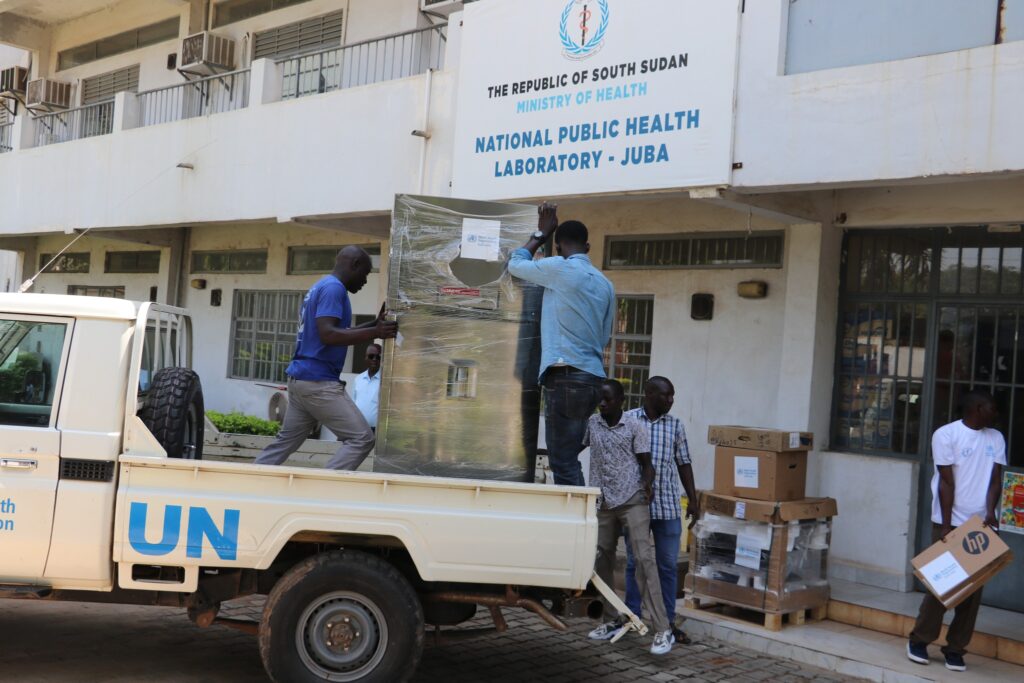
The Embassy of the United States of America in Juba has directed all U.S. Government-funded projects and implementing partners to immediately withdraw U.S. Government-funded laboratory personnel and equipment from the National Public Health Laboratory (NPHI) facility in Juba.
The National Public Health Laboratory (NPHL) is the country’s central public health laboratory and the top reference facility for medical testing.
The NHL is critical to South Sudan’s health system, especially in responding to outbreaks and guiding government and partner interventions. It often works with international partners to strengthen diagnostic capacity and emergency response.
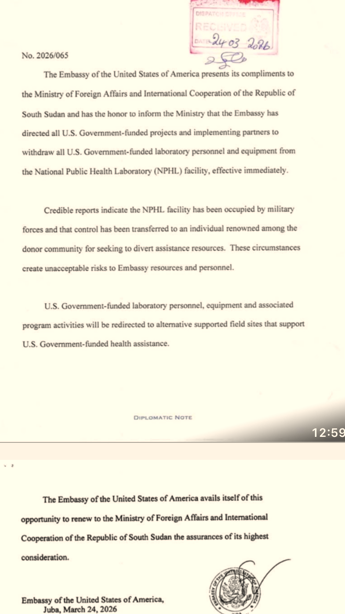
A letter from the U.S. Mission to the South Sudan foreign ministry, dated 24 March, seen by Radio Tamazuj, said that an official known for diverting aid, who was not named, has taken over the NPHI facility, and that soldiers occupy it.
“The Embassy of the United States of America presents its compliments to the Ministry of Foreign Affairs and International Cooperation of the Republic of South Sudan and has the honor to inform the Ministry that the Embassy has directed all U.S. Government-funded projects and implementing partners to withdraw all U.S. Government-funded laboratory personnel and equipment from the National Public Health Laboratory (NPHI) facility, effective immediately,” the letter reads in part. “Credible reports indicate the NPHL facility has been occupied by military forces and that control has been transferred to an individual renowned among the donor community for seeking to divert assistance resources. These circumstances create unacceptable risks to Embassy resources and personnel.”
“U.S. Government-funded laboratory personnel, equipment, and associated program activities will be redirected to alternative supported field sites that support U.S. Government-funded health assistance,” the letter added.
When contacted, SSPDF Spokesman Gen. Lul Ruai Koang said the matter is beyond him.
“It is only the government or the foreign ministry that can comment on any issue from an embassy,” he curtly said. “So, that is a matter between the two governments. The army is under the government. If the U.S. military had said something, we would have responded.”
Meanwhile, Amb. Thomas Kenneth Elisapana, the foreign ministry spokesperson, confirmed receipt of the letter,
“We have just received the latter and it will be discussed with the concerned ministry so that the issue is addressed,” he said.
For his part, Edmund Yakani, the executive director of the Community Empowerment for Progress Organization (CEPO), slammed the armed forces for disrupting humanitarian efforts.
“It is unfortunate that the military likes to interfere with public and donor-funded interventions,” he said. “This is a big mistake, disrespectful, and abusive of donor funding.”
South Sudan’s health sector is heavily dependent on donor funding, with external partners providing an estimated 85% of healthcare services nationwide. The government allocates a very small portion of its national budget to health, often less than 2%, leaving the sector reliant on mechanisms like the Health Pooled Fund (HPF), which ended in 2024, and the World Bank, among others.

 and then