



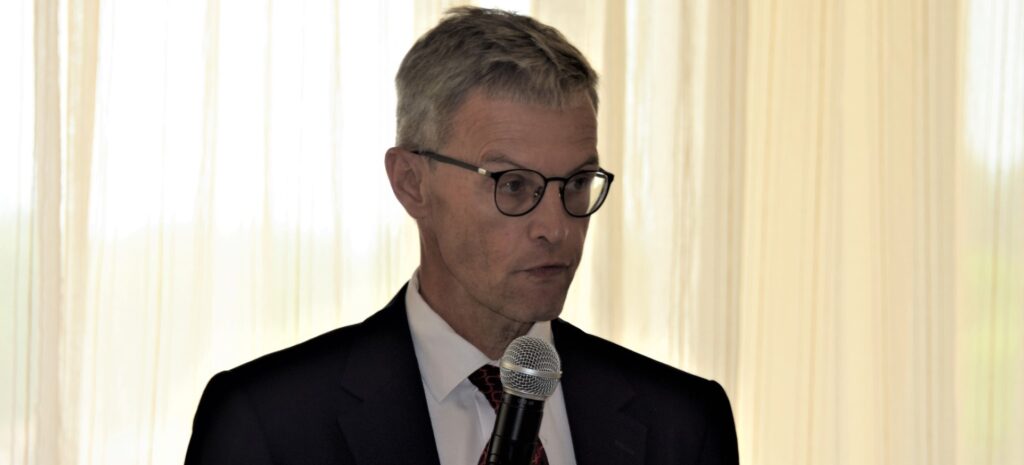
A top European Union official on Monday called on the South Sudanese government to significantly increase its investment in education, warning that current funding levels fall far below international standards and the country’s own constitutional commitments.
Speaking at the launch of the 2026 academic school year in Wau, Lothar Jaschke, Deputy Head of the EU Delegation, said that South Sudan’s education budget accounted for only about 2% of public spending in the last fiscal year. Jaschke noted that international standards suggest the allocation should be between 15% and 20%.
“Education needs strong commitment and strong leadership of the government,” Jaschke told an audience that included National Minister of General Education and Instruction Dr. Kuyok Abol Kuyok and the Governor of Western Bahr El Ghazal. “The launching of the school year is only the top of the iceberg. There are many other issues underneath”.
The EU official highlighted critical gaps in the system, including poor infrastructure, a lack of teacher training, and the chronic failure to pay educators. He noted that teachers’ salaries are frequently delayed or unpaid, leaving many classrooms empty.
Jaschke emphasized that providing free, quality education is a requirement under South Sudan’s Transitional Constitution and its international human rights obligations. He argued that fulfilling these responsibilities is a matter of national sovereignty.
“A sovereign country – a sovereign education,” Jaschke said. “Sovereignty also means responsibility; it means a social contract”.
Despite the challenges, the EU and the international donor community remain committed to supporting South Sudan through initiatives like the Girls’ Education South Sudan programme and various vocational training projects. However, Jaschke stressed that long-term progress depends on political stability and an end to the “cycle of violence and hate speech” currently gripping the nation.
“Education is an investment in the physical, intellectual and spiritual health of a nation,” Jaschke concluded. “It is the most sustainable investment for peace”.

 and then