



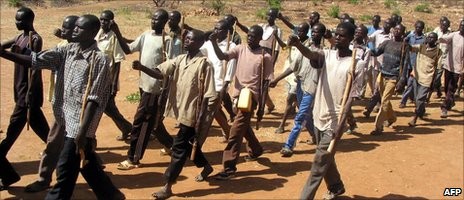
“We don’t have militias, but officials who are our neighbors keep creating militias, especially Terchuong. Who is responsible for them? Who feeds them? Who gives them guns? Who orders them to attack places in South Sudan?”
The remarks by Mayol Kur, a former chief administrator of the Ruweng Administrative Area, during a funeral service in Juba in March 2026 for victims of the deadly Abiemnhom attack, captured growing concern over the role of armed groups in South Sudan’s recurring conflicts.
More than 200 people were killed in the March 1 attack on Abiemnhom.
Investigations conducted by Radio Tamazuj point to longstanding allegations that Terchuong, an armed youth group largely drawn from the Bul Nuer community in Mayom County, operated with the support or tolerance of political figures during South Sudan’s civil war and its aftermath.
Supporters describe the group as a community force formed to defend the government of President Salva Kiir against opposition forces during the 2013 conflict. Critics accuse it of involvement in cattle raids, revenge attacks and violence against neighboring communities.
The debate has resurfaced following the reappointment of Unity State Governor Joseph Nguen Monytuil in March 2026 and reports that the militia has regrouped after being dissolved in 2024 by former governor Riek Bim Top.
‘We mobilized them’
John Bol Mayak, commissioner of Mayom County and an ally of Governor Monytuil, openly acknowledged that Terchuong was mobilized during the civil war.
“Terchuong are youth from Mayom who came together and we mobilized them to support the government because the other youth were supporting the opposition,” Bol told Radio Tamazuj.
He said the group emerged after fighting erupted in Unity State following Monytuil’s appointment as governor in 2013.
“We called it Terchuong because when President Salva Kiir appointed Dr. Joseph Nguen Monytuil as governor of Unity State, conflict erupted and we decided to defend this power because those who were causing fighting were people who did not want the people of Mayom to have power,” he said.
Bol described the group as an armed youth force formed to counter opposition-aligned youth militias, including the White Army and armed groups known locally as Gojam.
“In 2015, we mobilized the youth and told them that we should defend the government and the constitution because the opposition mobilized youth called Gojam and White Army. So we created Terchuong to defend the government,” he said.
“Terchuong are armed youth just like there were Mathiang Anyoor and the Titweng youth from Bahr el Ghazal,” Bol said.
Bol denied allegations that the Terchuong militia was also involved in cattle raiding or attacks in Guit, Leer, Koch, Rubkona and Mayendit counties.
“This is not true. Terchuong only fought with Gojam, which supported the opposition that was trying to overthrow the government. We did not establish it to raid cattle. We established it to defend the government,” he said.
He said armed youth from six counties in Unity State fought the state government during Monytuil’s administration, forcing the governor at one stage to flee Bentiu for Mayom County.
“That is why the sons of Mayom, or the Bul Nuer, decided to defend their leadership and power from being overthrown by the other counties,” Bol said.
Dissolution and revival
Bol confirmed that Terchuong had effectively returned following Monytuil’s reappointment.
Former governor Riek Bim Top dissolved the militia in July 2024 during a visit to Mayom County, describing it as an unlawful armed group.
“Riek Bim was not part of us or on our side when we used to struggle and fight against SPLA-IO,” Bol said. “When Riek Bim came as governor of Unity State, he said Terchuong were militias and should be dissolved, and he dissolved them.”
Bol said some Terchuong members later dispersed, with some joining Sudan’s Rapid Support Forces and others becoming involved in insecurity along border areas.
“After the appointment of Dr. Joseph Nguen Monytuil as governor again, we talked to the youth and asked them not to cause problems with neighbors and to return from the Rapid Support Forces,” he said.
“Those youths who are Terchuong were brought back after being scattered by Riek Bim, and now they are serving as community police in Mayom.”
He said the group was now focused on maintaining security along the borders with Warrap State and Abiemnhom.
“We are now working for peace. It is now more than a month since Dr. Joseph became governor and no insecurity has happened again,” Bol said.
Abiemnhom attack
The March attack on Abiemnhom has intensified scrutiny of the group.
Bol denied that Terchuong members were involved.
“It is not true because when Riek Bim came as governor, he scattered Terchuong and pushed some of them to join the rebel group led by Gen. Stephen Buay,” he said.
“Criminals were the ones who killed people in Abiemnhom because Terchuong had already been scattered and disbanded by Riek Bim.”
Jackson Mut, a former commissioner of Mayom County under Riek Bim, said authorities in Unity State and the Ruweng Administrative Area had prior warning of an imminent attack.
“I talked to the former governor of Unity State about the movement of youth and the former governor talked to the former chief administrator of Ruweng,” Mut said.
“We made a conference call and the decision came from the higher authorities that they would deploy forces to Abiemnhom.”
Mut declined to directly address who created Terchuong.
“People know when Terchuong was formed, and by whom and why it was formed. On the Abiemnhom attack, I already gave my report to the former governor. I cannot talk about it now because I am now a former commissioner,” he said.
James Monyluak Mijok, information minister for the Ruweng Administrative Area, said investigations by local authorities concluded that armed youth from Mayom County, including Terchuong members, were involved in the Abiemnhom attack.
“In that situation, we can conclude that Terchuong and groups of militia under Gai Machiek in Ajakuach in Twic County of Warrap, and youth under former commissioner of Mayom County Jackson Mut, were the ones who attacked people in Abiemnhom,” Monyluak said.
Gai Machiek is a Nuer spiritual leader from Mayom County in Unity State who has been based in Twic County in Warrap State.
The information minister said the attack on Abiemnhom appeared coordinated and involved multiple armed groups.
Monyluak also questioned the recent public display of armed youth during celebrations marking Monytuil’s reappointment earlier this month.
“We observed many people, including the militia of Terchuong, coming out in large numbers carrying arms in Mayom to celebrate the reappointment of Dr. Joseph Nguen Monytuil as governor. This raises eyebrows,” he said.
Conflicting narratives
A close associate of former governor Riek Bim, speaking on condition of anonymity, described Terchuong as an armed youth force formed under Monytuil and used during the conflict against SPLA-IO.
The associate said Riek Bim dissolved the militia because it consisted of untrained armed youth contributing to insecurity.
“After their disbandment, they used to gather themselves and raid cattle,” the associate said.
“They were involved in a number of crimes, including fighting among themselves, because they used to move in groups and call themselves soldiers.”
The former governor’s associate said the Abiemnhom killings stemmed from revenge attacks and failures by authorities to respond despite prior warnings.
“The youth of Unity whose relatives were killed made a plan earlier and both sides in Unity State and Ruweng failed to respond quickly,” the associate said.
“It was poor planning and a failure to respond that resulted in this loss of life. The attack was purely a revenge killing.”
The source said the militia was formed in early 2015 and that its first commander was Matwich Gatwech Magai, who was appointed in 2017 with the rank of lieutenant colonel.
Regional security concerns
Officials in neighboring Warrap State also linked recurring insecurity to armed youth groups operating out of Mayom County.
William Wol Mayom, Warrap State’s information minister, said border communities had experienced repeated attacks, cattle raids and killings before Monytuil’s return as governor.
“We have experienced relative calm between Mayom and Warrap State, but previously there were routine attacks,” Wol said.
According to security reports received by Warrap authorities, the attacks involved Terchuong members alongside rebel forces loyal to Gen. Stephen Buay Rolnyang and SPLA-IO fighters, he said. SPLA-IO has previously denied involvement.
“Since the appointment of Dr. Joseph as governor, no attacks have occurred,” Wol said, while cautioning that it remained unclear whether the calm would last.
Armed reception
Earlier this month, Governor Monytuil visited Mayom County, where he was welcomed by armed Terchuong members during public celebrations.
One member of the group defended the militia on camera.
“I am a member of a force called Terchuong. We are not in Terchuong to mistreat others. We are for peace,” he said.
“We are supporting the government of President Salva Kiir and Joseph Nguen.”
Another member said: “No problem will happen again in Mayom since the president told Joseph Nguen to come and bring back my people to start working.”
Background of appointments
President Salva Kiir reappointed Joseph Nguen Monytuil as governor of Unity State on March 23, 2026.
Kiir had appointed Riek Bim Top governor in May 2024 before removing him and reinstating Monytuil in March.
Monytuil, who hails from Mayom County, has remained a central figure in Unity State politics since the outbreak of civil war in 2013 and is considered a longtime ally of Kiir.
He first became caretaker governor in 2013 and later served as governor of Northern Liech State after South Sudan was reorganized into 28 states in 2015.
Following the return to 10 states under the 2018 peace agreement, he again served as governor of Unity State from 2020 until his dismissal in May 2024.
In August 2022, South Sudan’s Council of States passed a vote of no confidence against Monytuil over insecurity and alleged human rights violations, although Kiir did not act on the motion.
Constitutional questions
South Sudan’s Transitional Constitution prohibits the formation of armed groups outside official military structures.
Article 151(3) states that “no person or persons shall raise any armed or paramilitary force in South Sudan except in accordance with this Constitution and the law.”
The constitution further states that the armed forces must be “non-partisan, national in character, patriotic, regular, professional, disciplined” and subordinate to civilian authority.
Despite those constitutional provisions, South Sudan has continued to grapple with the proliferation of armed youth groups and militias amid years of conflict and political insecurity.

 and then