



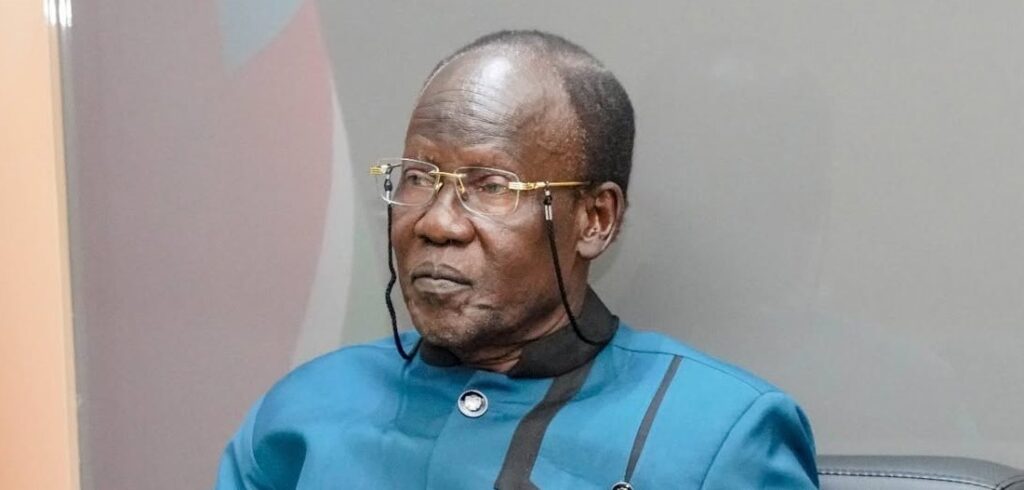
South Sudan’s Vice President James Wani Igga has backed calls by the Shilluk community for the government to resolve long-running disputes over land and boundaries in Upper Nile State, saying the issue has been a major source of conflict and displacement.
Wani Igga, who oversees the economic cluster, said the Shilluk people had suffered for more than a decade of conflict in Upper Nile, with fighting disrupting education, healthcare and livelihoods.
“The main grievance of the Shilluk tribe is the issue of land and boundaries of their areas with the neighbouring communities,” Wani Igga said on Saturday at a ceremony in Juba honouring General Johnson Olony, a prominent Shilluk military figure.
“I agree with the demand of the Shilluk to have clarity on the issue of land and boundaries.”
Land disputes and competing claims over territory have been a longstanding source of tension in South Sudan, where administrative boundaries have repeatedly been contested by communities and political actors.
Wani Igga said the creation of 32 states in 2015 had intensified disputes over territory and administrative boundaries.
“Land and boundaries in any country are the cause of fighting. We need to radically address the issue of land for the Shilluk community. After the creation of 32 states, it also exacerbated the issue and caused more fire,” he said.
He called on General Olony and the government to work together to find what he described as a “radical solution” to land and boundary disputes affecting Shilluk areas in Upper Nile.
“There are things that need us as South Sudanese to sit down and find a solution for them,” Wani Igga said.
Conflict and displacement
The vice president said years of fighting in Upper Nile had displaced large numbers of Shilluk people from their traditional areas, undermining the stability of the Shilluk Kingdom.
“The people of Shilluk in Upper Nile have suffered for the last decade due to war. Blood has been shed in Upper Nile senselessly,” he said.
He said schools had remained closed in some areas and children had been unable to attend classes because of the conflict.
“Women have died while giving birth because we have no access to hospitals. Fighting in Upper Nile has affected the Shilluk areas,” he said.
Wani Igga said the displacement of Shilluk communities was also affecting the traditional kingdom, which he said needs its people to remain settled around it. He said the government should listen to communities and armed groups to understand their grievances and address the causes of conflict.
“The Shilluk and the Shilluk community have rights, and anyone who takes up arms must be listened to so that he or she can express their grievances and reasons for fighting,” he said.
Olony urges unity
Olony, who was honoured at the ceremony organised by the Shilluk community under the leadership of King Kwongo Dak Padiet, thanked the community for its support and said it had strengthened him throughout his military career.
“I am your son, and you know me. I brought your children from different places, and some of them died in places you cannot even mention,” Olony said.
“You all know that I do not discriminate. I do not distinguish between someone from the Gar or someone from the Luak. People call me by my mother’s name, and that is something I am very proud of.”
Olony said he wanted to use his return to Juba to help restore the standing of the Shilluk community.
“I draw my strength from you as the Shilluk people. Thank you for raising my head. This time, I have come to raise your heads even higher,” he said.
He also sought to reassure supporters about security in Juba. “There is no need to be afraid. We have arranged all this with our President Salva Kiir Mayardit, my brother Tut Gatluak, our king and my brother Joakino. We have reconciled, and now we are in Juba,” Olony said.
“Juba belongs to all of us. It belongs to all South Sudanese. So people should not be afraid. Security is the responsibility of the army, not yours.”
Olony urged the Shilluk community to avoid activities that could create confusion or undermine the peace process.
He also cautioned against portraying the Shilluk community as uniformly aligned with the governing Sudan People’s Liberation Movement (SPLM), saying the party is a political organisation and membership is a personal choice.
“I do not want to tell you that all of you are members of the SPLM because it is a political party. If you want to join it, that is your decision. If you do not want to, that is also your choice,” he said.
Forces to be integrated
Olony said the peace agreement he signed with the government would lead to the reorganisation and integration of his forces and urged his supporters to prepare for the process.
“To those who signed the peace agreement, the reorganization and reintegration is coming,” he said.
Olony also sought to emphasise that his Agwelek forces are not exclusively Shilluk, saying they include members of several ethnic communities from across South Sudan.
“Agwelek is not only Shilluk. There are many tribes from South Sudan in it,” he said. “So let us join hands, organise ourselves and put our ranks in order, from Juba to Terekeka.”
Presidential Adviser on National Security Affairs Tut Gatluak Manime acknowledged the role played by King Kwongo in facilitating the peace agreement between Olony and the government, describing the king as a “man of peace”.
Tut also confirmed that Agwelek forces would be integrated into the South Sudan People’s Defence Forces (SSPDF).
King Kwongo said South Sudanese communities are one people and thanked those who attended the ceremony.
He described Olony as a fighter from the Shilluk Kingdom and called for implementation of the peace agreement between Olony and the government.
The ceremony, held under the theme “Together for Peace, Unity and Development”, brought together members of several communities, including the Bari and Mundari from Central Equatoria, the Moru from Western Equatoria and the Lopit from Eastern Equatoria.
Several communities from Upper Nile, including the Dinka and Nuer, were notably absent.
Olony’s shifting alliances
The ceremony came after the governing SPLM earlier this month formally absorbed members of the Agwelek-Kit-Gwang faction, with Olony declaring allegiance to President Kiir’s party. The move ended the faction’s separate political identity and brought its members into the ruling party.
Olony’s military career has been marked by shifting alliances.
He initially fought alongside government forces before defecting and taking up arms, saying he was defending the land of the Chollo (Shilluk) people in Upper Nile. He later joined the Sudan People’s Liberation Movement/Army-In Opposition (SPLM/A-IO), led by Riek Machar.
Under the 2018 revitalised peace agreement, Machar nominated Olony to become governor of Upper Nile State, but Kiir rejected the nomination and described him as a “warmonger”.
In August 2021, a rival SPLA-IO faction led by General Simon Gatwech Dual announced that it had ousted Machar in what became known as the Kit-Gwang Declaration. Olony was appointed Gatwech’s deputy.
In January 2022, the Kit-Gwang faction and Olony’s Agwelek forces signed separate peace agreements with Kiir’s government in Khartoum. The agreements later faltered, with faction leaders accusing the government of failing to implement key provisions.
Gatwech subsequently dismissed Olony as his deputy, and clashes broke out between their forces.
Olony later declared his willingness to pursue peace and return to Juba. His return to the capital in May 2023 followed months of negotiations with security officials aligned with Kiir.
In January 2025, Olony was appointed Assistant Chief of Defence Forces for Mobilization and Disarmament.

 and then