



The Central Equatoria State Ministry of Trade and Industry has given the state and Juba City chambers of commerce three months to implement recommendations aimed at resolving a prolonged leadership dispute.
The state ministry on Wednesday warned that failure to comply could lead to the suspension of the two competing chairpersons and the formation of an independent body to organise fresh elections, starting at grassroots level and extending to the state chamber.
The warning follows an investigation into a dispute between the Central Equatoria State Chamber of Commerce and the Juba City Chamber of Commerce. The conflict has escalated in recent months, with leaders of the two institutions accusing each other and using security forces to make arrests.
The investigation committee was established by the state Ministry of Trade and Industry to determine the causes of the dispute and examine how the two chambers should operate under the chamber’s constitution.
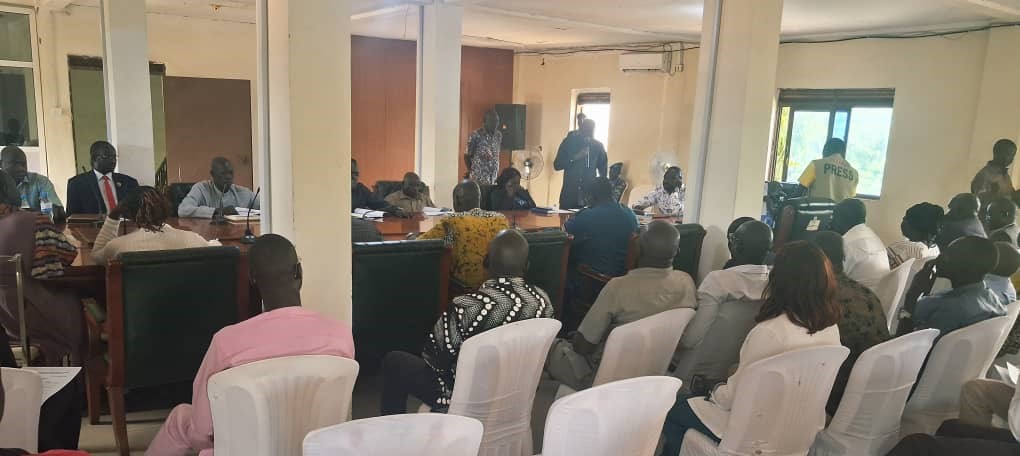
Presenting the committee’s findings in Juba on Wednesday, its chairperson, Emmanuel Chandiga Abias, said gaps in the chamber’s legal and administrative framework had contributed to the conflict.
“The chamber of commerce has its constitution, which was amended in March 2021, and this constitution helps to direct the work of the two chambers and the chamber of commerce in South Sudan,” he said.
Chandiga said the constitution was intended to be supported by regulations governing the day-to-day management of the chambers, but such regulations had not been developed.
“We discovered that that component is not there. Therefore, the reason why the two chambers of commerce are in problems is because they don’t have regulations,” he said.
He said the absence of clear regulations had contributed to disagreements over meetings and the respective responsibilities of leaders.
The committee also examined financial contributions between the chambers. It found that although the state chamber contributes 40% of its collections to the national chamber, it found no document clearly requiring the Juba City Chamber of Commerce to contribute the same proportion to the state chamber.
Chandiga said this had led to disagreement, with the city chamber arguing that it was not required to make the payment.
The committee also criticised the use of security forces in the dispute, describing the arrests of chamber officials as an abuse of office.
“The constitution is very clear. If there are issues, there are articles that talk about the resolution of conflict when it arises,” he said.
“Using the resources they have to organise forces to arrest a colleague … we feel this is an abuse of office.”
The committee further found that a board required under the chamber’s constitution had not been established at state level.
Chandiga said the board should include representatives of county chambers and the Juba City Chamber of Commerce and oversee the chamber’s activities before reporting to its general assembly.
“The constitution says there must be a board at the state level, but this board is not there,” he said.
Central Equatoria State Minister of Trade and Industry Mawa A. Moses said the recommendations called for the chambers to resolve their differences peacefully and stop interfering in the affairs of institutions operating at different administrative levels.
He also said the chambers should operate independently and leave government premises where some of them are currently based.
“We also observed that some of these chambers of commerce are operating in government institutions, and so the committee recommended that immediately they should move out from the government institutions so that they can operate as an independent entity,” Mr Moses said.
He said the government had formed another committee to oversee implementation of the recommendations.
The minister warned that the government would not allow the dispute to continue creating insecurity in the state.
“We told them that if they fail to implement those recommendations within a period of three months, we will be forced to suspend the two competing chairpersons and form an independent body to organise fresh elections from the grassroots, from the boma to the county and then to the level of the state,” he said.
Moses also warned the chambers against using security forces to settle disputes, saying their constitution provides mechanisms for arbitration and peaceful conflict resolution.
He added that any new tax introduced by a chamber of commerce must be approved by the state Ministry of Trade and Industry.
“If it is not with approval of the state minister of trade and industry, then it is an illegal tax which will not be allowed,” he said.
The officials said resolving the dispute and strengthening the chambers’ structures would improve their ability to represent businesses and engage with the government on taxation and other economic issues.
Acting Juba City Mayor Jennifer Yabu Lasuba said poor working relations between the institutions had been a major cause of the dispute.
She said clear regulations would help define the roles and responsibilities of each institution, and welcomed the investigation committee’s findings.
Yabu called for greater efforts to ensure the recommendations are implemented.

 and then