



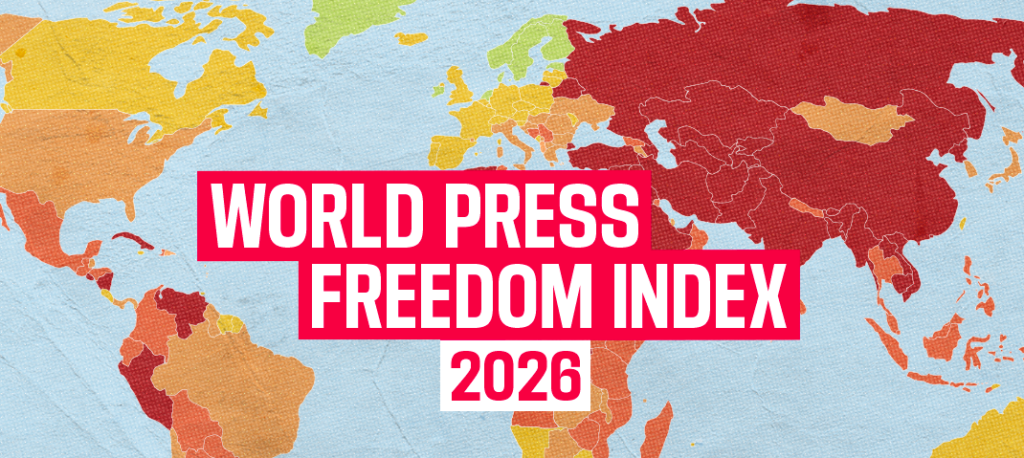
South Sudan’s press freedom situation has deteriorated further, according to the 2026 World Press Freedom Index released by Reporters Without Borders (RSF), which placed the country at 118 out of 180 countries, marking a continued decline in conditions for journalists.
The ranking represents a drop from 109th place in 2025, underscoring a worsening environment for media freedom in the country, according to the Paris-based watchdog Reporters Without Borders (RSF) on Thursday.
RSF said the media landscape in South Sudan remains “extremely precarious,” with journalists facing persistent intimidation, censorship, and insecurity linked to political instability and weak rule of law.
The organisation noted that reporters continue to operate under pressure from state and security actors, while access to information remains tightly restricted. Journalists, particularly outside the capital, face risks including harassment, detention and limitations on movement.
South Sudan has consistently ranked near the bottom of global press freedom indices since independence in 2011, with RSF attributing the long-term challenges to fragile institutions, ongoing insecurity and limited protections for media workers.
The index assesses countries based on political context, legal framework, economic pressures, socio-cultural conditions and the safety of journalists.
Rights Groups Concerned
Oyet Patrick, head of the Union of Journalists of South Sudan, said the union was deeply concerned about the decline, linking it to ongoing violence in parts of the country.
He told Radio Tamazuj that journalists had been directly affected, citing cases in which reporters working with Akobo FM fled violence and lost their jobs.
“There have also been a number of detentions of journalists in Unity State early this year. We have had cases in Leer as well as Bentiu,” he said.
Oyet also pointed to restrictions on access to information, including instances where the South Sudan People’s Defence Forces declined to provide official statements on security situations.
“All these, in our understanding as UJOSS, contribute to the country’s deteriorating press freedom situation,” he added.
Human rights activist Edmund Yakani said the decline was particularly concerning as the country moves toward elections.
“It is essential that authorities improve their record on press freedom and freedom of expression in the country,” he said.
Press Freedom Day
On World Press Freedom Day, observed on May 3 under the theme “Shaping a Future at Peace: Promoting Press Freedom for Human Rights, Development, and Security,” UJOSS called for greater protection of journalists.
As South Sudan prepares for elections in December, Oyet said a free and independent press would be critical for peace and stability.
UJOSS urged the government and other stakeholders to ensure access to information and the safety of journalists during the electoral process, saying reporters must be able to work without fear of harassment, intimidation or violence.
The union also called on journalists to use artificial intelligence responsibly while upholding ethical standards and information integrity.
World Press Freedom Day is observed annually on May 3 to promote press freedom, assess the state of media worldwide and honour journalists who have died in the line of duty.
At least nine journalists have been killed in South Sudan since 2014, including independent British-American war reporter Christopher Allen.

 and then