



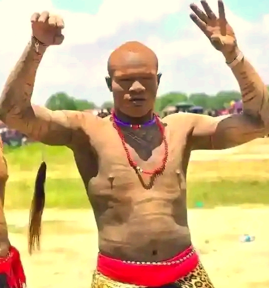
At 3:30 on the morning of October 12, 2026, a legend drew his last breath. By daybreak, the news had passed from person to person, and Yirol awoke to a silence it had never known. Aliajiou Nhial, whom the wrestling arena knew as Coronavirus, was gone. I went quiet for days. Even now, my heart refuses to believe it.
Aliajiou made more than a name for himself. He became a brand, and the brand was Yirol. When he stepped onto the wrestling field, our people stood taller, and spectators leaned forward on the edges of their seats, waiting to see what he would do next. At the microphone, commentators Pato Kuoi, Anyarjur, and Ater-Kuen shouted themselves hoarse, their voices cracking with excitement, much like Peter Drury when a football match reaches fever pitch. His fame spanned the Americas, Europe, Australia, Asia, and Africa, and fans around the globe rose in euphoria at the mention of his name. His strength was legendary. Merge the talents of Mark Henry, Brock Lesnar, John Cena, and Roman Reigns, and you would be only halfway to capturing his physical power.
Even Okonkwo, the hero of Chinua Achebe’s novel, could not compare. The man who threw Amalinze the Cat would never have dared to face Aliajiou. Had Aliajiou arrived in Umuofia, it would have been Okonkwo who retreated, and the nine villages would have learned a new name. But Aliajiou’s fame was never confined to nine villages.
Yirol was once home to exceptional wrestlers: Long Anguat, Malelung Makuei, Cuir Waat, Gai Bec (known as Nyanaliap), and Koc Aleth Anin Koc (known as Magoor), among many others. No one doubted them when it was time to represent Yirol. As these greats departed, Yirol’s prowess faded, worsened by internal conflicts and a rising culture of alcoholism.
Then came Aliajiou and his generation, proudly carrying the banner of Bahr el Ghazal. They were unbeatable. When Aliap, Atuot, and Ciec stood united, Yirol was a force no one dared to challenge. A rival would first have to divide Yirol into sections before he could hope to confront even a part of it.
Many admired Makur Telar and the Bahr el Ghazal Wrestling Association. Aliajiou represented this region with distinction, inspired the younger generation, and modeled responsibility in his community. He was the first official challenger to Magot Khot Ajak, known as Simba. Against a formidable roster of wrestlers, he remained undefeated. That was in his prime, before the rigors of competition began to take their toll, as time eventually does even to the strongest of men.
Strength, though, was never his greatest gift. Aliajiou was a man of integrity and strong moral character, a devout Christian and a gentleman. He was humble and approachable, and he met every situation with the composure of the paramount chiefs Bahon Mabor Deng and Reechdit Anyieth Reech. He never stirred sectional feuds. He was never a drunkard, and he never carried himself like the irresponsible wrestlers. In Bor, in Mundari land, and across the country, he was loved. A giant who walks softly is the rarest kind of giant.
Today, Yirol stands still, in disbelief. Mothers ask questions that have no answers. Young wrestlers gaze at the field and see only the space he has left behind. At his burial site, his fellow wrestlers gathered, clinging to the hope that he might awaken. If our people could confront death, they would have stepped forward to negotiate: “Leave Aliajiou. Take anything else.” They would have offered cattle, wealth, anything precious, for one more breath from our champion. But death does not bargain, and it does not return what it takes.
In the home Aliajiou left behind, five-year-old Nhial will wake up and wonder where his father is. He is too young to understand that the mighty man who once lifted him high is now beyond the reach of his small hands. No one will have enough words to answer him, so the answer must come from us, through our actions. To the young people who loved Aliajiou: do something meaningful for his family. Stand by his son. Raise Nhial, see that he gets a proper education, and help him grow up knowing that his father was strong and also a beautiful soul. That is how a legend lives on: in a boy who walks tall in his father’s name, long after the songs fade.
Aliajiou is a champion. The arena will remember his legacy, and every wrestler who follows will walk in his shadow. Rest in peace, Coronavirus.
Till then, yours truly, Mr. Teetotaler!
The writer, Dr. Sunday de John, holds an MBA and a Bachelor of Medicine and Bachelor of Surgery (MBChB) from the University of Nairobi, Faculty of Business and Management Sciences and Faculty of Medicine, respectively. He is the current Chairman of the South Sudan United Front-Progressive and can be reached via drsundayalong4@gmail.com
The views expressed in ‘opinion’ articles published by Radio Tamazuj are solely those of the writer. The veracity of any claims made is the responsibility of the author, not Radio Tamazuj.

 and then