



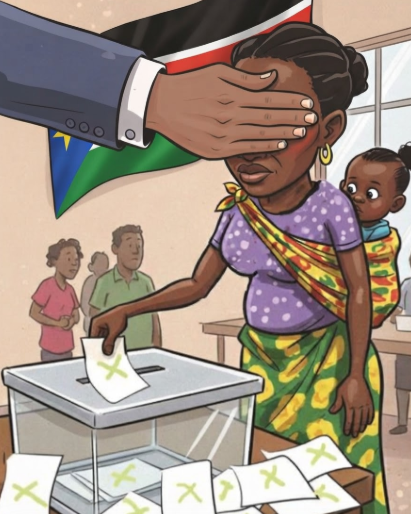
If South Sudan does not hold elections on 22 December 2026, the caretaker administration may keep state offices running, but it will face a deeper question of legitimacy. The safest path forward is a time-bound, inclusive, legally grounded arrangement that protects civic space and ends with a credible vote.
South Sudan has again reached a political deadline with the main promises of its transition still contested. The caretaker administration was presented as an election-period mechanism, not a new political settlement. If the vote is postponed, the country cannot simply behave as though the caretaker mandate has renewed itself. That would turn a short-term arrangement into an open-ended government with concentrated executive authority and reduced institutional checks.
The mandate question
President Salva Kiir dissolved the Revitalized Transitional Government of National Unity, the national legislature and state governments on 22 September 2026, then appointed a caretaker administration ahead of elections scheduled for 22 December. The same decision removed First Vice President Dr. Riek Machar and the other vice-presidents from office. Radio Tamazuj reported that the order relied on the National Elections Act, as amended in 2026, which allows the incumbent president to remain in office until an elected successor is sworn in.
That continuity clause may prevent a vacancy in the presidency, but it does not settle the political question created by a failed election. The 2018 peace agreement was built on power-sharing, collegial decision-making and negotiated safeguards among former belligerents. Once those arrangements are dissolved, any prolonged caretaker period requires more than executive interpretation. It requires a lawful and publicly accepted basis, clear limits on authority and a defined end date.
The European Union warned on 22 September that a caretaker government should concentrate on routine administration and avoid decisions with major political consequences while checks and balances are weakened. This is the correct standard. A caretaker administration should preserve essential services and public order. It should not use a delayed election to restructure the security sector, entrench appointments, alter electoral rules, or silence political competition.
Legality does not create democratic legitimacy
The amended election law provides a legal argument for presidential continuity during the electoral period. It does not give the executive an unlimited mandate if the electoral period no longer leads to an election. Parliament passed the amendment on 21 September, one day before the dissolution, and the law preserves the president’s full constitutional powers while requiring the vice-presidents to leave office. That asymmetry has already raised constitutional and political concerns.
Former Detainees represented in the peace monitoring system asked the Intergovernmental Authority on Development to clarify whether the 2018 agreement remained applicable after the transitional government was dissolved. Their question remains fundamental. If elections fail, South Sudan will need an agreed bridge between the expired transition and a future elected government. That bridge cannot credibly be designed by one side and imposed on all others.
Unresolved political and security questions
The continued detention and trial of Dr. Machar is part of the legitimacy problem. A July 2026 report of the UN Secretary-General recorded international calls for his release and for dialogue to restore an inclusive peace process. His case must be handled through transparent due process, independent judicial guarantees, and respect for the peace agreement. Keeping a principal opposition leader in detention while preparing an election would deepen doubts about whether contestants can organize, campaign and challenge state power freely.
The same concern applies to civic space. Journalists, civil society organizations, opposition parties and ordinary citizens must be able to debate the country’s future without intimidation, arbitrary detention or restrictions designed to favor incumbents. An election is not credible because ballots are printed. It is credible when citizens can register, obtain information and meet candidates, report abuses and vote without fear.
Public confidence is also damaged when state and security institutions are perceived as serving a party, leader or ethnic constituency rather than the republic. Claims about ethnic domination are politically explosive and should be tested against verifiable data, not repeated as slogans. The remedy is institutional: publish recruitment and command structures, enforce merit-based appointments, strengthen civilian oversight and ensure that the army, police and National Security Service act impartially under the law.
An election still lacks visible safeguards
The National Elections Commission has reported receiving US$25 million from the government and has displayed a voter-registration book, but it had not yet announced the start date for registration when Radio Tamazuj reported on the preparations. Funding is important, but money alone cannot compensate for unresolved legal disputes, insecurity, weak transport and communications, displacement and limited civic space. Millions of South Sudanese remain displaced inside the country or live as refugees abroad. Their right to participate must be addressed through clear procedures, realistic timelines and independent observation.
The UN Commission on Human Rights in South Sudan warned in August that renewed political fractures, conflict-related violations and shrinking civic space could reproduce the patterns that preceded earlier violence. If the vote proceeds without minimum safeguards, the result may be challenged. If it is postponed without a negotiated alternative, the caretaker government may lose public acceptance. Both paths carry risks, but indefinite rule without consent is the more dangerous destination.
What should happen if the election is postponed?
First, the government, opposition parties, civil society, faith leaders, women’s and youth representatives, refugees and internally displaced people should enter a short, independently facilitated dialogue. The purpose should be narrow: determine the legal status of the caretaker administration, agree on the minimum conditions for elections and adopt a schedule that cannot be extended by executive decree alone.
Second, the caretaker mandate should be published in full. It should define which decisions are permitted, which require multi-party consent, and which must wait for an elected government. Major security appointments, disposal of public assets, long-term borrowing and changes to electoral institutions should face heightened scrutiny. A small, representative oversight mechanism should publish regular compliance reports.
Third, the National Elections Commission should issue a public readiness assessment. It should state what has been completed, what remains outstanding, how much money is available, how displaced citizens will vote, and what operational risks could change the timetable. This assessment should be subject to review by parties, civil society and independent observers. A date without verified milestones is a political promise, not an election plan.
Fourth, the authorities should restore the conditions for peaceful competition. Political detainees should receive due process; arbitrary restrictions on assembly, travel and expression should end; and media outlets should be allowed to report without retaliation. The security services must adopt and publish election rules of conduct, with complaints investigated by bodies that are not controlled by the alleged violators.
Fifth, regional and international partners should support a credible process rather than a deadline at any cost. Their assistance should be linked to transparent benchmarks: voter registration, civic freedoms, security-sector neutrality, dispute resolution, inclusion of displaced citizens and independent monitoring. External recognition cannot replace domestic consent, but principled mediation can help prevent another unilateral extension.
The political choice
If elections do not take place, the caretaker administration should not be treated as a permanent government by default. It may continue essential functions temporarily, but its authority must be narrowed, monitored and tied to a new agreement with a fixed electoral endpoint. The question is not whether the country needs an administration the day after a postponement. It plainly does. The question is who authorises that administration, what it may do, and when citizens will finally choose their leaders.
South Sudan’s leaders can still prevent a caretaker arrangement from becoming another extension of elite rule. They should replace ambiguity with law, unilateralism with an inclusive agreement, and promises with measurable electoral steps. If they do not, the caretaker government may survive institutionally while losing the consent it needs to govern a divided and exhausted country.
The writer is a researcher and writer specializing in humanitarian and development issues in South Sudan, holding a degree in Sociology and Political Science from the Catholic University of Eastern Africa and a Master’s in Peace and Development Studies from the University of Juba. He can be reached via mogtomloyo@yahoo.co.uk.
The views expressed in ‘opinion’ articles published by Radio Tamazuj are solely those of the writer. The veracity of any claims made is the responsibility of the author, not Radio Tamazuj.

 and then