



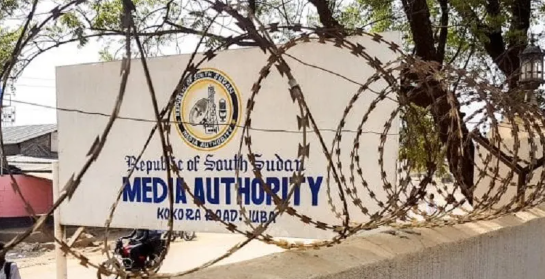
The South Sudan Media Authority has placed itself under scrutiny following an administrative decision requiring media institutions and platforms operating across the country to renew their licenses within 30 days. The decision, issued by the Media Authority in the exercise of its regulatory mandate under the Media Authority Act, has prompted concerns from numerous media outlets over the short timeframe, the high licensing costs and the absence of prior notice or clear procedural terms.
These concerns come at a time when the country is experiencing a severe economic recession affecting households, businesses and institutions alike. For many media organizations already struggling with high operating costs and declining revenues, the combination of a one-month deadline and steep licensing fees could have serious consequences for their ability to remain operational.
In the ongoing debate regarding this decision, it must be noted that the Media Authority exercised powers granted to it under the Media Authority Act as an independent regulatory body – or at least what ought to be an independent body – entrusted with regulating and developing the media sector in the public interest.
Discussing media oversight in the country through its two primary bodies – the Media Authority and the South Sudan Broadcasting Corporation (SSBC) – should not be reduced merely to freedom of expression as an existential right. It must also address the institutions tasked with regulating and protecting that freedom, as well as the Media Authority’s willingness to reject directives that conflict with its founding laws, core goals, and noble mission. This may place Journalist Ajou Luol Akuei, the director of the Media Authority, in front of a moral responsibility before it is an organizational obligation.
Regulating the fourth estate, before anything else, is a national responsibility that should not be monopolized or exploited by any party whatsoever, especially since this estate is considered the mother of all powers, given that every action begins with the word and ends with it through various means.
However, the regime’s exercise of power reveals that its targeting of the fourth estate is not new; rather, it has been a primary objective throughout its disastrous rule. The regime has deployed its full capacity – administrative, legal, financial, and security – not to foster regulation, but to besiege media institutions.
This is further demonstrated by persistent discriminatory appointment practices. A glaring example is the presidential appointment of Mr Kongder Dut Jok as Chairperson of the Board of Directors of the South Sudan Media Authority, alongside Gen. Peter Wal Athieu as Chairperson of the Board of Directors of the South Sudan Broadcasting Corporation. These two key figures lead the highest regulatory entities in the country, effectively overseeing mechanisms that restrict freedom of expression – a trend likely to intensify as the regime prepares for upcoming elections.
Regulating media work is, above all, an existential necessity – not just any existence, of course, but the free existence that the regime attempts to control through the two censorship councils.
One of them has recently sharpened its teeth. The Media Authority has given media outlets 30 days to renew their licenses, reportedly without prior notice or clearly defined procedural terms. This ambiguity alone gives reason to suspect security directives driving the Media Authority’s actions.
The sudden push appears designed to align with the requirements of the upcoming elections scheduled for the end of this year, while simultaneously relieving financial pressures in a state where official government stamps have increasingly become revenue-generating tools, outside the purview of the Ministry of Finance.
When examining the Media Authority, we must look beyond its paper mandate of laws, policies and regulations to consider what the regime actually demands of it.
Independence on paper is one thing; exercising statutory power strictly according to the regime’s directives is quite another.
Regulating and developing the media as a strategic objective should have placed the Media Authority at the forefront of its national responsibilities. However, recent security directives issued through the Media Authority suggest that what lies ahead is far worse, especially as the two regulatory bodies are striving to demonstrate their partisan loyalty over their professional loyalty.
Therefore, we cannot rule out the possibility that they will become tools for professional and institutional cleansing.
This one-month deadline for license renewal raises three fundamental questions.
First, is one month a reasonable timeframe given the current economic climate?
Media organizations are already struggling with high operating costs, low revenues, security challenges, and broader economic pressures. A brief deadline paired with high licensing fees moves beyond standard administration – it becomes a direct threat to the survival of many media outlets.
A regulator genuinely committed to a pluralistic media environment must ask whether this measure strengthens the sector or simply forces vulnerable outlets out of existence.
Secondly, what does this decision mean in the context of the elections?
I am against holding elections in this undemocratic and insecure environment. However, if we look at the Media Authority’s decision from this perspective, we will conclude that it is a different kind of war.
Because elections require more information, not less.
Citizens need newspapers, radio and television stations, digital platforms and journalists capable of presenting competing political viewpoints and holding candidates accountable. If media outlets are forced to close because they cannot renew their licenses on time, the space for public information will shrink precisely when citizens need it most.
That directly contradicts the Media Authority’s stated responsibility to foster an independent and pluralistic media environment.
This point alone seems to reveal the true intentions behind the security directive regarding license renewals.
Third, can regulation become a tool for political selection?
The absence of clear, transparent, and objective criteria reinforces the suspicion of bias. The Media Authority bears a heavy responsibility to demonstrate that its decisions are administrative rather than political, regulatory rather than punitive, and aimed at serving the public interest rather than political agendas.
The principle of licensing and oversight itself is not the issue. A functioning media sector requires professional standards, regulations, and accountability.
However, the fundamental question remains: Can the current regime of tribal oppression even be capable of regulating and developing an independent and pluralistic media through its two instruments, the Media Authority Council and the South Sudan Broadcasting Corporation Council?
This is clearly impossible, which is why many are concerned about the license renewal decision, its timing, and the potential consequences of the delay.
This leads me to ask again: Is the Media Authority a regulatory body or an instrument of professional and institutional cleansing?
This is simply an invitation to continue the discussion on this topic.
The writer, Sokiri Lo Poni, is a concerned South Sudanese. He can be reached via Sokiril8@gmail.com.
The views expressed in ‘opinion’ articles published by Radio Tamazuj are solely those of the writer. The veracity of any claims made is the responsibility of the author, not Radio Tamazuj.

 and then