



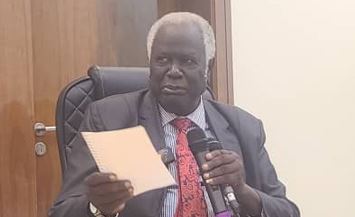
South Sudan’s National Elections Commission (NEC) has made substantial progress in preparations for the country’s first post-independence general elections, with electoral commissioners appointed in almost all states; however, funding gaps, insecurity, and logistical challenges continue to threaten the electoral timetable.
Speaking during an interview, NEC Chairperson Professor Abednego Akok said the commission has already established its structures across most parts of the country, leaving only the appointment of commissioners in Malakal before completing the nationwide deployment.
“We have achieved a lot,” he stated. “Commissioners have already been appointed in nine states, and only Malakal remains. We are moving forward with the preparations for the elections.”
The elections, expected to mark South Sudan’s first democratic transfer of power since independence in 2011, have repeatedly been delayed under successive peace agreements. The latest roadmap sets out a series of pre-election activities, including voter registration, civic education, and candidate nominations before polling can take place.
Although time is running short, Prof. Akok expressed confidence that the commission can complete the remaining activities if the government and all stakeholders provide the necessary political and financial support.
“What is required from the government and the commission is seriousness,” he stressed. “If there is commitment, there will be opportunities to complete the remaining activities without unnecessary delay.”
Akok explained that the electoral process will be conducted in phases, beginning with voter registration, followed by candidate registration, voter education, and polling.
One of the commission’s priorities, he said, is ensuring that internally displaced persons (IDPs) and refugees are not excluded from the elections. He said IDPs living in Protection of Civilians (POC) sites will register at designated centers within the camps. In contrast, South Sudanese refugees living in neighboring countries such as Uganda, Kenya, and Ethiopia will be able to register through South Sudanese embassies.
“There will be registration centers in the POC sites, while refugees living outside the country will register through our embassies,” he said.
Security remains one of the biggest challenges facing the planned elections. Akok acknowledged that some parts of the country continue to experience instability, which could affect voter registration and polling.
The commission, he said, will conduct security assessments across all states and administrative areas in collaboration with national security institutions and relevant international partners before deciding where voting can safely take place.
“We will assess every state and administrative area. Where there is insecurity, we must first consider the safety of the people before conducting elections,” he said.
Areas that remain inaccessible due to insecurity may be unable to participate in the polls until conditions improve, he added.
Funding is another major obstacle. Prof. Akok disclosed that the commission has so far received about US$21 million to support operational activities, including vehicles and state-level preparations, and an additional US$6 million for civic and voter education programs.
However, he said more financial support is required to complete voter registration and other remaining electoral activities.
“We expect the government to release additional funding in the coming days so that voter registration and other activities can continue,” he said.
The NEC is also procuring ballot boxes and other election materials needed for the polls. Akok said additional logistical equipment is expected to arrive before voter registration begins.
To enhance transparency and public confidence, the commission plans to deploy election observers from relevant state institutions and civil society organizations to monitor voting and vote counting throughout the country.
Asked whether the planned elections could be postponed, Akok said the commission remains committed to the current timetable, noting that any decision to delay the vote would ultimately be political rather than technical.
While a limited extension could be considered under exceptional circumstances, he cautioned that a prolonged postponement would have wider political implications.
Prof. Akok concluded by urging South Sudanese citizens to register and participate in the electoral process.
“The people have the right to choose their leaders. Every eligible citizen should register and take part in the elections because this is their democratic right,” he said.
The National Elections Commission is expected to begin voter registration once the remaining operational requirements, including funding and deployment of election materials, are completed. The conduct of the elections is widely viewed as a critical milestone in implementing the 2018 Revitalized Peace Agreement and advancing South Sudan’s democratic transition.
South Sudan has repeatedly postponed elections since gaining independence in 2011. The unity government has said the next polls are scheduled for December 2026 as part of the country’s extended transitional roadmap.

 and then