



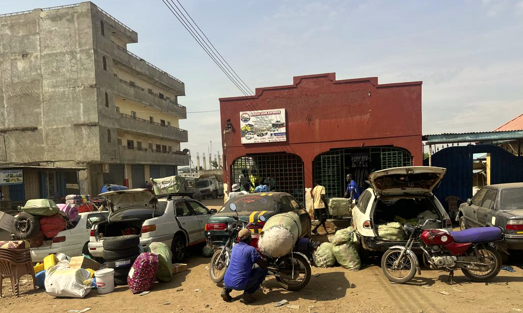
The first thing that hits you at Juba’s Customs Taxi Park is not the smell of diesel or the dust spinning under the worn tires.
It is the noise. “Yei! Yei! Yei!”, “Koboko! Koboko!” “Rumbek! Rumbek!” and “Terekeka! Terekeka!”
Young conductors weave between ageing station wagons and minibuses, shouting destinations with the urgency of men racing against time. Drivers lean against dusty Land Cruisers, calling out to hesitant passengers, while women carrying trays of roasted groundnuts, tea, boiled eggs and bottled water weave through the maze of vehicles, hoping to make one last sale before another taxi pulls away.
The Customs Taxi Park is more than a transport terminal. It is one of South Sudan’s economic lifelines.
Every day, hundreds of vehicles leave this crowded hub carrying traders, farmers, students, civil servants, and families to destinations across the country. Pick-up trucks head to Yei, one of South Sudan’s most productive agricultural regions, returning laden with bananas, cassava, tomatoes, and leafy vegetables that supply markets across the capital. Others travel to Terekeka, Rumbek, Nimule, and the Ugandan border, transporting the goods that keep businesses running and households supplied.
Here, movement is commerce. It is an opportunity. For many families, it is survival.
Across South Sudan, however, simply moving from one place to another has become one of life’s costliest necessities.
Behind every taxi fare lies a chain of rising costs driven by soaring fuel prices, a weakening currency and an economy struggling to recover from years of instability. Although South Sudan is an oil-producing nation, it imports nearly all of its refined fuel through neighbouring Uganda and Kenya, leaving domestic prices vulnerable to exchange-rate fluctuations, transport costs and regional supply disruptions.
The conflict in neighbouring Sudan has compounded those pressures by disrupting South Sudan’s crude oil exports, its main source of government revenue and foreign exchange. As the South Sudanese pound has depreciated, imported fuel has become increasingly expensive, driving up transport fares and, ultimately, the price of almost everything that reaches homes, markets and businesses.
Few people understand that reality better than John, a commercial driver whose name has been changed because he feared speaking publicly about checkpoint payments could put his safety at risk.
For years, John has driven passengers between Juba and Yei along one of the country’s busiest commercial corridors. The road links farmers to urban markets, traders to suppliers, and families separated by work or conflict. But before he even turns the ignition key, he already knows today’s trip may not earn him a profit.
Standing beside his ageing station wagon, he watches conductors persuade travellers to fill the remaining seats. His attention drifts instead to the fuel gauge.
“A litre of fuel is now around 20,000 South Sudanese pounds,” he says. “To make one trip, we need about 40 litres. That is nearly 800,000 pounds.”
He pauses before adding another calculation.
“Even if four passengers each pay 180,000 pounds, we still cannot recover the fuel cost.”
Fuel, he says, is only the beginning.
Before leaving the taxi park, drivers make a series of mandatory payments to different offices operating around the terminal. Once on the Juba–Yei Road, additional checkpoint charges accumulate long before they begin thinking about repairs.
Then comes the road itself.
Deep potholes, eroded sections and rough surfaces punish vehicles every day, wearing out tyres, suspension systems and shock absorbers long before they should.
“By the time you reach Yei,” John says, “you have already spent so much money.”
The journey covers only about 170 kilometres, yet it is one of South Sudan’s most important transport corridors. Much of the fresh produce sold in Juba travels along this road, meaning every increase in transport costs is eventually reflected in market prices across the capital.
A rise at the fuel pump leads to higher prices for tomatoes in Konyo Konyo Market.
More expensive diesel becomes an added cost on a plate of food in a roadside restaurant.
Transport quietly becomes one of the strongest drivers of inflation felt by ordinary families.
The trend is reflected in regional data.
The Famine Early Warning Systems Network (FEWS NET) reported that fuel prices in many South Sudanese markets were between 45 and 105 percent higher in May 2026 than they had been just three months earlier. As transport costs increased, traders passed those expenses on to consumers, contributing to rising food prices in a country where millions already struggle to afford necessities.
Economists often describe fuel as the bloodstream of an economy. When its price rises, the effects spread far beyond filling stations, flowing into farms, markets, restaurants, construction sites, schools, and health facilities.
For drivers like John, however, those economic forces are measured less in statistics than in the uncertainty of every journey.
Each morning begins with the same calculation: fuel, checkpoint fees, vehicle repairs, and passenger fares.
Only after subtracting those costs does he discover whether a day’s work has earned him enough to take something home.
The passengers boarding John’s vehicle do not see the calculations behind their fare.
They see only the amount they are asked to pay.
A trader carefully unfolds worn banknotes before handing them to the conductor. A mother quietly counts the money left in her purse after paying for two seats. A young man travelling in search of work hesitates before climbing aboard, knowing the fare will leave him with less to spend when he reaches his destination.
Every passenger is making a calculation.
One of them is Awan Ach, a salaried worker who commutes daily between New Site and Customs.
Until recently, the journey cost him about 3,000 South Sudanese pounds. As fuel prices climbed, the fare rose first to 4,000 pounds and then to 5,000, turning what was once a routine expense into one of the biggest demands on his monthly income.
“I spend more than 10,000 pounds every day on transportation,” he says. “The salary I receive is worth less than 50 US dollars.”
The rising fare is only part of his financial struggle. His income supports his wife, three children, and several relatives, while rent alone costs more than 200,000 South Sudanese pounds each month.
“So actually we are working at a loss,” he says. “The money that I earn goes to transportation.”
For Awan, going to work has become an exercise in survival. Staying home is not an option.
“I have to come to work every day,” he says. “If I don’t come, I could lose my job.”
Like many commuters, he says the increase in fuel prices affects far more than transport.
“When fuel prices go up, everything else also goes up,” he says. “You go to the market now, and food prices have increased.”
He believes the government should do more to explain the crisis and help ease the burden on struggling households.
“If the government is concerned about the citizens, they should come out and do something,” he says. “They should explain what is happening and find ways to reduce the burden on people.”
His experience mirrors that of thousands of workers across Juba, where transport is consuming an ever-larger share of household incomes, leaving less money for food, rent, healthcare and school fees. For many families, the daily commute has become almost as costly as the salary it is meant to earn.
Every additional litre of fuel burned on South Sudan’s roads eventually appears somewhere else in the economy.
For drivers like John, it is another expense deducted from already thin earnings.
For passengers like Awan, it is another cut into a shrinking household budget.
Several kilometres away, inside a busy roadside restaurant where chicken sizzles in bubbling oil and lunchtime customers crowd nearly every table, the same crisis is unfolding differently.
The steady hiss of hot oil competes with the chatter of customers waiting for meals as smoke from charcoal stoves hangs in the air.
From the kitchen, Rose barely looks up as another order comes in.
Like many workers in Juba, her day begins long before she reaches her workplace. Recently, the hardest part has not been the job itself, but getting there.
“Before, I used to spend about 5,000 South Sudanese pounds to come to work,” she says without taking her eyes off the frying pan. “Now I pay 10,000.”
The return journey costs the same.
By the end of each working day, Rose spends about 20,000 South Sudanese pounds simply travelling between home and work.
“It is a lot of money,” she says quietly. “People are suffering.”
Around her, customers eating lunch are having much the same conversation. Some complain about taxi fares. Others discuss the rising cost of vegetables, cooking oil, and charcoal.
The fuel crisis has become impossible to escape.
What begins at the fuel pump now reaches almost every household budget, leaving families with difficult choices about what they can still afford.
Across Juba, the cost of moving shapes the day long before the working day begins.
For Betty, the calculations start before sunrise.
Leaving her home in Gurei, she pieces together a journey that now requires two boda boda rides and a shared taxi before reaching her office. Every stage costs more than it did only weeks earlier.
“Before, I paid 4,000 pounds for the first boda boda,” she says. “Now it is 5,000.”
By the time she reaches work, she has spent about 17,000 South Sudanese pounds. The journey home costs the same.
“Sometimes you remain hungry,” she says. “The money has already gone to transport.”
She says the strain is becoming increasingly visible in her community. More children are walking long distances to school because their parents cannot afford transport, while others remain at home after being sent away for unpaid school fees. For many families, transport no longer competes only with convenience—it competes with food, education and healthcare.
The burden is felt just as sharply by those who earn a living from transport.
On a roadside in Malakia, a boda-boda rider waits beside his motorcycle, hoping for another customer. Business has slowed as rising fuel prices force riders to increase fares.
“When I tell someone that a journey which used to cost 5,000 pounds is now 7,000, they complain,” he says.
He understands their frustration. His passengers are struggling with the same rising cost of living. But before he can earn an income, he must first buy fuel.
“Earning money now is not easy,” he says. “If fuel keeps increasing, some people will stop operating.”
Every rider forced off the road means fewer transport options for workers, patients, and traders who depend on motorcycles to navigate parts of the city beyond the reach of shared taxis.
The pressure extends beyond transport.
Outside a modest hotel in Juba, manager Paul Godfrey watches staff clear away lunch plates while thinking about tomorrow’s shopping list.
“The prices keep changing,” he says. “You prepare your budget today, but when you go back to the market tomorrow, everything has changed.”
For restaurant owners, the impact of rising fuel prices begins long before customers see it on the menu. Suppliers charge more to transport vegetables from farming communities. Cooking oil, meat, and beverages arrive with higher delivery costs, while generators consume increasingly expensive diesel during frequent power cuts.
“The money you collect today goes back to the market tomorrow,” Godfrey says. “You think you have made a profit, but when you replace your stock, you realise you have earned almost nothing.”
Like many business owners, he faces a difficult choice: absorb rising costs or increase prices and risk driving customers away.
“If you increase prices today and tomorrow the market goes up again, what do you do?” he asks. “People think you are simply increasing prices, but they don’t know what has happened behind the scenes.”
South Sudan’s economy remains heavily dependent on oil exports, which provide most government revenue and foreign exchange. But the conflict in neighbouring Sudan disrupted the pipeline carrying South Sudan’s crude to Port Sudan, reducing export earnings and putting further pressure on the South Sudanese pound. As the currency has weakened, imported fuel has become increasingly expensive, driving up transport costs and the price of goods across the country.
According to the Famine Early Warning Systems Network (FEWS NET), fuel prices in monitored markets rose by between 45 and 105 percent in the three months to May 2026, contributing to rising food prices nationwide.
For Edmond Yakani, Executive Director of the Community Empowerment for Progress Organization (CEPO), the statistics tell only part of the story.
“Prices are getting abnormal,” he says. “Civil servants, soldiers, and ordinary citizens are asking what is happening.”
He says the government should engage fuel suppliers, review taxes that may be contributing to higher prices, and communicate more openly with the public about the country’s economic challenges.
“If there are problems affecting supply or taxation, people deserve to know,” he says. “Something needs to be done before the situation becomes even more difficult.”
The Ministry of Petroleum and the Ministry of Finance and Planning did not respond to requests for comment on the recent increase in fuel prices or the concerns raised by transport operators, businesses, and consumers.
As afternoon gives way to evening, the pace at the Customs Taxi Park begins to slow.
The conductors who spent the morning shouting destinations lowered their voices. Traders gather unsold goods into sacks. The final passengers climb aboard vehicles bound for Yei, Terekeka, and towns beyond the capital.
John walks slowly around his ageing station wagon, checking each tyre before settling into the driver’s seat.
Tomorrow, he knows, he will repeat the same routine.
Calculate the fuel.
Count the passengers.
Estimate the checkpoint fees.
Hope nothing breaks down.
Hope there is something left to take home.
The engine coughs to life, and dust rises behind the vehicle as it pulls onto the Juba–Yei road, carrying traders, mothers, students and labourers towards one of South Sudan’s most important agricultural corridors.
For the passengers, it is another journey.
For John, it is another gamble.
His story began with the price of a litre of fuel.
By the end of the day, it had become the story of a commuter whose wages are swallowed by transport, a waitress spending half her earnings getting to work, a boda boda rider struggling to keep his business alive, and a restaurant owner watching profits disappear as costs climb.
In South Sudan, the price displayed on a fuel pump does not remain at the filling station. It travels with every taxi leaving Customs, every motorcycle weaving through Juba’s streets, and every truck carrying food to market. It arrives in household budgets, school fees, restaurant kitchens, and family dinner tables.
A litre of fuel has become more than a commodity.
It has become a measure of how far people can travel, how much they can earn, what they can afford to eat and, increasingly, how difficult it has become simply to move forward.
As darkness settles over the taxi park and the last calls of “Yei! Yei!” fade into the evening, the day’s journeys come to an end.
The calculations, however, begin again tomorrow.

 and then