



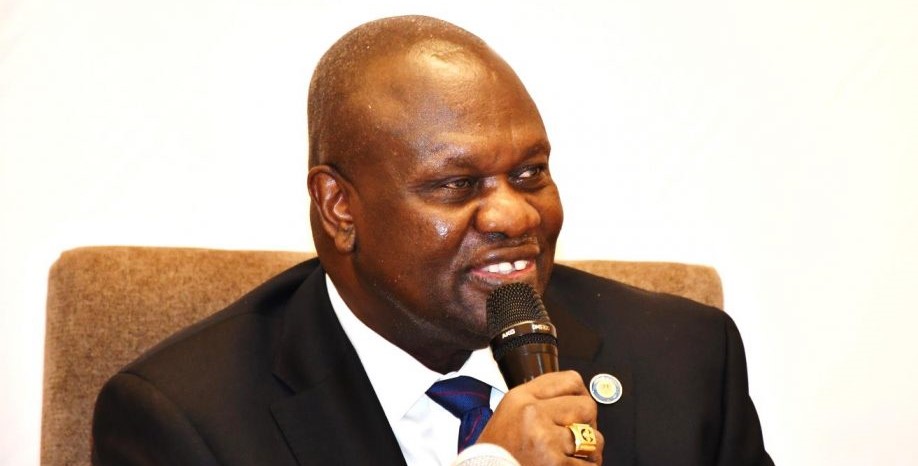
A South African digital forensic expert told the special court in Juba on Friday that suspended First Vice President Dr. Riek Machar declined to provide passwords for his electronic devices, complicating efforts to extract data.
Ratlhogo Peter Calvin Rafadi made the remarks during the 71st session at Freedom Hall, where he was questioned by judges about the handling of digital evidence linked to Machar.
Judge Stephen Simon Isaac asked Rafadi why he had not extracted an article from Machar’s device.
Rafadi said Machar had not complied with investigators’ requests to provide passwords, preventing access to the data.
“The password was not provided and I kept the sealed all the time and those articles were inside sealed evidence plastic bag. I didn’t want to tamper with them to protect integrity of data in those phones and laptop,” Rafadi said.
He told the court that Machar’s devices contained built-in security systems that could result in data loss if accessed improperly.
“They operate in protected built-in security feature such as Knox and such features if interrogated with investigative tool, you are more likely not to recover any data,” he said.
Simon asked who was expected to provide the passwords for Machar’s two devices.
“The rightful owner is supposed to comply with investigating officer in providing the password,” Rafadi said.
He also said he had not requested the investigating officer to obtain the passwords from Machar, adding that he believed the devices were already without passwords as they were received in sealed evidence bags.
Rafadi said the investigating officer also did not have the passwords, which led him to seek alternative technical options. The 40-year-old investigator said he consulted a private digital forensic expert, who told him there was no tool capable of unlocking the latest Samsung and MacBook devices used by Machar.
Presiding Judge James Alala Deng questioned whether the devices may have been tampered with and raised concerns about the scope of the analysis.
Rafadi said the devices had not been altered, adding that he only worked on items physically presented to him.
The judge also asked whether any extracted messages suggested that any of the accused ordered the Sudan People’s Liberation Army-in-Opposition (SPLA-IO) and the White Army to attack the army garrison in Nasir.
“There were various communication with SPLA-IO and there were also calls made by some of the accused and there were also idiom languages such as ‘we baptized five of them and we welcome them with songs,’” Rafadi said.
Defense lawyer Kur Lual Kur requested a one-week adjournment to prepare the accused for questioning by judges and asked that the next session be broadcast live on the South Sudan Broadcasting Corporation (SSBC).
However, lead prosecutor Ajo Onyo’Ohisa Issa opposed both requests, arguing that questioning would be conducted by judges rather than the defense and should proceed without delay. He also warned that live broadcasting could be used to mobilize supporters and pose security risks.
Judge James Alala Deng adjourned the proceedings until Monday, April 27, when the panel is expected to rule on the defense application.
Machar, 73, who is under house arrest, faces charges including murder, conspiracy, terrorism, treason and crimes against humanity. His co-accused remain in detention under the National Security Service.
Prosecutors allege that forces of the Sudan People’s Liberation Army-in-Opposition (SPLA-IO), allied with the White Army militia, killed 257 South Sudan People’s Defence Forces soldiers, including commander David Majur Dak, and destroyed or seized military equipment worth about $58 million in an attack on a garrison in Nasir in March 2025.
The seven co-defendants are Puot Kang Chuol, 40; Mam Pal Dhuor, 37; Gatwech Lam Puoch, 66; Lt. Gen. Gabriel Duop Lam, 53; Camilo Gatmai Kel, 47; Mading Yak Riek, 45; and Dominic Gatgok Riek, 27.

 and then