



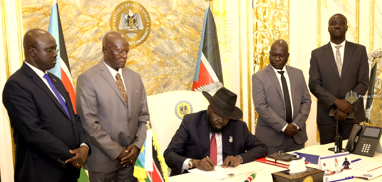
South Sudanese President Salva Kiir Mayardit on Wednesday finally assented to the East African Community (EAC) Treaty Act 2026 in the presence of TNLA Speaker Joseph Ngele Paciko and Council of States Speaker Daniel Akot Akot.
The Treaty for the Establishment of the East African Community is the legal instrument signed on 30 November 1999, and in force since 7 July 2000, that created the regional intergovernmental organization. It established a Customs Union, Common Market, and a framework for political federation among Partner States to foster economic, social, and political integration.
Adv. Beny Gideon Mabor, a Private Attorney with Premier Choice Law Group and a former Undersecretary at the Ministry of East African Community Affairs, told Radio Tamazuj on Thursday that it is a long-overdue but strategic and timely legal framework that guarantees South Sudan’s major achievements in the journey for state and nation-building as a responsible member of the regional and international economic community.
“On a personal note, this is a joyous day, not only for me as a former mandate holder who has been at the forefront of ensuring development, ratification and assent of the said regional legal instrument, but equally good for our country and the region for timely integration processes into the East African Community organs and institutions to achieve socio-economic, political, scientific and cultural growth and developments amongst others,” he said.
According to Mabor, after the domestication of the EAC Treaty Act, the government is expected to take several key steps, effective immediately, including the government establishing mechanisms at the Ministry of East African Community Affairs to monitor the implementation of the treaty and assess its impact on regional integration and national development.
“The government is to harmonize national laws and policies in line with the EAC Treaty to ensure commitment and implementation of regional integration, including those related to customs, trade, and other commitments under the common market protocol. The Government should, from now, invest in infrastructure development that facilitates trade and movement within the EAC partner states, such as transport networks and communication systems,” he counseled. “The government and the development partners should, from now on, strengthen the institutional capacities of public servants across the institutions and the private sector to effectively manage and advance EAC integration processes for the common good.”
Mabor added that the assent of the EAC Treaty Act is a positive step toward implementing the decisions of the 25th summit of the EAC Heads of State.
“South Sudan has three challenges to address: the removal of all non-tariff barriers before 30 June 2026; the conduct of a national consultation on the EAC constitutional arrangement; and the clearance of statutory arrears,” he said. “I must sincerely applaud all those involved in making the EAC Treaty Bill come to light, particularly the Ministry of Justice and Constitutional Affairs, Ministry of East African Community Affairs, Ministry of Parliamentary Affairs as leader of government business in parliament; Ministry of Cabinet Affairs that take charge of the Cabinet memorandum and above all legal administration in the Presidency led by senior counsel Athian Akec that did nitty-gritty of the Bill before it’s assent into law by H. E the President.”

 and then