



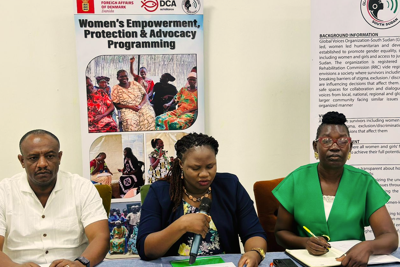
A new women-focused project has been inaugurated in the South Sudan capital, Juba, aiming to protect women and girls, tackle inequality, and support small business owners struggling under economic pressure.
The Women’s Empowerment, Protection and Advocacy Programme is being implemented by the women-led Global Voices Organization (GVO) with support from Dan Church Aid (DCA) and funding from Danida.
The one-year pilot project, running from January to December 2026, will focus on four areas of Juba County considered among the city’s most vulnerable: Gumbo-Sherikat, Gudele, New Site, and Hai Referendum.
Organizers say the programme will directly target 255 beneficiaries, including 156 women, 99 men, and 55 persons with disabilities. In contrast, nearly 36,965 people are expected to benefit indirectly through awareness campaigns, community outreach, and media engagement.
Speaking during the project inception meeting in Juba, Josephine Chandiru, the Executive Director of Global Voices, said groundwork had already begun, but that stakeholders first needed to understand the project’s goals and activities.
“We are a bit late, but we have already started groundwork in terms of implementation,” she said. “Before we go deep into the implementation, we needed to make key stakeholders aware of the project goals, objectives, and activities so that they also support the successful outcomes of the programme.”
The initiative comes as many women in South Sudan continue to face domestic violence, limited economic opportunities, social exclusion, and barriers to justice.
According to project documents, the programme aims to empower women, social movements, and marginalized groups to claim and protect their rights, reduce extreme inequalities, and strengthen inclusive and accountable governance.
South Sudan has faced years of conflict, displacement, and economic hardship since its independence in 2011, with women and children often carrying the burden of crises.
GVO says persistent conflict, land disputes, inflation, weak governance, climate shocks, and exorbitant and multiple taxes on small businesses have increased frustration and vulnerability in Juba.
“If unaddressed, Juba will remain a hotspot for crime, land disputes, gender-based violence and exploitation,” the organization said in its presentation.
One of the project’s key advocacy goals will be to support women traders who say that multiple taxes and fees are making it harder for them to survive.
“We now have very many taxes and heavy taxes that are being levied on women doing small businesses,” Chandiru said. “We want to engage the city council authorities so that some of these taxes can be reduced, if not completely removed.”
She said women themselves would be supported to identify priority issues and present them directly to authorities.
The programme will also provide training for traditional chiefs, women leaders, and civil society organizations on women’s rights, legal entitlements, gender-based violence prevention, and referral systems.
Other planned activities include public meetings, church gatherings, market-day forums, drama performances, and role plays designed to challenge harmful social practices such as early marriage, wife inheritance, denial of girls’ education, and domestic abuse.
Men will also be engaged as allies in women’s protection and empowerment. Organizers plan to mentor 30 male champions, including chiefs, police officers, legislators, youth leaders, and faith leaders, to promote positive masculinity and non-violence.
Brigadier General James Dak Karlo, the director of the Special Protection Unit and Child Affairs at the South Sudan National Police Service, said the selected locations were areas facing serious social protection concerns.
“These are the areas where we are having more crises,” he said, pointing to cases of rape, domestic abuse, and trafficking.
Dak cited one case in which a trafficked child was taken to Uganda before being traced and returned, and another in which more than two dozen children were intercepted while allegedly being moved through the region. He said domestic violence had also become a growing concern, driven partly by economic hardship.
“The issue of domestic violence is a bit high,” he said. “This is being triggered because of the economic crisis.”
He added that empowering women benefits entire communities.
“If we empower women, we empower society,” he said.
Jemal Seid, the DCA acting country director, said the partnership with GVO replicated a commitment to localization by placing national organizations at the center of humanitarian and development work.
“We firmly believe that sustainable impact is best achieved when local actors are at the center of humanitarian response and development efforts,” he said.
He described GVO as a women-led organization with community trust and local knowledge, adding that the pilot project could help demonstrate how inequality can be reduced and safer spaces created for women and girls.
“We know the challenges women and girls are facing in this country cannot be addressed within a single year or a single project,” Seid said. “But we take this project very seriously.”
Organizers also acknowledged challenges already affecting implementation, including poor mobility between communities, high fuel prices, and the limited participation of persons with disabilities.
Chandiru said the group planned to improve inclusion by setting clear targets to ensure people with disabilities are represented in future activities.
Expected results include stronger cooperation between civil society, government, and community leaders, improved accountability, reduced violence, and better protection for women and girls.
For many women in Juba trying to support families through small businesses or informal work, organizers say the project could offer not only training and advocacy, but also a voice in shaping the decisions that affect their lives.

 and then