



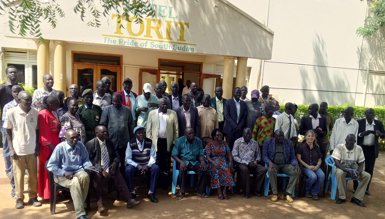
Eastern Equatoria State leaders, community elders, government officials, legislators, and representatives from different administrative areas have renewed calls for collective action to end cattle raiding, revenge attacks, and other conflicts affecting communities around the Kidepo Valley.
The call was made over the weekend during a peace dialogue organized in Torit, where participants discussed practical solutions to insecurity, particularly in areas surrounding the Kidepo Valley and Kidepo Game Reserve.
Claudio Opwanya, an elder from Kidepo Valley, shared his experience in resolving past conflicts through the recovery and return of stolen property. He said cattle raiding has become one of the major threats to peace in the region but insisted that it can be stopped if leaders take practical measures.
He recalled a previous incident when communities were preparing for revenge attacks after cattle were rustled. He explained that intervention by government authorities helped prevent further violence by recovering stolen cattle and returning them to their rightful owners.
According to him, after the stolen cattle were recovered and returned, communities stopped retaliatory attacks, creating lasting peace between the affected groups.
“Raiding can be stopped,” he stated. “Cows that have been raided should be rounded up and returned to the rightful owners.”
He appealed to the state government to support county authorities with security forces because local administrations alone cannot handle such situations without government backing.
He also called for honesty from communities when reporting losses, warning against exaggerating the number of stolen animals because it makes recovery efforts more difficult.
For his part, Auxillio Odume, Director General in the State Ministry of Peacebuilding, said peace efforts must focus on communities because conflicts are experienced mainly at the grassroots level. He praised the approach taken by Enjojo Foundation in supporting peacebuilding initiatives around Kidepo Valley, saying the organization began by creating community peace committees at the boma level.
According to Auxilio, peace cannot only be discussed at government offices but must involve local communities who understand the causes of conflict. He highlighted several challenges affecting Kidepo Valley, including cattle raiding, alcohol abuse, gender-based violence (GBV), and revenge killings, among others.
He also praised initiatives such as Kidepo Kids, describing them as a way of changing young people’s attitudes and preventing future involvement in violence.
“These children are already disarming the mind,” he said. “They will never go for raiding because they are learning peace.”
He encouraged communities around Kidepo Valley to support peace initiatives and allow organizations working in the area to continue their programs.
Meanwhile, Onyang Peter Ohuyoro, Chief Administrator of Kidepo Valley Administrative Area, said the biggest challenge facing peace efforts is the lack of implementation of agreements and resolutions. He also appealed to the government to deploy mobile security forces to support local authorities in responding to conflicts and protecting communities.
He also called for improved communication networks and stronger early warning systems to help authorities respond quickly whenever tensions emerge.
“This is a concern of the state; it does not only require Kidepo Valley to act, but it is also our collective responsibility,” he said.
The administrator also emphasized the importance of training community rangers who can support government efforts, especially around conflict hotspots.
For her part, Margaret Kasara, who represented state lawmakers at the meeting, praised the dialogue for allowing communities to raise their concerns and find solutions. She urged commissioners, administrators, and youth leaders from affected areas to work together in addressing cattle raiding, saying young people are central to either creating conflict or building peace.
“You are the eyes on the ground. Open your eyes so that you give a good example to the people,” she told the youth.
Tobiolo Alberio Oromo, a national parliamentarian and former governor of the defunct Torit State, said leaders must work together and speak with one voice when addressing insecurity. He reminded leaders that the government has a constitutional responsibility to protect citizens and their property.
“Peace must start with us; we must move together, strategizing together on how to build a new generation,” he said.
He called for stronger law enforcement and urged leaders to separate politics from administration when serving communities.
Margaret Idwa Okuye, Acting Governor of Eastern Equatoria State, assured participants that the government will continue working to reduce insecurity and promote peace.
She acknowledged the role of peace partners such as Enjojo Foundation, saying their work must be supported because peace requires shared responsibility.
“If we do not take full responsibility, this Enjojo also will die,” she warned.
The acting governor also defended the importance of protecting Kidepo Game Reserve, saying the area belongs to the people and can become an important economic resource if properly managed.
She urged communities to avoid negative discussions that undermine development initiatives and instead use proper channels to raise concerns.
The peace dialogue concluded with a strong message that ending conflict in Eastern Equatoria requires unity among government institutions, communities, elders, youth, and peace organizations.
Participants agreed that security alone cannot solve conflicts unless communities also change attitudes, reject revenge, and support reconciliation.
Leaders emphasized that Kidepo Valley has the potential to become a symbol of peace, tourism, and economic development if communities work together.
The meeting ended with calls for continued engagement between communities and authorities, with leaders urging citizens to embrace dialogue as the path toward lasting peace.
“If we put our minds together, we feel that we have our people. Let us work collectively and talk with one language,” Acting Governor Idwa said.

 and then