



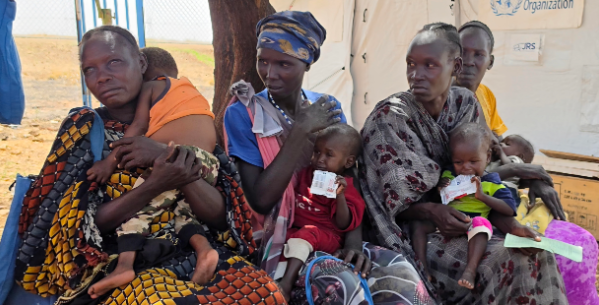
36-year-old Ekang Jok, a mother of four, crossed into South Sudan after walking from Sudan for a month and a half with her children in search of safety. By the time she reached the transit center in Upper Nile State’s Renk County, her daughter had become seriously ill.
“The child was suffering from fever, cough, and different illnesses before I brought her here,” she said outside a primary health care center, where mothers waited in the shade with babies tied to their backs.
Now enrolled in treatment, the girl has improved. But recovery remains fragile.
“The child is a bit better, but not fully recovered, Jok said. “Sometimes she gets diarrhea, fever, and other illnesses.”
Across South Sudan’s border areas, aid workers say children and mothers who escaped war in neighboring Sudan are now facing a second threat: hunger and malnutrition.
In Abukadra, a settlement in Renk County, the population has surged with the arrival of refugees, returnees, and families relocated from overcrowded transit centers. Services originally designed for a much smaller host community are straining under the pressure.
The nutrition response in Abukadra is supported by the European Commission’s Civil Protection and Humanitarian Aid Operations department (DG ECHO), through UNICEF, and implemented by Community in Need Aid (CINA). However, humanitarian workers warn that needs are rising faster than resources.
“Previously, the planning of the facility was to only respond to the host community,” said Jansuk Alex, a UNICEF nutrition specialist based in Renk County. “But with the coming of returnees and refugees, the number keeps growing.”
He said one in three children screened in some locations is found to be malnourished, with at least one suffering severe acute malnutrition.
“So that means malnutrition within the transit center and in Abukadra is becoming a bigger issue for us,” he said.
At the local primary health care unit, around 50 children with severe acute malnutrition and up to 100 children with moderate acute malnutrition are treated each month, according to UNICEF. More than 150 pregnant and breastfeeding women are also enrolled in feeding programmes.
Yet many vulnerable families remain beyond reach.
“We need to maintain the services or even expand more so that we can reach a good number of children,” Alex said.
‘We only depend on what we get.’
For many mothers, the crisis begins at home, where food is scarce, and incomes are nonexistent.
“Now things are not easy. The child sometimes can eat one meal a day,” Jok said. “My biggest worry is what to eat. We only depend on what we get a day.”
She said her husband remained behind in Sudan, leaving her alone to care for the children.
Another mother, Nyawak Gai, 35, a mother of seven, said she was pregnant when she fled Sudan and gave birth immediately after reaching South Sudan.
“It was not easy, moving as a pregnant woman and suffering on the road,” she said.
She said soldiers beat civilians, looted belongings, and that some people died along the route.
At one point, she lost hope for her child’s survival after the baby was admitted to the hospital in critical condition.
“The child was really, really suffering,” she said. “But since I brought her here and she was enrolled, the child is okay. It is not like before.”
Still, even reaching treatment can be uncertain. Mothers described arriving after long walks only to find supplies unavailable and being told to return another week.
“When there is no supply, we go back home with our kids,” Gai said.
Centers expanded as needs soared.
Robert Richardson, a Health and Nutrition Program Officer with GOAL, said the organization has been forced to rapidly scale up services in response to growing demand.
“Currently, GOAL is operating in 21 health facilities across Renk County,” he said. “When we started, there were 10 nutrition facilities, but due to the demand and to ensure maximum coverage, we have scaled up to 21.”
Some of the newer facilities are in Omdulus, Gombar, and Atam, areas hosting returnees and refugees in informal settlements.
Richardson said the transit center is seeing especially high caseloads.
“On average, we normally admit around 10 to 15 children with severe acute malnutrition in the transit center each day,” he said. “And from 15 to 20 children with moderate acute malnutrition.”
He said staff are also supporting children with medical complications through referrals to stabilization centers, where doctors, clinical officers, and nurses provide intensive care.
But mounting pressure is stretching frontline workers.
“The workload really becomes very hectic for them,” Richardson said. “A ratio of one staff is equal to maybe 25 beneficiaries or at times beyond that.”
Food, water, and funding gaps
Aid workers say malnutrition is being driven not only by lack of food, but also by poor sanitation, disease, and water shortages.
“The biggest problem in the household is food insecurity,” Alex said. “Without food in the household, the situation of the mother and the children deteriorates.”
He added that inadequate access to clean water and sanitation exposes children to infections such as diarrhea, which can quickly worsen malnutrition.
In some settlements, damaged or underfunded water systems have left families dependent on insufficient or unsafe supplies.
“Water is life,” Alex said. “Without water, things are not good.”
Richardson warned conditions could deteriorate further if sanitation support does not improve.
“The population in the transit center is increasing, and the water being trucked is basically not enough to serve the increasing population,” he said. “If this continues, obviously, it is going to lead to diseases like diarrhea.”
In Chimedi, another area receiving displaced families, he said people are relying on unsafe water sources also used by animals.
“If nothing is done, obviously we are going to have a lot of waterborne diseases,” he said.
Humanitarian groups say the crisis is compounded by delays in moving families out of transit centers, where people often remain for months instead of days. As food runs short, children become weaker and more likely to need treatment.
In the Renk Transit Centre alone, more than 350 children and 250 mothers are being treated for malnutrition each month, according to UNICEF.
However, current funding only runs through the end of the year, Alex said, leaving uncertainty over what happens next.
“If we don’t have more funding, children will be severely wasted, their conditions will deteriorate, and it will definitely lead to deaths,” he said.
Richardson delivered a similar warning.
“If the support stops coming or there is no scaling up of the support, obviously the rate of acute malnutrition is going to increase,” he said. “The escalation of acute malnutrition is going to be at its peak.”
For mothers like Yoke, the appeal is simpler.
“I am hoping that there is good help that can come,” she said.

 and then