



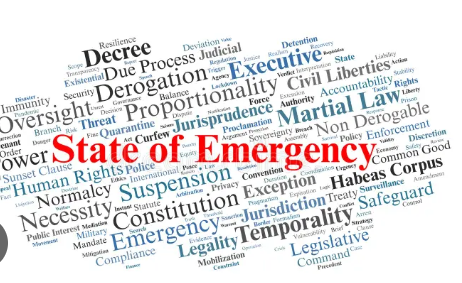
President Salva Kiir has lifted the state of emergency in four states, ending exceptional measures imposed in July, as a policy analyst questions their effectiveness in addressing insecurity and calls for improved governance ahead of elections.
A presidential order broadcast on the state-owned South Sudan Broadcasting Corporation (SSBC) on Thursday evening said Kiir terminated the state of emergency in Lakes, Warrap, Western Bahr el Ghazal and Unity states with immediate effect.
The emergency was initially declared on July 29, 2026, through Republican Order No. RSS J2707-2026.
According to Kiir, the decision is intended to restore normal governance, uphold the rule of law, protect civilians and ensure the enjoyment of constitutional rights in the affected areas.
However, Boboya James Edimond, a policy and political analyst and chief executive officer of the Institute of Social Policy and Research in South Sudan, said the emergency measures had failed to achieve their intended security objectives.
He argued that despite the deployment of security forces and government interventions, communities in the affected states continued to experience intercommunal violence, revenge killings, and cattle raiding.
“In terms of the impact of this sanction or the state of emergency, it has not actually fulfilled its own objective,” Boboya stated. “So, it has actually failed.”
He cited persistent revenge killings, intercommunal conflicts and cattle raiding in Warrap State, as well as deadly communal violence in Lakes State, where clashes between two communities in Rumbek Centre County reportedly left more than 100 people dead.
In Western Bahr el Ghazal State, he said insecurity had also affected voter registration, with some areas unable to complete the exercise because of ongoing conflict.
Boboya said the lifting of the emergency was nevertheless a welcome development, particularly as the country approaches its planned December 2026 general elections.
He argued that the decision could allow political parties, community members and other political actors to move freely, engage with voters and mobilise support in the affected states.
“It is also good news that at least this has been lifted so that different political parties can be able to rally support from those communities and in those regions,” he said.
He added that the move could give communities an opportunity to choose leaders of their preference through the electoral process.
Under the presidential order, all national and state institutions have been directed to resume their ordinary constitutional and legal responsibilities.
Kiir also directed security institutions to continue protecting civilians, maintaining peace and public order, and carrying out their duties in accordance with the law.
The order specifically tasks the Chief of Defence Forces of the South Sudan People’s Defence Forces (SSPDF), the Inspector General of the National Police Service, the Director General of the National Security Service, and the governors of the four states with implementing the directive.
It further revokes all directives and measures that are inconsistent with the presidential order.
Boboya, however, cautioned that lifting the emergency and holding elections would not automatically resolve the challenges facing communities unless accompanied by improvements in public services and economic opportunities.
He called on the government to prioritise healthcare, education, road construction, access to clean water, electricity and telecommunications, as well as support for agriculture and livestock production.
He also stressed the need for employment opportunities for young people and women, poverty reduction, inclusive decision-making and stronger local governance.
The analyst further called for sustained peacebuilding initiatives and the strengthening of the rule of law to rebuild trust between communities, political leaders and security institutions.
“The government needs to do a lot after this lifting of the state of emergency,” he said, adding that development programmes and improved access to essential services were necessary to address the underlying causes of instability.
The lifting of the emergency marks a return to ordinary constitutional arrangements in the four states, although the presidential order does not provide details of the specific emergency measures that had been in force or how their termination will affect ongoing security operations.
 and then