



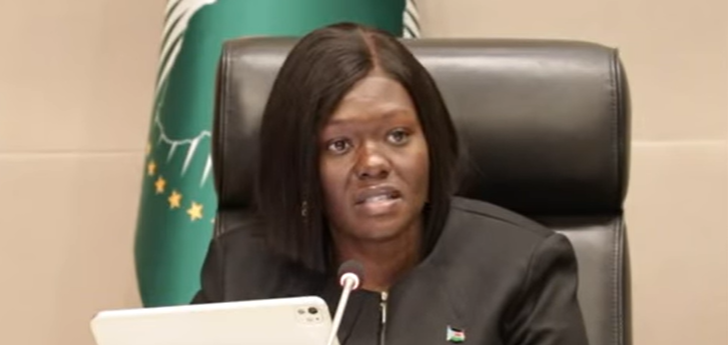
South Sudan’s Foreign Affairs Minister Cecilia Adut Manyok has urged international partners to respect national ownership of the country’s peace process, saying the government and its people bear primary responsibility for achieving peace, security, reconciliation and democratic governance.
Speaking on behalf of President Salva Kiir Mayardit at the inauguration and first working session of the AU-IGAD-UN Joint Task Force on South Sudan in Addis Ababa, Ethiopia, on Friday, Adut said international support should help the country complete its transitional period while safeguarding its sovereignty.
“South Sudan acknowledges that the primary responsibility for peace, security, reconciliation and democratic governance rests with its government and its people,” she said.
Adut expressed appreciation to the African Union, the Intergovernmental Authority on Development (IGAD) and the United Nations for their continued support, as well as to the C5 and other international partners for their contributions to South Sudan’s liberation struggle, independence and nation-building efforts.
She said the task force is being established at a critical moment as the country approaches the end of its transitional period.
“Our collective objective must be to successfully conclude the transitional period and not to institutionalise the transitional process indefinitely,” Adut said.
She cited the inter-party political dialogue concluded by Kiir in Juba on Thursday, saying participating parties had presented consolidated resolutions and a joint communiqué aimed at building political consensus and completing the transition.
According to Adut, the resolutions addressed political freedoms, peaceful election campaigns, security guarantees for candidates and their supporters, political party financing in accordance with the law, and the 35% affirmative action provision for women.
She said the participating parties had also reaffirmed the mandate of the National Elections Commission and their commitment to concluding the transitional period.
However, the dialogue involved political parties based in Juba and did not include opposition groups operating outside the country, raising questions about the inclusivity of the political process ahead of the planned elections.
Adut called for continued national ownership and stronger coordination with regional and international partners to implement the peace agreement. She also urged international partners to provide adequate financial and technical support.
“We ask for a strategic shift from peace management to peace dividends,” she said, citing education, healthcare, employment, infrastructure, food security, investment and economic opportunities as areas in which citizens should experience tangible benefits from peace.
She said the task force should help address outstanding challenges rather than create another layer of processes.
“South Sudan looks forward to constructive partnership. We seek a partnership that helps South Sudan complete its transition, not prepare for it; consolidate its sovereignty, not diminish it; and transform peace into prosperity,” she said.
International support
The task force brings together the AU, IGAD and the United Nations to coordinate support for South Sudan’s peace process under the 2018 Revitalised Agreement on the Resolution of the Conflict in South Sudan.
At Friday’s inauguration, AU Commission Chairperson Mahmoud Ali Youssouf called for inclusive political dialogue, warning that divisions among political stakeholders could undermine implementation of the peace agreement and efforts to complete the transition.
Youssouf said repeated extensions of the transitional period had prolonged uncertainty. He urged political leaders to rebuild trust, uphold the ceasefire and ensure meaningful participation by women, young people and civil society.
South Sudan is preparing for its first general elections since gaining independence in 2011. The National Elections Commission has set February 11, 2027, as the revised polling date, amid continuing disagreements over implementation of the peace agreement and outstanding transitional arrangements.

 and then