



South Sudanese reporters have been urged to use accurate, balanced and dignified language when reporting on migrant workers, with rights advocates warning that careless terminology and unverified information can reinforce stigma and undermine public trust.
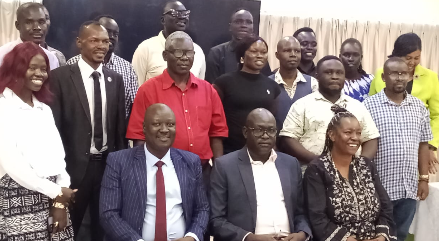
The call was made on Friday during a Paralegal Training on Reporting Migrant Workers’ Rights and Labour Migration in South Sudan, which brought together more than 30 journalists to strengthen media coverage of migration, labour rights and related human rights issues.
Speaking during the training, Rosemary Kabaki, Country Director of Nonviolent Peaceforce, emphasized the importance of understanding the different experiences of migrant workers and being careful about the language used to describe them.
“I am a migrant worker myself, and terminology matters. There is often a vast difference in how international staff enter South Sudan compared to other migrant workers,” she said. “We must advocate for all migrant workers in South Sudan to be treated equitably and with dignity.”
According to Kabaki, employees of international organizations often benefit from privileges, protection, and institutional support that may not be available to other migrant workers, leaving many vulnerable to exploitation and abuse.
“Even with a formal government, executive branch, and judiciary, the media plays an indispensable role in safeguarding civilian rights,” she said. “When formal systems fall short, society looks to the media to bridge the gap and ensure accountability.”
She noted that many migrant workers, as well as South Sudanese nationals living and working abroad, experience vulnerable conditions and often lack platforms through which they can raise concerns or seek justice.
“A single unverified story or inaccurate statement can instantly destroy years of built trust,” she stated, urging journalists to ensure that every article, broadcast, and social media report undergoes rigorous fact-checking and provides appropriate context and balance.
She also encouraged journalists to embrace constructive journalism that not only exposes challenges but also highlights practical solutions, arguing that solutions-oriented reporting can help counter feelings of helplessness among communities affected by migration-related challenges.
Meanwhile, Oyet Patrick Charles, President of the Union of Journalists of South Sudan (UJOSS), described migration as an important regional and economic reality that should be approached from a human rights perspective.
He said organizations such as the International Labour Organization (ILO) and the International Organization for Migration (IOM) recognize the importance of orderly regional labour migration, noting that arbitrary restrictions can push people toward unsafe and irregular migration routes.
“It is beneficial for people to work within their regions and cooperate. Examples from around the world show that migrant workers build economies,” Oyet said.
“At the same time, migrant workers support their families back home through remittances, which in turn help build their home economies,” he said. “Most importantly, migrant workers are human beings just like us.”
According to Oyet, the paralegal training builds on previous UJOSS human rights programmes by providing journalists with more specialized knowledge of legal terminology, labour migration and immigration frameworks.
For his part, James Bidal, Coordinator of the South Sudan Human Rights Defenders Network, commended UJOSS for its continued engagement in defending press freedom and intervening in cases involving journalists and detention.
Reading from a prepared statement by the Network’s legal counsel, Bidal said reporting on labour migration should go beyond statistics, border crossings, and headlines to focus on the human experiences behind migration.
“Labor migration is not just about movement across borders in search of work; behind every migrant worker is a human being seeking dignity, security, and a better livelihood,” he said.
He said migrant workers continue to face a range of challenges, including exploitation, unsafe working conditions, non-payment of wages, human trafficking, unfair recruitment practices, lack of documentation, and limited access to legal remedies.
Bidal called on journalists to place human dignity at the center of their reporting, respect the privacy of survivors of abuse and avoid language that stigmatizes or discriminates against migrants.
He also urged the media to recognize the economic contribution of migrant workers while investigating and reporting abuses against them.
Bidal commended the Ministry of Interior for issuing a national order banning unauthorized alien registration practices, while raising concerns about unregulated checkpoints where, he said, foreign workers can face harassment and extortion by security personnel.
He urged journalists to use their watchdog role to monitor implementation of these commitments and hold authorities accountable where migrant workers’ rights are violated.
The training underscored the growing responsibility of South Sudan’s media to provide accurate, ethical and human-centered reporting on migration, particularly as the country continues to experience cross-border movement of workers, refugees, returnees and other migrants.
Participants were encouraged to treat migrant workers not merely as foreigners or statistics, but as people whose rights, dignity and contributions deserve fair and responsible representation in the media.

 and then