



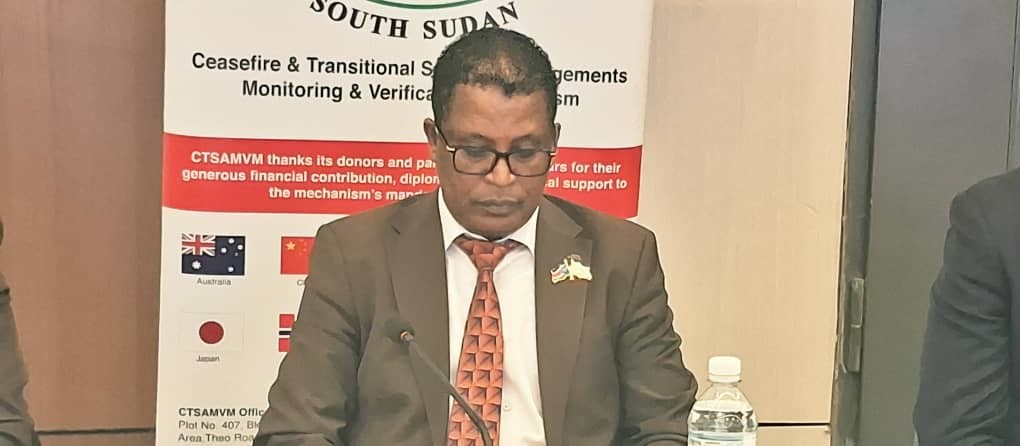
South Sudan’s ceasefire monitoring body has urged the transitional government and parties to the 2018 peace agreement to strengthen protection for civilians and humanitarian workers as insecurity, abductions and attacks on aid operations persist.
General Hailu Endashaw Atomsa, the newly appointed chairperson of the Ceasefire and Transitional Security Arrangements Monitoring and Verification Mechanism (CTSAMVM), said on Tuesday that the security situation remains unpredictable despite a decline in major military confrontations during the latest reporting period.
“Although major military confrontations showed a downward trend, inter-communal tensions, cattle-related violence, restrictions on humanitarian access, and threats to civilians and humanitarian personnel continued to pose significant security concerns,” Hailu told the mechanism’s seventh Technical Committee meeting of 2026.
He said parts of Greater Equatoria and Greater Upper Nile remain particularly concerning, with attacks and restrictions on movement disrupting civilian life and humanitarian operations.
In Greater Mundri, Western Equatoria State, reported abductions and alleged forced recruitment in Bongolo, Lasu and Lainya had contributed to civilian displacement, Hailu said.
He also cited an alleged ambush on humanitarian trucks along the Buaji-Dollo road and the abduction of three aid workers on the Yei-Lasu road.
“These developments highlight the continued risks to civilians, humanitarian personnel and freedom of movement,” he said.
Hailu described Greater Upper Nile as the country’s most volatile region, citing continued attacks against civilians and restrictions on humanitarian access.
He said the permanent ceasefire should not be measured only by the absence of large-scale fighting but also by the protection of civilians and unhindered delivery of humanitarian assistance.
“The Permanent Ceasefire is not merely about preventing large-scale hostilities. It is equally about protecting civilians, preserving humanitarian access and fostering confidence,” he said.
Hailu called on the Transitional Government of National Unity to improve civilian protection along high-risk roads and in conflict-prone areas through coordinated security deployments, stronger early-warning systems and timely preventive action.
He also urged all signatories to the Revitalized Agreement on the Resolution of the Conflict in South Sudan (R-ARCSS) to refrain from abductions, forced recruitment, attacks on civilians and actions that obstruct humanitarian operations.
CTSAMVM also condemned the deadly attack on a United Nations Mission in South Sudan (UNMISS) patrol in Pajut, Jonglei State, on Aug. 24, in which two peacekeepers were killed and seven wounded.
“We strongly condemn this deplorable attack against personnel dedicated to supporting peace and protecting civilians in South Sudan,” Hailu said, calling for a prompt investigation and accountability for those responsible.
CTSAMVM said it would continue monitoring and verifying security incidents through its Monitoring and Verification Teams and reporting alleged violations of the peace agreement.
Hailu said the mechanism’s ability to verify incidents depend on cooperation from all parties, including access to affected areas and timely information.
“Our work is most effective when all Parties engage openly with the Mechanism, facilitate access and provide the information necessary to enable incidents to be verified and reported accurately,” he said.
South Sudan’s peace agreement, signed in 2018, ended years of civil war, but implementation has repeatedly been delayed and insecurity has persisted in several parts of the country.
CTSAMVM was established under the 2018 peace deal to monitor, verify and report ceasefire violations and progress on transitional security arrangements.

 and then