



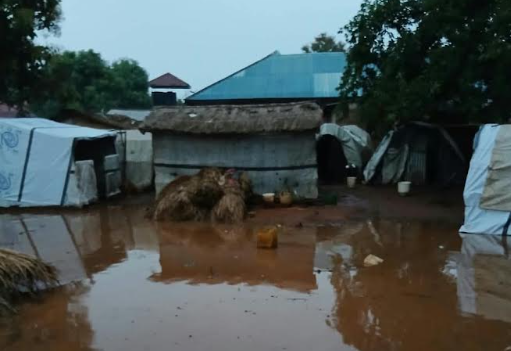
Flooding, hunger, limited healthcare, and disrupted education are worsening the humanitarian situation of internally displaced people and host communities in Tambura County, Western Equatoria State.
Heavy rainfall has left several IDP camps flooded, damaging makeshift shelters and leaving some families struggling to find safe places to sleep.
John Kumbo, a resident of Tambura, told Radio Tamazuj on Tuesday night that heavy rain that fell from about 4 p.m. to 7 p.m. flooded homes and IDP camps, making movement difficult.
“All the camps are flooded. The water is everywhere, and both children and adults are struggling to move through it,” he narrated. “In some places, the water has reached under people’s beds. It is flowing around the houses, leaving residents in a very difficult situation.”
He said some residents had been forced to leave their sleeping areas and seek higher ground after their shelters were flooded.
Kumbo warned that if the water remains for several days, it could worsen sanitation conditions and increase the risk of diseases, including malaria.
“We pray that the water goes away as soon as possible. If it remains, it could cause serious health problems, particularly for children,” he said. “Stagnant water can also create breeding grounds for mosquitoes and increase the risk of malaria.”
Kumbo called on the county and state governments to coordinate with humanitarian organizations and well-wishers to provide urgent assistance to affected families.
He appealed for improved drainage around the camps, particularly those in low-lying areas, as well as tents, mosquito nets, medicines and other essential supplies.
Meanwhile, Peter Marko Yensi, an IDP representative in Tambura, said the flooding had worsened existing problems, including hunger, limited healthcare and lack of access to education.
“People are dying due to hunger, and the health situation is very difficult. There are no medicines, and people rely on private clinics,” he lamented. “Education is also a problem, and there is no way for our children to continue.”
Natalia Zenaroone, an IDP in Tambura, said some families had lost their sleeping areas after their shelters were flooded.
“We need education, money for business, good education for our children, food items and non-food items,” she said.
Lucy Edward, the Relief and Rehabilitation Commission coordinator in Tambura County, acknowledged that IDPs and host communities were facing serious humanitarian challenges.
She said food prices had increased, with a measure of cassava selling for about 6,000 South Sudanese Pounds and groundnuts for about 7,000 pounds. She said flooding had destroyed makeshift shelters in several camps and that vulnerable people had died from hunger.
“I am appealing to the government. We have been in the camps for six years, and we need improvement in health services, food and non-food items, education, safety and protection,” Edward said.
Residents are calling for urgent assistance to address flooding, hunger, healthcare, education, shelter and protection needs in Tambura County.
Efforts to reach relevant county authorities for comment were futile.

 and then