



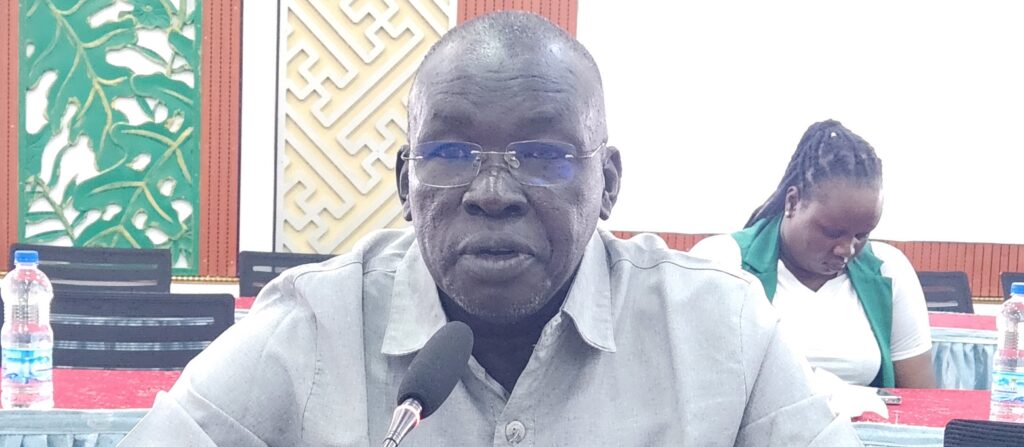
A senior representative of the SPLM Former Detainees (SPLM-FDs) has called on the regional bloc IGAD to clarify whether the country’s 2018 peace agreement remains applicable following the dissolution of the transitional unity government.
Bior Leek Kuong, who represents the Former Detainees (FDs) on the Ceasefire and Transitional Security Arrangements Monitoring and Verification Mechanism (CTSAMVM), raised the issue during a meeting of the monitoring body in Juba on Tuesday.
President Salva Kiir dissolved the Revitalised Transitional Government of National Unity on Tuesday and appointed a caretaker administration ahead of elections scheduled for 22 December.
The order removed First Vice-President Riek Machar and the four other vice-presidents from office and dissolved the national and state legislative assemblies. Kiir is to remain president with full constitutional powers until an elected president assumes office.
The transitional government was established under the 2018 Revitalised Agreement on the Resolution of the Conflict in South Sudan (R-ARCSS).
The Former Detainees are a group of senior members of the Sudan People’s Liberation Movement (SPLM) who were detained during the December 2013 conflict and later released. They participated in the peace process that led to the 2018 agreement.
Under the power-sharing arrangements, the FDs were represented in the transitional government by a political team led by Deng Alor Kuol. Rebecca Nyandeng De Mabior was also appointed one of the five vice-presidents under the FD quota. Her tenure ended with the dissolution of the transitional government on Tuesday.
Bior questioned the legal basis for CTSAMVM’s monitoring work following the latest political and constitutional changes.
“We are monitoring the peace agreements. But I’m very concerned, what are we monitoring? Is the agreement existing, or there is no agreement?”
He called on IGAD and other guarantors of the 2018 peace agreement to clarify which provisions of the R-ARCSS remain applicable as the country moves towards elections.
“You may have heard the amendment of the constitution. The constitution now is 2011 constitution. So I’m doubting whether the article is there,” Bior said.
He questioned the status of provisions relating to the vice-presidency, elections and the supremacy of the 2018 peace agreement over conflicting laws.
Bior said the changes had created uncertainty over the legal framework governing the transition.
“I want IGAD to clarify to me” whether key provisions of the agreement remain applicable, he said.
He also questioned whether CTSAMVM could continue operating under the same agreement after the power-sharing government created by it had been dissolved.
“Yes, we will be here monitoring the peace agreement. But under which basis? Under which basis?”
Bior said the agreement also provided protection for people involved in monitoring its implementation.
“Because if we continue here, anything can happen to us. Because the agreement is the one protecting us here. Nothing else. Only the agreement.”
He warned that the uncertainty could have wider implications for the political transition and the planned elections.
“We are entering a very blurry situation. I don’t know what will happen.”
His comments come despite recent statements by IGAD reaffirming the continued importance of the 2018 peace agreement (R-ARCSS).
At its 74th Extraordinary Session on 15 September, IGAD said the R-ARCSS remains the “sole viable framework for peace” and that the December elections remain anchored in the agreement.
It also called for inclusive dialogue to restore confidence and establish a consensual path towards the elections.
Bior nevertheless called for clearer guidance from IGAD, the international community and South Sudanese political actors on how the peace agreement should be applied following the dissolution of the transitional government.
“I need answers from the international community, answers from the IGAD team, and from the people themselves,” he said.

 and then