



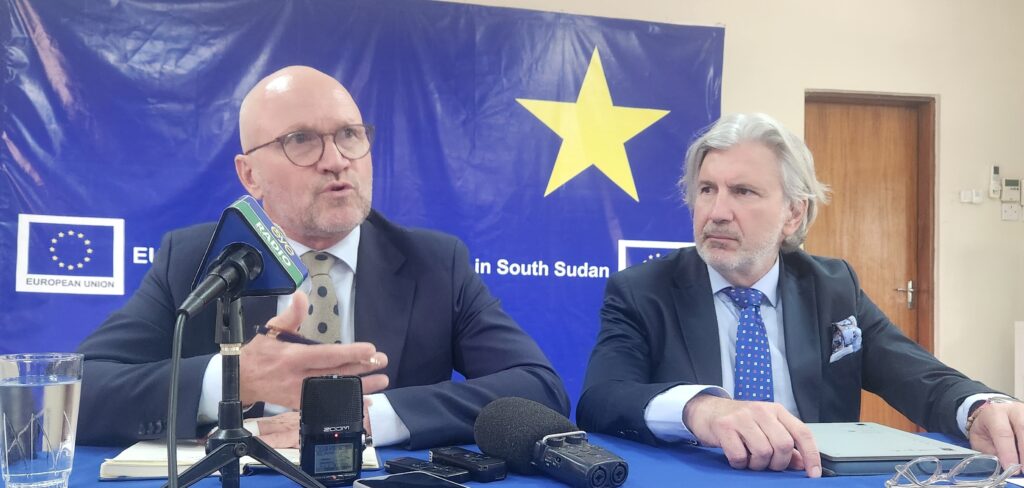
The European Union on Tuesday cautioned South Sudan’s incoming caretaker government against taking decisions with significant political implications as the country prepares for elections scheduled for December, while warning that holding free and fair polls in three months would be an “incredible challenge”.
Pelle Enarsson, the EU head of delegation to South Sudan, said a caretaker government should limit itself to routine administration and avoid “overusing its powers” at a time when checks and balances could be weakened.
“The concern would be if the executive is overusing its powers at a time when the checks and balances may be somewhat weakened,” Enarsson told journalists in Juba during a press conference.
He said the existence of a caretaker government is not in itself a problem, noting that similar arrangements exist in other countries during election periods.
Enarsson said the caretaker administration would, however, face the difficult task of responding to a potentially worsening humanitarian situation in South Sudan.
The comments came as South Sudan approaches the December 22 elections, with preparations still facing political, technical and financial challenges.
The press conference focused on EU priorities for the 81st UN General Assembly and their impact on South Sudan.
Ambassador Enarsson said only about three months remained before the planned elections and that the country would need to accelerate preparations.
“It’s going to be an incredible challenge to pull off free and fair elections by December,” Enarsson said.
He said the elections could still take place if the government provides sufficient resources, technical expertise and capacity, accelerates voter registration and trains the officials needed to conduct the polls.
“We need to see in the next few days, from both a technical perspective and a political perspective, if there is readiness for the elections,” he said.
Enarsson spoke after meeting Minister of Parliamentary Affairs Michael Makuei Lueth, who briefed him on recent developments in parliament, including the adoption of the national election law and the expected dissolution of the transitional government.
President Salva Kiir is expected to dissolve South Sudan’s transitional government on Tuesday evening, after parliament on Monday passed amendments to the election law allowing the president to relieve the vice presidents and dissolve the government three months before the December 22 elections. Kiir signed the amendments into law on Monday.
The law also provides for the incumbent executive to remain in office with full constitutional powers throughout the election period until a newly elected president assumes office.
Election funding
The EU envoy said the bloc currently has no funding available to support the elections because it has not received a clear appeal or budget outlining what is required.
He said the government should first provide resources for the elections, identify funding gaps and, together with the African Union, potentially approach the wider international community for assistance.
Any future international support, he added, would depend on factors including the inclusivity and credibility of the electoral process.
“The government needs to be in the driver’s seat,” Enarsson said, stressing that national authorities should first allocate resources before seeking additional international assistance.
Inter-party dialogue
Enarsson said an inter-party political dialogue expected to begin on Thursday would be important in determining the country’s political readiness for the elections.
He said some parties that did not sign the 2018 peace agreement had not accepted the planned polls.
If the African Union succeeds in creating a mechanism that accommodates the views of those groups and produces a more inclusive political process, Enarsson said a change to the election calendar could also be considered.
He stressed that the EU was not leading the process and that South Sudanese political parties must reach an agreement.
Climate risks
The EU also warned that drought, flooding and food insecurity could undermine electoral participation.
Enarsson said the effects of El Niño were already being monitored, including dry conditions in Eastern Equatoria and the risk of increased hunger.
He said flooding in other parts of the country could cause displacement and make it difficult for people to participate in elections.
The EU is also planning to increase its humanitarian contribution, according to Enarsson.
He said the government must take the lead in responding to disasters rather than relying entirely on international organisations.
Constitution-making
Ambassador Enarsson said the EU had received assurances that work on South Sudan’s permanent constitution would continue even after the elections.
He said the constitution-making process should remain inclusive and people-centred and should not be controlled solely by a future executive.
According to Enarsson, Minister Makuei indicated that the inter-party dialogue would also consider how elements of the peace agreement could be carried forward after the elections and the formation of a new government.
“The work on the constitution really needs to continue with full force even after elections,” Enarsson said.
Hydropower investment
The EU also expressed interest in South Sudan’s potential for renewable energy, particularly hydropower.
Enarsson said South Sudan has “incredible potential” for hydropower and referred to a feasibility study related to Fula Falls.
He said the feasibility study should be completed first before major investment decisions are considered.
The envoy said the EU could potentially explore its Global Gateway investment instruments once an elected government is in place, political stability improves and a viable project is presented.
Red Sea insecurity
Enarsson also linked insecurity in the Red Sea to South Sudan’s economic vulnerability.
He said disruptions to the Red Sea shipping route could affect South Sudan because the country depends heavily on oil exports transported through the region.
He described the situation as another example of the interconnectedness between global developments and South Sudan’s economy.
African representation
Zissimos Vergos, deputy head of delegation and head of political, press and information at the EU Delegation to South Sudan, said the EU supports calls for greater African representation in the international multilateral system.
He said the African continent should have stronger representation in global decision-making institutions.
Ambassador Enarsson also confirmed that the EU supports expanding the United Nations Security Council to include greater African representation, while stressing that African countries should determine how such representation should be achieved.

 and then