



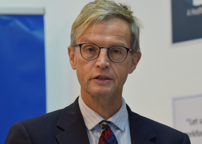
The Deputy Head of Delegation of the European Union (EU) Delegation, Lothar Jaschke, on Wednesday said they are committed to reinforcing protection, resilience, and self-reliance mechanisms for the forcibly displaced, migrants, and their host communities.
The envoy was speaking at the launch of the Managing the impacts of environmental change and conflict on mobility in Eastern Africa (MECMEA) project in Juba and said the EU fully supports it because it will lead to tangible action on the ground with real impact for communities in need.
The MECMEA project is an 18-month initiative addressing the complex links between climate change, environmental disasters, conflict, and migration in the region. The project is coordinated by the Horn of Africa Regional Environment Centre and Network (HoA-REC&N-AAU) at Addis Ababa University, funded by the European Union, and contracted by the International Centre for Migration and Policy Development (ICMPD).
“It is an honor to be at the launch event of this project as it is about strengthening the resilience, protection, and self-reliance of migrants, which is close to our heart. The link between conflict and displacement is clear to see. As is the link between conflict and hunger, stressed by the IPC analysis, published last week,” Jaschke said. “The Horn of Africa is a region, rich in history, characterised by its diverse and beautiful landscapes, economic potential, but also significant challenges, including severe impacts of climate change.”
“Common climate stressors, such as droughts, floods, cyclones, and precipitation variability, contribute to food insecurity and livelihood losses,” he added.
According to the envoy, the region is experiencing rapid population growth and is projected to reach 523 million inhabitants by 2050.
“This demographic expansion, coupled with environmental degradation and climate-induced disasters, is leading to increased displacement, migration, and competition for scarce resources,” Jaschke stated. “Migration can serve as a proactive adaptation strategy, helping communities cope with changing conditions. But it can also take the form of forced displacement or unplanned relocation in response to life-threatening risks.”
He highlighted that South Sudan remains among the countries most affected by disaster displacement, where floods, droughts, conflicts, weak governance, and lack of protection shape population movement.
“In this context, the European Union and its partners are committed to strengthening the resilience and adaptive capacity of Displacement-Affected Communities and intra-regional migrants living in areas exposed to disasters, conflict, climate change, environmental degradation, and related stressors,” he said. “In Bentiu, for example, we are working alongside our partners to support communities affected by recurrent flooding and conflict —helping them to strengthen their ability to adapt and rebuild their lives.”
“This includes the construction of dykes, reforestation, the promotion of climate-resilient agriculture, and support to urban planning,” Jaschke added.
The envoy said that more broadly, the EU supports locally owned climate-resilient solutions with emphasis on building resilience and reducing vulnerabilities at all levels.
“In South Sudan, the number of those displaced by conflicts has increased considerably since the beginning of the year. It is not only a human catastrophe and waste of resources, it is a liability to the future of a country that has so many assets and so much potential to become a powerhouse and a corn chamber of the region,” he enlightened. “The conflicts that we see popping up in many parts of the country bring immense human suffering. The EU and our partners call for high-level dialogue, an immediate ceasefire, as well as a return to the implementation of the peace agreement. This is the best way forward and the best way to reduce the issue of forced displacement.”
Jaschke said the UN Security Council discussion yesterday (Tuesday) in New York sent clear messages, and he is glad that the South Sudanese representative recommitted to the peace agreement as the only way forward.
“Let us then walk the talk and prepare the key tasks of unification of forces, holding of elections, constitution making, and transitional justice,” he concluded.

 and then