



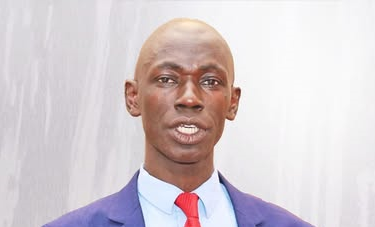
A prominent South Sudanese civil society activist who doubles as the executive director of the Community Empowerment for Progress Organization (CEPO), on Tuesday, while addressing the UN Security Council virtually, told the UN Security Council that the country could go back to all-out war if the parties to the 2018 peace agreement do not genuinely engage in dialogue.
Edmund Yakani, speaking on behalf of the civil society, urged the Council to support South Sudan in averting a looming catastrophe, which was snowballed by the outbreak of violence in Upper Nile State’s Nasir County in March 2025.
“We are concerned that the recent renewed armed violence may return the country to war if the parties fail to embrace an inclusive political dialogue for resolving the ongoing political stalemate,” he stated. “Coordinated regional and international political pressure is required to be maintained and increased now. Evidently, we observed a series of attacks on humanitarian workers and properties, mainly in the areas witnessing armed violence.”
Yakani urged the Council to demand the immediate observation of the ceasefire, resumption of inclusive political dialogue, and release of political detainees.
“We also urge the Council to support the enforcement of the recent African Union Peace and Security Council 1326th Meeting communique dated 23February 2026, and restate the need for a swift and coordinated implementation of the pending tasks of the R-ARCSS with full participation from rightful signatories of R-ARCSS and all stakeholders,” he said.
Yakani added that unrestricted access must be granted to humanitarian actors, including protection of humanitarian workers and properties.
“We urge the Council to ensure that the South Sudan parties agree upon good enough conditions for the conduct of the elections scheduled for December 2026, and ensure that South Sudan parties undertake serious action for an inclusive political dialogue, such as the Tumaini Initiative and the South Sudan Women Mediators’ Intervention,” he said. “The Council must demand that the leaders of the warring parties abstain from any form of hate speech, child recruitment into their forces, and hateful sentiments.”
Yakani highlighted that despite the shortcomings in South Sudan’s peace process, in the past, coordinated regional and international pressure has commendably led to a marked decrease in fighting.
“This coordinated pressure is required now for the protection of civilians, like in the ongoing violence in Jonglei, Upper Nile, and other parts of the country, and the creation of good conditions for the conduct of the elections in December 2026,” he stated. “Pressure is required for the observation of the ceasefire and resumption of inclusive political dialogue among the rightful signatories of the R-ARCSS. Support for Tumaini Initiative and the South Sudan Women Mediators Intervention is essential.”
“There are well-documented violations of the ceasefire and peace agreement, all of which have affected the momentum of peace efforts, and deciding not to pressure the South Sudan parties lets them continue with impunity,” Yakani added.
He said that following the multiple extensions of the agreement’s tenure and its transitional periods, the civil society and public expected the warring parties to set aside their differences for the sake of the suffering citizens and work for peace.
“…but still today in Jongeli and Upper Nile states and other parts of the country, citizens are suffering. The big question is until when?” Yakani charged. “The high deficit in trust and confidence among the elites demonstrates that the majority of our elite act like people who do not intend to implement the peace agreement. Instead, these are the acts of people who are intent on keeping their grip on power and working together only so far as it enables them to continue profiteering from the suffering of South Sudan’s citizens.”
“The recent reports of the Reconstituted Joint Monitoring and Evaluation Commission (RJMEC) show that neither of the R-ARCSS signatories will implement its terms on their own volition,” he added.
Yakani said there must be consistent pressure from the regional and international community to demonstrate to the South Sudan leaders that peace is the only option going forward.
“Therefore, we urge the Council to send a clear message to South Sudan’s government and opposition leaders that they will be held accountable for any further violation of the R-ARCSS and manipulation of any inclusive political dialogue,” he concluded.

 and then