



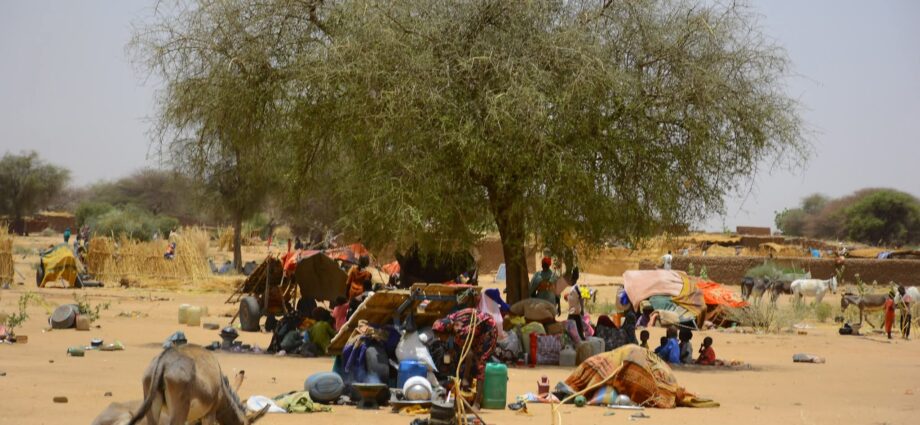
The number of people newly displaced to Tawila camp in Sudan’s North Darfur state has risen to 6,191 following poor rainfall, crop failures and worsening food shortages in their areas of origin, representatives of displaced people said.
Tawila is about 50 km west of El Fasher, the state capital.
Adam Rijal, spokesperson for the Coordination of Displaced Persons and Refugees, told Radio Tamazuj on Sunday that 260 households, comprising 1,394 people, had arrived at the camp between Sept. 28 and Oct. 3.
The arrivals brought the total number of people newly displaced to Tawila because of crop failures and deteriorating conditions in their areas of origin to 6,191, Rijal said.
Most of the new arrivals were women, children and older people, he said.
Rijal said the displaced were fleeing deteriorating security, loss of livelihoods, food shortages, drought and crop failures and had travelled to Tawila in search of humanitarian assistance.
He said the continued influx was putting additional pressure on host communities and called on humanitarian organisations to provide food, medicines, clean drinking water and shelter, as well as sanitation and hygiene services.
He warned that continued arrivals and shortages of humanitarian assistance could further worsen conditions for displaced people in Tawila.
Kaltouma Fadul, a displaced resident, said the war and worsening economic conditions had made it increasingly difficult for families to remain in their villages.
“Life has become extremely difficult in the villages we fled from in El Fasher because of soaring prices and a lack of income for families. On top of that, there is drought and the failure of the agricultural season. We came to Tawila after hearing that humanitarian assistance was available here,” she told Radio Tamazuj.
Fadul said food prices had risen sharply in the areas they had left. A bowl of sorghum cost 10,000 Sudanese pounds, while a bowl of dried okra powder and a bowl of onions each cost 8,000 pounds, she said. A bottle of cooking oil cost 10,000 pounds and a kilogramme of meat cost 18,000 pounds, she added.
She said high transport costs were forcing some families to separate, with some members travelling to Tawila while others remained behind.
“Families cannot afford to travel together because of the high cost of transportation. As a result, families are being split up, with some members leaving while others remain at home. Most of those who leave are people who are able to walk long distances,” she said.
Sudan’s war began in April 2023 when fighting erupted in Khartoum between the Sudanese army and the paramilitary Rapid Support Forces. The conflict has since spread to several parts of the country, including Darfur, displacing millions of people and worsening food insecurity and humanitarian needs.

 and then