



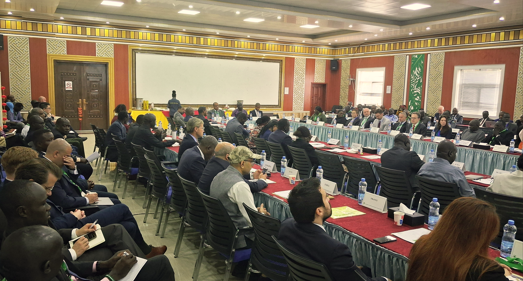
The Ceasefire and Transitional Security Arrangements Monitoring and Verification Mechanism (CTSAMVM) on Thursday warned that South Sudan must urgently accelerate implementation of the security provisions in the 2018 revitalized peace agreement, saying delays in unifying forces and recurring violence could jeopardize preparations for the country’s planned elections.
Presenting CTSAMVM’s assessment during the Reconstituted Joint Monitoring and Evaluation Commission (R-JMEC) meeting in Juba, representative Gilbert Ozuo said progress under Chapter Two of the peace agreement, which covers the permanent ceasefire and transitional security arrangements, remains incomplete.
“We therefore overall assess that Chapter Two is partially implemented with significant progress in maintaining the ceasefire but comparatively limited progress in completing key transitional security arrangements,” he stated. “The overall security environment across South Sudan remains volatile. At the sub-national level, violations continue to be reported particularly in parts of Jonglei, Upper Nile, Central and Eastern Equatoria States.”
According to Ozuo, localized clashes involving government and opposition forces, intercommunal violence, cattle-related conflicts, and the activities of armed groups outside formal command structures continue to threaten civilians.
“There is a persistent gap between formal ceasefire compliance and the lived security realities within the communities,” he added.
CTSAMVM said its monitoring teams based in Juba, Malakal and Wau continue to conduct patrols, verification missions and investigations into alleged ceasefire violations, while regular meetings among the peace parties have helped prevent isolated incidents from escalating into wider military confrontations.
However, Ozuo said repeated violations continue to undermine confidence in the agreement.
“The overall ceasefire continues to be repeatedly violated,” he said, citing localized armed confrontations, unauthorized troop movements, intercommunal violence and the continued occupation of civilian facilities by the South Sudan People’s Defence Forces (SSPDF).
“The successful implementation of transitional security arrangements remains one of the most critical outstanding benchmarks,” he said.
He revealed that although CTSAMVM received communication in 2024 that 8,000 members of the Necessary Unified Forces had been deployed in eight battalions, monitors have been unable to verify their locations.
“But currently, CTSAMVM on its verification cannot trace where these deployed battalions are,” he said.
He added that graduates from the police, national security, prisons, wildlife and civil defence services have yet to be deployed, while security personnel continue to operate under existing command structures instead of a unified command.
Ozuo attributed the delays to inadequate funding, shortages of food, water, medicine, and transport at training centres, political disagreements over the unified command structure, and uncertainty over the next phase of deployments.
He also said CTSAMVM’s work continues to be hampered by poor road infrastructure, flooding, insecurity and logistical constraints, delaying investigations into reported violations.
“Some incidents are reported more than six months after they have occurred,” he said.
CTSAMVM urged the peace parties to recommit to the permanent ceasefire, expedite deployment of the Necessary Unified Forces, provide adequate funding for security mechanisms, and guarantee unrestricted movement for monitors.
“Prioritize implementation of Chapter Two as a prerequisite for peaceful and credible elections,” Ozuo said.
He concluded that renewed political commitment, timely funding and faster implementation of the security provisions of the peace agreement are essential to consolidate peace, strengthen public confidence and create a secure environment for South Sudan’s transition.

 and then